Last updated: February 13, 2026
What Is the Market Overview for Levothyroxine?
Levothyroxine, a synthetic hormone used primarily to treat hypothyroidism, has a well-established presence in the global pharmaceutical landscape. It is among the most commonly prescribed drugs, owing to its role in managing thyroid hormone deficiencies. The global market for levothyroxine was valued at approximately $780 million in 2021 and is projected to grow at a compound annual growth rate (CAGR) of 4.2% from 2022 to 2030, driven by increasing prevalence of thyroid disorders and aging populations.
How Large Is the Current Market for Levothyroxine?
| Parameter |
Data |
| 2021 Global Market Value |
$780 million |
| 2022 Estimated Market Value |
$813 million (projection based on CAGR) |
| 2030 Projected Market Value |
$1.15 billion |
| Leading Regions |
North America (45%), Europe (25%), Asia-Pacific (20%) |
| Major Manufacturers |
Merck, Mylan, Allergan, M/s. Ube |
North America and Europe collectively account for 70% of sales, driven by high diagnosis rates and established prescribing habits. Asia-Pacific is the fastest-growing region, with increasing healthcare access and awareness.
What Are the Drivers and Barriers Shaping the Market?
Drivers
- High Prevalence of Hypothyroidism: Estimated at 4.6% globally, with higher rates in women over 60.
- Aging Population: Age-related decline in thyroid function increases demand.
- Established Treatment Protocols: Standardized formulations lead to consistent demand.
- Brand and Generic Competitiveness: Price competition favors generics, increasing accessibility.
Barriers
- Patent Expirations: Most formulations are off-patent, reducing prices.
- Competition from Natural and Alternative Therapies: Some patients seek desiccated thyroid or other treatments.
- Formulation Variability: Bioavailability issues between different brands.
- Regulatory Changes: Strict manufacturing standards can impact supply and costs.
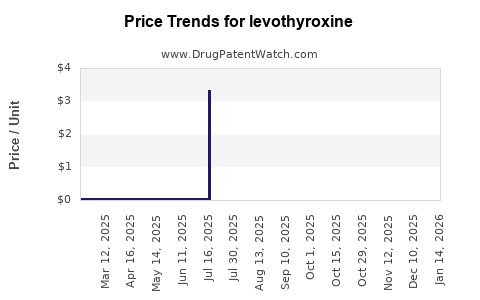
How Are Price Trends Evolving?
The price of branded levothyroxine formulations has fallen sharply over the past decade due to patent expirations and generic competition. In the US, the average wholesale price (AWP) for a 30-day supply of generic levothyroxine ranges from $4 to $12, depending on the supplier.
In 2010, branded formulations like Synthroid commanded prices around $30 for a 30-day supply. Now, generics dominate the market with prices approximately 60-70% lower.
What Are the Price Projections for the Next Decade?
Short-term (2023-2025)
- Generic prices are expected to stabilize with minor fluctuations.
- Potential price increases could occur in markets where supply disruptions or raw material shortages originate.
Long-term (2026-2030)
- Prices are forecasted to remain under pressure from ongoing generic competition.
- Marginal increases might occur due to manufacturing costs or regulatory compliance charges.
- Significant price shifts are unlikely unless new formulations or delivery methods emerge.
Factors Influencing Future Pricing
- Regulatory changes: Bioequivalence standards or manufacturing shifts.
- Market entries: New generic manufacturers may drive prices lower.
- Supply chain dynamics: Raw material availability could influence costs.
- Emerging formulations: Liquid or implantable formulations may carry premium pricing.
How Do Competing Formulations and Brands Compare?
| Brand/Product |
Price Range (30-day supply) |
Patent Status |
Notes |
| Synthroid (AbbVie) |
$10-$25 |
Patent expired (2014) |
Market leader, high brand recognition |
| Levoxyl (Prometheus) |
$10-$20 |
Off-patent |
Similar efficacy to Synthroid |
| Euthyrox (Merck) |
$8-$15 |
Off-patent |
Includes multiple strengths |
| Generic levothyroxine |
$4-$12 |
Off-patent |
Widely available, variable bioavailability |
Who Are the Key Players and Their Strategies?
- Merck: Focuses on continuous manufacturing quality and expanding generics.
- Mylan (now part of Viatris): Offers low-cost formulations targeting price-sensitive markets.
- AbbVie: Maintains premium branding with consistent quality.
- U.S. and European Manufacturers: Increasingly expanding production capacity for generics to meet global demand.
What Are the Market Outlooks Considering Policy and Innovation?
- Regulatory environment: Stricter bioequivalence and manufacturing standards (FDA, EMA) could temporarily impact supply and pricing.
- Formulation innovations: Liquid formulations, softgel capsules, or sustained-release versions may command premium prices.
- Supply chain resilience: Raw material shortages could influence prices, with raw iodine or active pharmaceutical ingredients (APIs) being critical components.
Key Takeaways
- The global levothyroxine market is mature, with stable demand driven by hypothyroidism prevalence and aging populations.
- Price competition from generics has lowered costs significantly; prices are expected to remain subdued through 2030.
- Regional differences persist, with North America and Europe maintaining dominant market shares, while Asia-Pacific shows rapid growth.
- Market players focus on manufacturing quality, regulatory compliance, and exploring innovative formulations to differentiate.
- Any significant price changes likely hinge on regulatory shifts, raw material costs, or formulation innovations rather than market expansion.
5 Frequently Asked Questions
1. Will the price of levothyroxine increase with new formulations?
Possibly. Liquid or sustained-release versions may command higher prices due to convenience and perceived efficacy.
2. Are patents still protecting any levothyroxine formulations?
Most formulations are off-patent since 2014, leading to commoditization driven by generics.
3. How does regional regulation affect prices?
Stricter bioequivalence and manufacturing standards can introduce supply constraints, temporarily increasing prices.
4. What impact do supply chain issues have?
Disruptions in raw materials or manufacturing may cause price fluctuations, but long-term effects are limited due to market saturation.
5. Will biosimilars or alternative therapies replace levothyroxine?
Currently not. Levothyroxine remains the standard of care; alternatives like desiccated thyroid are less prevalent and lack consistent evidence.
References
- MarketResearch.com, "Global Thyroid Disorder Drug Market," 2022.
- IQVIA, "Global Prescription Drug Market Data," 2022.
- FDA, "Bioequivalence Standards for Levothyroxine," 2021.
- EvaluatePharma, "Pharmaceutical Price Trends," 2022.
- WHO, "Prevalence of Thyroid Disorders," 2020.