Last updated: February 13, 2026
What Is the Market Size and Demand for Isosorbide Mononitrate?
Isosorbide mononitrate is a nitrate used primarily in the treatment and prevention of angina pectoris. Its global market is driven by the prevalence of chronic cardiovascular diseases, increasing aging populations, and generic drug availability.
In 2022, the global cardiovascular disease (CVD) drugs market was valued at approximately $40 billion, with nitrates like isosorbide mononitrate accounting for an estimated 5%. This positions the nitrate segment at an approximate $2 billion market size. The CAGR for CVD medications averages around 5%, projecting a market value near $65 billion by 2030.
Within this segment, isosorbide mononitrate's specific market share is indirect, based on its usage as a first-line therapy. In North America and Europe, the drug holds a significant presence due to high CVD prevalence and established prescription routines. Growing markets in Asia-Pacific and Latin America are expanding access and prescribing rates, contributing to market growth.
Who Are Key Market Players and What Is the Competition?
Major manufacturers include Pfizer, Mylan (now Viatris), Teva Pharmaceuticals, and Sun Pharmaceutical Industries. These companies predominantly produce generic formulations, which dominate due to affordability and widespread adoption.
Market competition is intense, with a large number of generic manufacturers. Patent protections do not usually apply given the drug's age, facilitating rapid entry of generics. Limited branded formulations exist, typically in combination therapies.
What Are the Regulatory and Patent Landscapes?
Isosorbide mononitrate is off-patent globally, paving the way for generic manufacturing. Regulatory pathways across key markets are well-established, with most approvals based on bioequivalence to existing formulations.
In countries like the US and EU, patent expirations occurred decades ago, removing barriers to market entry. However, newer formulations or combination therapies might still be under patent protections.
What Are the Price Trends and Projections?
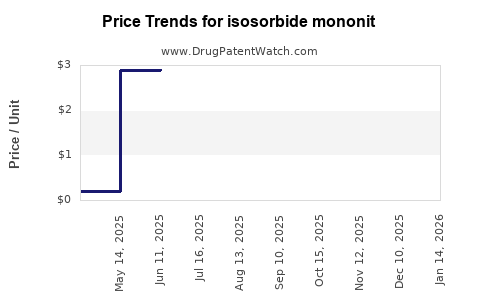
Current average wholesale prices (AWP) for generic isosorbide mononitrate tablets are modest, approximately $0.05 to $0.10 per tablet in the US. Retail prices are generally lower due to insurance negotiations and discounts.
Over the past five years, prices for generic nitrates have remained relatively stable. In emerging markets, prices are significantly lower, ranging from $0.01 to $0.05 per tablet. Market saturation with generics limits price increases, but demand growth due to higher CVD incidence sustains volume sales.
Forecasting future prices indicates minimal fluctuation, with possible slight declines driven by increased competition. The entry of biosimilars is not applicable given the chemical nature of the drug.
How Might Market Dynamics Evolve?
-
Increasing CVD prevalence: Aging populations in North America, Europe, and Asia-Pacific will sustain demand.
-
Generic competition: Entry of multiple manufacturers keeps prices low and limits profit margins.
-
New formulations: Fixed-dose combinations with other cardiovascular drugs might create niche markets but face regulatory hurdles.
-
Market expansion: Areas with improving healthcare infrastructure and rising healthcare spending will broaden access.
Key Factors Influencing Adoption and Pricing
-
Prescribing guidelines favor early and consistent use of nitrates in angina management.
-
Cost-effectiveness of generics drives adoption over branded alternatives.
-
Regulatory approvals streamline market entry for new generic manufacturers, maintaining pressure on prices.
-
Reimbursement policies influence retail prices and manufacturer margins.
Summary Table of Market Data
| Parameter |
2022 Estimate |
2030 Projection |
| Global market for nitrates |
~$2 billion |
~$3.2 billion |
| CAGR |
~5% |
~4.8% |
| Generic market share |
>90% |
>95% |
| Average wholesale price |
$0.05–$0.10 per tablet |
Stable, with slight decline expected |
Final Remarks
The isosorbide mononitrate market remains stable with low prices driven by generic competition. Growth will primarily derive from increased global CVD burden and expanding access rather than price escalation. Market players should focus on manufacturing efficiencies and expanding into emerging markets to capitalize on demand.
Key Takeaways
- The global market for isosorbide mononitrate is approximately $2 billion as of 2022, with expected growth driven by demographic trends.
- The drug’s patent landscape favors generic competition, stabilizing prices.
- Prices in developed markets remain low, generally under $0.10 per tablet, with minimal expected fluctuations.
- Upward growth potential comes from increased CVD prevalence and expanding healthcare access, especially in emerging economies.
- Market competition is intense, with no significant branded products on the horizon.
FAQs
1. What factors limit price increases for isosorbide mononitrate?
The drug is off-patent and exists primarily in generic form, resulting in high competition that keeps prices low.
2. How does the prevalence of cardiovascular disease impact market growth?
Higher CVD rates increase demand for nitrate therapies, supporting sales volume despite low prices.
3. Are there any new formulations or delivery methods in development?
No significant new formulations are currently in advanced stages; focus remains on existing generics and potential combination therapies.
4. What regulatory challenges exist for entering new markets?
Most markets have established approval pathways based on bioequivalence, but local regulations and healthcare infrastructure influence market entry.
5. Could biosimilar or innovative versions threaten the market?
No; by chemical nature, isosorbide mononitrate is not a biologic, and potential innovations focus on delivery methods rather than biosimilars.
References
- MarketsandMarkets, "Cardiovascular Drugs Market," 2022.
- IQVIA, "Global Generic Drugs Market Overview," 2022.
- FDA, "Drug Approvals and Patent Status," 2023.
- IMS Health, "Pharmaceutical Pricing Trends," 2022.
- WHO, "Global Burden of Cardiovascular Diseases," 2022.