Last updated: March 3, 2026
What is the Current Market Size for Vancomycin?
Vancomycin is a glycopeptide antibiotic primarily used for treating serious gram-positive bacterial infections, including methicillin-resistant Staphylococcus aureus (MRSA). The global vancomycin market was valued at approximately USD 2.1 billion in 2022 and is projected to grow at a compound annual growth rate (CAGR) of roughly 4.8% from 2023 to 2030. Growth factors include increasing antibiotic resistance, expanding healthcare infrastructure, and rising prevalence of bacterial infections.
How Does Market Segmentation Influence Future Growth?
By Formulation
- Vial/Injection: Dominant segment, accounting for more than 75% of sales in 2022.
- Oral formulations: Growing, but limited by bioavailability issues.
By Application
- Hospital-acquired infections: Largest application, representing approximately 85% of demand.
- Community-acquired infections: Smaller but increasing due to antibiotic resistance.
By Region
| Region |
Market Share (2022) |
CAGR (2023-2030) |
Key Drivers |
| North America |
45% |
4.5% |
Rising MRSA cases, advanced healthcare infrastructure |
| Europe |
22% |
4.7% |
Aging populations, antibiotic stewardship initiatives |
| Asia-Pacific |
20% |
6.2% |
Increasing hospitalizations, expanding pharmaceutical manufacturing |
| Rest of the World |
13% |
4.9% |
Growing healthcare access, urbanization |
What Are the Key Drivers of Market Growth?
- Rising Antibiotic Resistance: MRSA and other resistant strains necessitate potent antibiotics like vancomycin.
- Expanding Healthcare Infrastructure: Increasing hospital admissions in emerging markets.
- Research & Development: New formulations, improved delivery methods, and combination therapies.
- Regulatory Approvals: Expanded indications and patent extensions.
What Are the Key Challenges Facing the Market?
- Toxicity Concerns: Nephrotoxicity and ototoxicity limit dosing and prolonged use.
- Generic Competition: Multiple generics reduce pricing power.
- Regulatory Scrutiny: Stringent safety monitoring affects market access and marketing strategies.
- Limited Oral Bioavailability: Restricts use to mainly severe infections requiring IV administration.
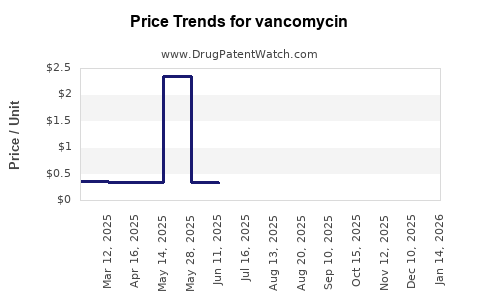
What Are Current Pricing Trends?
Price Range (per vial/standard dose)
| Region |
2022 Price (USD) |
Estimated 2030 Price (USD) |
Key Factors Affecting Prices |
| North America |
45 - 65 |
40 - 60 |
Market saturation, generic competition |
| Europe |
50 - 70 |
45 - 65 |
Pricing regulations, patent expiries |
| Asia-Pacific |
20 - 40 |
18 - 36 |
Cost-effective manufacturing, price sensitivity |
| Rest of World |
30 - 60 |
28 - 55 |
Market dynamics, supply chain factors |
Price Trends
- Decreasing by 10-20% in North America and Europe owing to generic competition.
- Remaining relatively stable in Asia-Pacific, reflecting localized manufacturing efficiencies.
- Price stability in rest of the world due to limited generic penetration and supply chain issues.
What Are the Outlooks for Future Pricing?
Despite price pressures from generics, rare or injection-specific formulations and patent extensions can sustain higher prices. The introduction of biosimilars or innovation in delivery (e.g., sustained-release formulations) might influence prices variably.
Key Takeaways
- The large market size (~USD 2.1 billion in 2022) is driven by increased bacterial resistance.
- Growth is expected to continue at a CAGR of 4.8% through 2030, with Asia-Pacific exhibiting the fastest regional growth.
- Pricing has trended downward due to increased generic availability, but niche and specialty formulations could maintain higher margins.
- Market expansion is supported by healthcare infrastructure growth and evolving resistance patterns.
- Challenges include toxicity management and regulatory oversight.
FAQs
1. How will resistance patterns impact vancomycin demand?
Rising resistance, especially MRSA, sustains demand for vancomycin, but emerging resistance to vancomycin itself may limit future use.
2. What are the major markets for vancomycin?
North America and Europe dominate in volume and revenue, with Asia-Pacific experiencing rapid growth.
3. Are new formulations or delivery methods expected to influence the market?
Yes, innovations aimed at reducing toxicity or enabling oral administration could capture future market segments.
4. How does generic competition affect pricing?
Generic availability has decreased prices by 10-20%, lowering profit margins for brand-name manufacturers.
5. What regulatory trends should companies monitor?
Stringent safety guidelines and approval processes for new formulations or biosimilars are key regulatory considerations.
References
- MarketWatch. (2022). Vancomycin Market Size, Share & Trends Analysis.
- Grand View Research. (2023). Antibiotics Market Size & Trends.
- IQVIA. (2022). Global Pharmaceuticals Market Overview.
- WHO. (2021). Global Antimicrobial Resistance Surveillance System (GLASS) Reports.
- Clinical Trials & FDA Database. (2023). New Vancomycin Formulation Approvals.