Last updated: February 20, 2026
What is the current market size for testosterone products?
The global testosterone market was valued at approximately USD 2.78 billion in 2022. It is projected to grow at a compound annual growth rate (CAGR) of 4.4% from 2023 to 2030. The increase results from higher diagnosed cases of testosterone deficiency (TD), rising awareness of hormone replacement therapy (HRT), and expanding use in sports and aging populations.
Key segments include:
- Therapeutic Use: Testosterone replacement therapy (TRT) for hypogonadism and age-related decline
- Performance Enhancement: Use in sports doping, though illegal and not included in mainstream market estimates
- Other Uses: Anabolic applications, although restricted
North America accounts for roughly 45% of the market, driven by high healthcare spending; Europe holds 25%, Asia-Pacific 20%, with the remaining 10% dispersed globally.
How are different formulations impacting market dynamics?
Formulations include injections, gels, patches, buccal systems, pellets, and oral capsules. Injections dominate with over 50% market share, due to their cost efficiency and reliable dosing. Gels and patches are gaining popularity for ease of use and compliance.
| Formulation |
Market Share (2022) |
Growth Drivers |
Limitations |
| Injections |
52% |
Cost, dosing reliability |
Pain, frequency of administration |
| Gels |
23% |
Convenience |
Skin irritation, transfer risk |
| Patches |
15% |
Ease of use |
Skin irritation, dose variability |
| Buccal/System |
5% |
Reduced first-pass metabolism |
Discomfort, compliance issues |
| Others |
5% |
Niche applications |
Limited market size |
What are the competitive landscape and key players?
Major pharmaceutical companies dominate, including:
- AbbVie (AbbVie Inc.)
- Ferring Pharmaceuticals
- Endo International
- Perrigo Company
These companies prioritize product innovation, new formulation development, and geographic expansion. Biosimilar entries are limited due to patent protections and manufacturing complexities, but entries are expected post-expiry.
What pricing trends are projected for testosterone products?
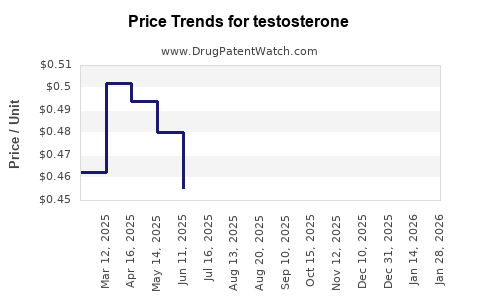
Pricing varies significantly based on formulation, brand, and geographic location. In the U.S., the average annual cost for testosterone gels ranges from USD 1,200 to USD 2,400. Injectable testosterone (testosterone cypionate or enanthate) costs approximately USD 30–USD 50 per 10 mL vial, lasting about four weeks.
Projected inflation-adjusted price trends:
- Generic Testosterone Products: Stable or slight decline (~1-2% annually) due to increased competition post-patent expiration.
- Brand-Name Products: Maintain premium pricing, around 20-30% higher than generics.
- Emerging Markets: Lower prices driven by lower healthcare costs and regulatory environments.
What are the regulatory and technological factors influencing market prices?
Regulatory approvals in key markets like the U.S. (FDA), Europe (EMA), and Japan set pricing benchmarks. Stricter approval processes heighten costs but also establish a level of market exclusivity.
Technological advances include sustained-release injectables and topical formulations, which command higher prices due to innovation and patient preference. Patent protections last typically 20 years from filing, with patent expiry leading to generic entry and price erosion.
How does geographic variation influence price projections?
| Region |
Current Price Range |
Growth Factors |
Price Trend (2023–2030) |
| US |
USD 1,200–USD 2,400/year |
High adoption, insurance coverage |
Slight decline or stabilization |
| Europe |
EUR 1,000–EUR 2,000/year |
Reimbursement policies |
Stable with minor declines |
| Asia-Pacific |
USD 500–USD 1,200/year |
Lower healthcare costs, increasing access |
Slight decrease, competitive entry |
| Latin America |
USD 600–USD 1,300/year |
Growing awareness, regulatory changes |
Stable to slight reduction |
What are the key factors impacting future market growth?
- Increasing diagnosis of hypogonadism and TD.
- Growing acceptance of hormone therapy in aging men.
- Development of convenient, patient-friendly formulations.
- Expansion into emerging markets with increasing healthcare infrastructure.
- Potential regulatory shifts impacting access and pricing policies.
Key Takeaways
- The testosterone market is approximately USD 2.78 billion, with steady growth.
- Injections lead in market share; gels and patches are growing segments.
- Prices for testosterone products are stable with slight declines expected due to generic competition.
- Regional variations influence price points, with the highest in North America.
- Technological innovation and regulatory regimes substantially influence pricing strategies.
FAQs
1. How will patent expiries affect testosterone prices?
Patent expiries typically lead to generic entries, which drive prices down by around 20–30% over 1–3 years.
2. What are the main safety concerns affecting market growth?
Risks include cardiovascular events, prostate health issues, and abuse potential, which influence prescribing practices and regulatory scrutiny.
3. Are biosimilars entering the testosterone market?
Limited biosimilar presence exists; manufacturing complexities and patent protections delay market entry. Biosimilar development is planned but not yet imminent.
4. How is the aging population impacting demand?
Aging adult males with declining testosterone levels increase market demand, particularly for convenient formulations like gels and patches.
5. What technological innovations are anticipated?
Extended-release injectables and transdermal systems designed for improved compliance will likely command premium prices.
References
- Statista. (2023). Testosterone market size and growth.
- MarketWatch. (2022). Global testosterone products market analysis.
- FDA. (2022). Regulatory guidelines for hormone replacement therapies.
- Forbes. (2021). Trends in hormone therapy in aging populations.
- IQVIA. (2022). US pharmaceutical pricing insights.