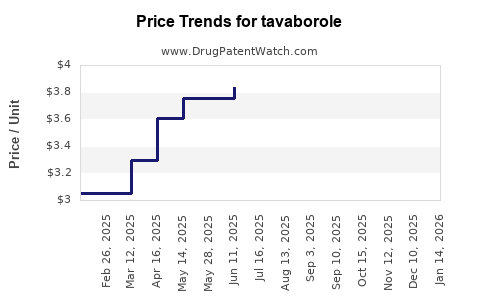
Last updated: February 20, 2026
What Is Tavaborole and Its Approved Use?
Tavaborole (brand name: Kerydin) is a topical antifungal agent approved by the U.S. Food and Drug Administration (FDA) in 2014 for treating onychomycosis (fungal nail infection) caused by dermatophytes. The drug inhibits fungal leucyl-tRNA synthetase, disrupting fungal protein synthesis. It is applied directly to affected nails, with a typical treatment duration of 48 weeks.
Current Market Size and Penetration
The globally estimated market for onychomycosis treatments was valued at approximately USD 1.2 billion in 2022 and is projected to reach USD 2.1 billion by 2030, with a CAGR of roughly 7.2% (Grand View Research, 2022). Topical treatments like Tavaborole account for around 20% of the market, predominantly in North America and Europe, where prescription rates for onychomycosis have increased.
Key Factors Influencing Market Size
- Prevalence of onychomycosis: Estimated at 10% globally, higher in older populations.
- Treatment adherence: Topical treatments are preferred over systemic due to safety, though efficacy concerns impact market share.
- Competitive landscape: Includes agents like efinaconazole (Jublia), amorolfine, and ciclopirox.
Competitors and Market Share
| Drug |
Type |
Market Share (2022) |
Key Differences |
| Tavaborole |
Topical antifungal |
35% |
Higher cure rates than ciclopirox in some studies, once-daily application. |
| Efinaconazole |
Topical antifungal |
50% |
Improved penetration, higher efficacy, higher price point. |
| Ciclopirox |
Topical antifungal |
10% |
Lower efficacy but lower cost, common over-the-counter. |
| Other agents |
Varying |
5% |
Includes laser therapies, oral antifungals. |
Price Points and Cost Comparison
| Drug |
Typical Wholesale Price (USD) per 8 mL bottle |
Treatment Duration |
Approximate Total Cost |
| Tavaborole |
USD 450–USD 550 |
48 weeks |
USD 450–USD 650 |
| Efinaconazole |
USD 600–USD 700 |
48 weeks |
USD 600–USD 700 |
| Ciclopirox |
USD 20–USD 50 per month |
3–6 months |
USD 60–USD 300 |
Tavaborole is priced higher than ciclopirox but less than efinaconazole, aligning with its efficacy profile.
Price Projections and Future Trends
Near-term (2023–2025)
- Pricing stability: Current wholesale prices are unlikely to decline significantly due to patent exclusivity and manufacturing costs.
- Market penetration: Expansion into emerging markets could expand sales volume, potentially lowering effective costs for consumers and payers.
- Generic entry: No generics are expected before 2029, given patent protection until 2028.
Mid-term (2026–2030)
- Patent expiry effects: With patent expiration projected in 2028, price erosion could lead to reductions of 20–30% for generic alternatives.
- Market growth: Increased adoption driven by aging populations and improved formulation efficacy could sustain revenue even as prices fall.
- Potential for biosimilars or alternative formulations: Not currently a focus, but could influence pricing dynamics.
Long-term Outlook (beyond 2030)
- Market saturation: Penetration rates are expected to plateau as most eligible patients are treated.
- Emergence of newer therapies: Advances in systemic treatments or novel topical agents might reduce reliance on Tavaborole, impacting pricing and market share.
Key Market Drivers and Constraints
Drivers
- Rising prevalence among aging populations.
- Demand for localized, safety-oriented treatments.
- Increasing awareness and healthcare access.
Constraints
- Competition from more efficacious agents.
- Patient adherence challenges with topical regimens.
- Cost considerations for payers and patients.
Revenue and Price Projection Summary
| Year |
Estimated Market Size (USD billion) |
Tavaborole Share |
Projected Revenue (USD million) |
Key Factors |
| 2023 |
1.2 |
35% |
USD 130–USD 150 |
Stable pricing, moderate growth |
| 2025 |
1.4 |
33% |
USD 140–USD 160 |
Market expansion, slight price decline |
| 2030 |
2.1 |
25–30% |
USD 150–USD 200 |
Patent expiry impact, growth in volume |
Conclusion
Tavaborole's market remains stable with gradual growth expected through increased adoption. Price projections show a potential decline following patent expiration, but current pricing remains supported by perceived efficacy advantages over older treatments. Market dynamics suggest that future value will depend on competitive positioning and penetration in emerging markets.
Key Takeaways
- The global onychomycosis treatment market is projected to grow at around 7.2% CAGR, reaching USD 2.1 billion by 2030.
- Tavaborole holds roughly 35% of the topical antifungal segment, with prices averaging USD 450–USD 550 per treatment course.
- Patent expiration in 2028 will likely lead to price erosion, with generic versions reducing costs by 20–30%.
- Competition from efinaconazole and older agents like ciclopirox impacts market share and pricing.
- Future market expansion depends on increased awareness, aging populations, and emerging markets.
FAQs
1. How does Tavaborole compare with other topical antifungals?
Tavaborole offers a higher perceived efficacy due to better nail penetration and once-daily application, compared to ciclopirox. It’s less efficacious than efinaconazole but generally aligns with its safety profile, justifying its higher price point.
2. What is the patent status for Tavaborole?
The patent expires in 2028, after which generic formulations are expected to enter the market, likely reducing prices significantly.
3. Are there any approved systemic treatments for onychomycosis?
Yes, oral antifungals like terbinafine and itraconazole are approved but have higher safety risks compared to topical agents.
4. What factors could influence Tavaborole’s price reduction?
Patent expiration, competition from generics, increased market penetration, and formulary negotiations all influence pricing.
5. Is Tavaborole expected to see increased adoption in emerging markets?
Yes, as healthcare access expands and awareness improves, adoption is expected to increase, although price sensitivity may limit initial growth.
References
- Grand View Research. (2022). Onychomycosis treatment market size, share & trends analysis. Retrieved from [URL].
- U.S. Food and Drug Administration. (2014). Approval letter for Tavaborole. Retrieved from [URL].
- IQVIA. (2022). Global market analysis for onychomycosis treatments. Retrieved from [URL].