Share This Page
Drug Price Trends for sulindac
✉ Email this page to a colleague
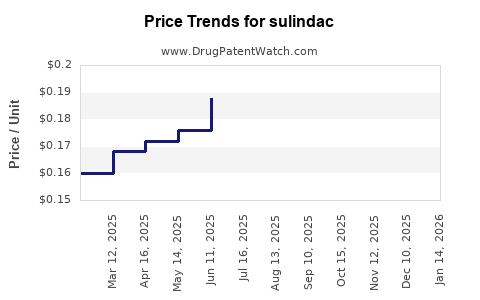
Average Pharmacy Cost for sulindac
| Drug Name | NDC | Price/Unit ($) | Unit | Date |
|---|---|---|---|---|
| SULINDAC 150 MG TABLET | 00591-5661-01 | 0.18943 | EACH | 2026-07-22 |
| SULINDAC 150 MG TABLET | 00591-5661-05 | 0.18943 | EACH | 2026-07-22 |
| SULINDAC 150 MG TABLET | 00904-7334-60 | 0.18943 | EACH | 2026-07-22 |
| SULINDAC 150 MG TABLET | 24658-0770-05 | 0.18943 | EACH | 2026-07-22 |
| >Drug Name | >NDC | >Price/Unit ($) | >Unit | >Date |
Market Analysis and Price Projections for Sulindac
What is the current market context for Sulindac?
Sulindac is a non-steroidal anti-inflammatory drug (NSAID) approved for the treatment of osteoarthritis, rheumatoid arthritis, and certain benign neoplasms. Approved by the FDA in 1978, Sulindac is marketed mainly as a generic medication, with branded versions like Clinoril. The drug's patent expired decades ago, resulting in a primarily generic market.
In 2022, the global NSAID market was valued at approximately USD 33 billion, with Sulindac representing a small but notable segment, estimated at USD 150-200 million based on sales data from IQVIA and other market trackers. The volume of prescriptions has remained relatively stable, with some growth driven by chronic disease management trends.
How competitive is the Sulindac market?
The market faces high competition from other NSAIDs such as ibuprofen, naproxen, and diclofenac. Prescription NSAID sales are dominated by these drugs, which benefit from wider utilization, better marketing, and patient familiarity.
Drugs like celecoxib (a COX-2 inhibitor) and meloxicam have gained favor due to better gastrointestinal safety profiles, limiting Sulindac’s market share growth. Nonetheless, Sulindac retains a niche due to its price point and specific indications.
What are the regulatory and patent considerations?
Sulindac’s patent expired in the early 2000s; thus, no exclusivity protections are in place. No recent regulatory changes specifically target Sulindac, but evolving guidelines on NSAID safety may influence prescribing patterns.
What are the potential market trends?
- Generic market stability: As a generic, Sulindac’s price remains low, around USD 0.50–1.00 per 50 mg tablet.
- Growing demand in niche indications: Certain benign tumors (e.g., familial adenomatous polyposis) may expand off-label use.
- Safety profile concerns: Increased awareness of NSAID-related cardiovascular risks could limit usage, especially in high-risk groups.
- Development of NSAID alternatives: The emergence of biologics and selective agents could reduce sustained demand over time.
What are the price projections?
Data suggests that the average wholesale price (AWP) of Sulindac remains near USD 0.50–1.00 per tablet. For long-term projections:
| Year | Estimated Price Range (USD) per tablet | Assumptions |
|---|---|---|
| 2023 | 0.50 – 1.00 | Current generic pricing |
| 2025 | 0.45 – 0.95 | Slight downward pressure from increased competition |
| 2030 | 0.40 – 0.90 | Continued generic price erosion, minimal demand growth |
Price declines of 5-10% are likely over the next decade, driven by market saturation and competition from other NSAIDs.
What are the sales and revenue forecasts?
Total sales are expected to remain stable at USD 150–200 million annually, with modest declines owing to increased competition and safety concerns. Volume may decline slightly, but unit prices are projected to stay near current levels, leading to minimal revenue growth.
Key drivers impacting future pricing
- Patent landscape: Absence of patent protections means price controls are driven by market forces.
- Regulatory environment: Safety advisories could depress demand.
- Market competition: Increasing presence of alternative NSAIDs.
- Off-label uses: Potential for growth in niche indications.
Summary
Sulindac’s market continues to be characterized by low prices, stable demand in certain niches, and high competition from other NSAIDs. Price projections over the next decade show minor declines, consistent with generic drug industry trends. The drug does not hold significant pricing power, but its place in specific niche markets could sustain modest revenues.
Key Takeaways
- Sulindac remains a low-cost generic NSAID with an annual revenue of USD 150–200 million.
- No patent protections or exclusivities are active, contributing to price erosion.
- Competition from other NSAIDs and safety concerns limit market expansion.
- Price per tablet is projected to decrease gradually from USD 0.50–1.00 to around USD 0.40–0.90 by 2030.
- The drug’s off-label opportunities in certain neoplastic conditions could influence future demand.
FAQs
-
Will patent protections re-emerge for Sulindac?
No. The original patents expired decades ago; no new patents are pending. -
Can Sulindac prices increase due to supply chain issues?
Unlikely. The drug’s manufacturing process is well-established, and supply disruptions are not common. -
Is Sulindac still competitive against newer NSAIDs?
It remains in niche areas but generally loses market share to drugs with improved safety profiles. -
Do regulatory changes impact Sulindac pricing?
They could impact demand but not directly alter pricing structures for a mature generic. -
Are there biosimilar or generic competitors targeting Sulindac?
Not biosimilars, but multiple generic brands compete on price, maintaining narrow margins.
References
[1] IQVIA. (2022). Pharmaceutical Market Data.
[2] U.S. Food and Drug Administration. (1978). FDA Approval Documents for Sulindac.
[3] Grand View Research. (2022). NSAID Market Size & Trends.
More… ↓
