Last updated: February 19, 2026
Summary: Spiriva (tiotropium bromide) is an established long-acting muscarinic antagonist (LAMA) for the treatment of chronic obstructive pulmonary disease (COPD). Market exclusivity for the originator product has expired, leading to increased generic competition and downward pressure on pricing. Future market trajectory will be influenced by the introduction of novel combination therapies, evolving clinical guidelines, and the sustained adoption of generic tiotropium.
What is the Current Market Landscape for Spiriva?
The global market for Spiriva has been shaped by its long-standing presence in COPD management and the subsequent erosion of patent protection. Originally developed and marketed by Boehringer Ingelheim, Spiriva (in its nebulizer solution and dry powder inhaler formulations) has been a cornerstone therapy for symptom relief in moderate to very severe COPD.
Key Market Segments and Drivers
- COPD Treatment: This is the primary market for Spiriva. The increasing global prevalence of COPD, driven by aging populations and smoking rates, continues to underpin demand for effective bronchodilators.
- Generic Competition: The expiration of key patents for Spiriva has opened the door for multiple generic manufacturers. This has significantly impacted originator pricing and market share.
- Therapeutic Positioning: Spiriva is typically used as a maintenance bronchodilator for patients experiencing symptoms of breathlessness and reduced exercise tolerance. It is not intended for the relief of acute bronchospasm.
- Clinical Guidelines: Inclusion in major COPD treatment guidelines, such as those from the Global Initiative for Chronic Obstructive Lung Disease (GOLD), has been critical to Spiriva's sustained use.
Competitor Landscape
The competitive environment for tiotropium bromide is characterized by the presence of both branded and generic products.
- Originator Product: Spiriva (Boehringer Ingelheim).
- Generic Tiotropium: Numerous manufacturers globally now offer generic versions of tiotropium bromide, significantly fragmenting the market and driving down prices. These include companies such as Teva Pharmaceutical Industries, Mylan (now Viatris), and Cipla.
- Other LAMAs: Spiriva competes with other LAMAs, both as monotherapies and as components of fixed-dose combination (FDC) inhalers. Examples include:
- Umeclidinium (Incruse Ellipta, GSK)
- Glycopyrronium bromide (Seebri Breezhaler, Novartis)
- Fixed-Dose Combinations: A significant trend is the development and adoption of FDCs that combine a LAMA with a long-acting beta-agonist (LABA) or an inhaled corticosteroid (ICS). Many of these combinations have shown improved efficacy and patient adherence compared to monotherapies. Examples include:
- Breo Ellipta (fluticasone furoate/vilanterol, GSK) - ICS/LABA
- Anoro Ellipta (umeclidinium/vilanterol, GSK) - LAMA/LABA
- Stiolto Respimat (tiotropium/olodaterol, Boehringer Ingelheim) - LAMA/LABA (a follow-on product from Boehringer Ingelheim leveraging the tiotropium molecule)
- Duaklir (aclidinium/formoterol, AstraZeneca) - LAMA/LABA
What are the Key Patents and Exclusivity Periods for Spiriva?
Boehringer Ingelheim's market exclusivity for Spiriva has been systematically dismantled by patent expirations and successful Paragraph IV challenges from generic manufacturers.
Major Patent Expirations and Generic Entry
| Patent Type |
Expiration Date (Approximate) |
Impact |
| Composition of Matter |
Circa 2010-2014 |
First wave of generic launches |
| Formulation Patents |
Varying, extending to mid-2010s |
Further opportunities for generic entry |
| Method of Use Patents |
Varying |
Limited impact on branded market share |
| Orphan Drug Exclusivity |
Expired |
Not a primary driver for Spiriva |
- The expiration of the core composition of matter patents was the primary catalyst for broad generic competition. This allowed multiple companies to launch bioequivalent generic tiotropium bromide inhalers.
- While secondary patents (e.g., specific formulations or delivery devices) may have extended exclusivity for certain aspects of the branded product, their impact on overall market exclusivity was largely superseded by the expiry of the primary patents.
- Boehringer Ingelheim has also strategically introduced combination products containing tiotropium, such as Stiolto Respimat (tiotropium/olodaterol), to maintain a presence in the COPD market and leverage their existing molecule. These newer products have their own patent protection periods.
How is the Price of Spiriva Expected to Evolve?
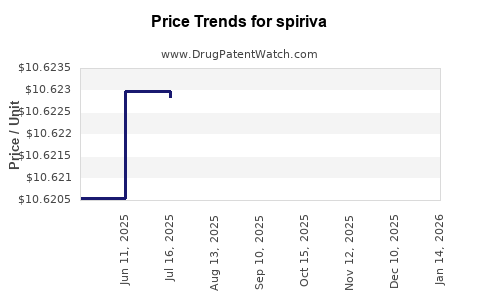
The pricing trajectory for Spiriva is characterized by a steep decline in the originator product's price post-exclusivity and a competitive pricing environment for generic tiotropium.
Factors Influencing Price
- Genericization: The most significant factor driving down the price of tiotropium bromide is the availability of multiple generic alternatives. This creates a highly competitive market where price is a primary differentiator.
- Reimbursement Policies: Payer formularies and reimbursement policies often favor lower-cost generic options, further accelerating the price erosion of the branded product.
- Volume-Based Discounts: In large healthcare systems or for significant purchasers, volume-based discounts can further reduce the effective price paid.
- Competition from Newer Therapies: The development of novel FDCs, some of which may offer perceived superior efficacy or convenience, can also put downward pressure on the pricing of older monotherapy agents like tiotropium, especially as healthcare providers aim for cost-effectiveness.
- Originator Product Pricing Strategy: Boehringer Ingelheim's strategy for the branded Spiriva product (if still actively marketed in specific regions) would likely involve aggressive price reductions to retain market share against generics, though this is increasingly challenging.
Price Projection Scenarios
Scenario 1: Continued Generic Dominance (Most Likely)
- Price Trend: Further incremental price declines for generic tiotropium. Originator Spiriva prices will continue to be significantly discounted or withdrawn from some markets.
- Projected Price Range (per inhaler, estimated):
- Branded Spiriva (if available): Likely to be between $50 - $150 USD (heavily discounted from original prices of $300-$500+).
- Generic Tiotropium: Expected to stabilize in the range of $25 - $75 USD.
- Rationale: High volume of generic manufacturers competing on price. Payers will continue to push for cost savings.
- Timeline: Over the next 3-5 years.
Scenario 2: Stiolto Respimat Differentiation
- Price Trend: While generic tiotropium prices decline, Boehringer Ingelheim's Stiolto Respimat (tiotropium/olodaterol) may maintain a higher price point due to its FDC status and potentially differentiated clinical profile.
- Projected Price Range (per inhaler, estimated):
- Stiolto Respimat: $150 - $300 USD.
- Rationale: Combination products typically command higher prices than monotherapies, especially if clinical benefit is demonstrated.
- Timeline: Ongoing, with Stiolto Respimat remaining a premium option in the tiotropium-containing segment.
Scenario 3: Market Consolidation and Limited Price Stabilization
- Price Trend: Some degree of price stabilization for generic tiotropium as smaller manufacturers exit the market or as pricing reaches a floor dictated by manufacturing costs.
- Projected Price Range (per inhaler, estimated):
- Generic Tiotropium: May see marginal increases or stabilization in the $30 - $80 USD range.
- Rationale: Market consolidation can sometimes lead to less aggressive price competition. However, the low barrier to entry in generic manufacturing makes sustained significant price increases unlikely.
- Timeline: Potentially 5+ years out, depending on market dynamics.
Note: These price projections are estimates based on current market trends and patent expirations. Actual prices will vary significantly by region, specific product formulation, manufacturer, and negotiation with payers.
What are the Future Market Opportunities and Challenges for Tiotropium-Based Therapies?
The future of tiotropium-based therapies hinges on navigating a complex landscape of evolving COPD treatment paradigms, clinical evidence, and competitive pressures.
Opportunities
- Emerging Markets: Significant growth potential exists in emerging markets where COPD prevalence is high and access to advanced therapies is increasing. Generic tiotropium offers a cost-effective solution for these regions.
- Combination Therapies: The continued development and adoption of tiotropium in fixed-dose combinations (e.g., with LABAs like olodaterol) presents an opportunity to capture higher market share and value, provided these combinations demonstrate clear clinical advantages.
- Long-Term Cost-Effectiveness Data: Generating and disseminating robust real-world and long-term cost-effectiveness data for tiotropium, especially in comparison to newer, more expensive agents, can solidify its position in treatment guidelines and payer decisions.
- Device Innovation: While less likely for established molecules, continued incremental improvements in inhaler device usability, adherence monitoring, or drug delivery could offer a competitive edge.
Challenges
- Intensifying Competition: The market is saturated with generic tiotropium. Furthermore, newer LAMAs and novel FDCs are continually being introduced, offering potential advantages in efficacy, safety, or patient experience.
- Shifting Clinical Guidelines: If future clinical guidelines increasingly favor triple therapy (LAMA/LABA/ICS) as a first-line or early-stage treatment for certain COPD phenotypes, the role of LAMA monotherapy could diminish.
- Development of Novel MOAs: Research into novel mechanisms of action for COPD treatment could introduce therapies that are fundamentally different and potentially more effective than existing bronchodilators.
- Healthcare Budget Constraints: Global healthcare systems face increasing pressure to manage costs. This will continue to favor generics and cost-effective treatments, but also drives interest in therapies with demonstrable superior outcomes to justify higher prices.
- Patient Adherence: Ensuring consistent patient adherence to inhaled therapies remains a challenge. While tiotropium inhalers are generally considered user-friendly, adherence can still impact long-term outcomes.
Key Takeaways
- Spiriva (tiotropium bromide) has transitioned from a blockbuster branded drug to a highly competitive generic market following patent expiries.
- Generic tiotropium pricing is expected to remain low, with potential for further incremental declines and stabilization in the $25-$80 USD range per inhaler.
- Boehringer Ingelheim's branded Spiriva is likely to see continued price erosion or market withdrawal in many regions, with the company focusing on combination products like Stiolto Respimat.
- The COPD treatment landscape is increasingly dominated by fixed-dose combinations (LAMA/LABA, LAMA/LABA/ICS), which pose a competitive threat to tiotropium monotherapy.
- Future opportunities for tiotropium lie in emerging markets and its incorporation into advanced combination therapies, while challenges include intensifying competition and evolving clinical guidelines.
Frequently Asked Questions
-
What is the primary indication for Spiriva?
Spiriva is indicated for the long-term, once-daily maintenance treatment of bronchospasm associated with chronic obstructive pulmonary disease (COPD), including chronic bronchitis and emphysema.
-
Why has the price of branded Spiriva decreased so significantly?
The decrease in the price of branded Spiriva is due to the expiration of its primary patents, which has allowed multiple pharmaceutical companies to launch bioequivalent generic versions of tiotropium bromide. This increased competition drives down prices.
-
Are there different formulations of Spiriva, and do they affect pricing?
Yes, Spiriva has been available in various formulations, including a dry powder inhaler (HandiHaler) and a metered-dose inhaler (Respimat). While formulation patents might have extended some periods of exclusivity, the core molecule's genericization has been the dominant pricing factor. Generic versions may also offer different inhaler devices.
-
How does tiotropium bromide compare to newer LAMA/LABA combination therapies in terms of efficacy?
Clinical trials suggest that LAMA/LABA combinations generally provide superior bronchodilation and symptom relief compared to LAMA monotherapy, including tiotropium. However, the choice of therapy depends on individual patient characteristics, disease severity, and cost-effectiveness considerations.
-
What is the outlook for generic tiotropium in emerging markets?
Generic tiotropium is expected to see continued growth in emerging markets. Its affordability, combined with the increasing prevalence of COPD in these regions and improving healthcare access, makes it a vital treatment option.