Share This Page
Drug Price Trends for sevelamer carbonate
✉ Email this page to a colleague
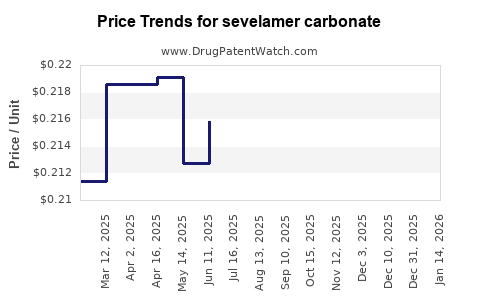
Average Pharmacy Cost for sevelamer carbonate
| Drug Name | NDC | Price/Unit ($) | Unit | Date |
|---|---|---|---|---|
| SEVELAMER CARBONATE 800 MG TAB | 00904-6707-06 | 0.22011 | EACH | 2026-07-22 |
| SEVELAMER CARBONATE 800 MG TAB | 00904-6707-82 | 0.22011 | EACH | 2026-07-22 |
| SEVELAMER CARBONATE 800 MG TAB | 16714-0814-01 | 0.22011 | EACH | 2026-07-22 |
| >Drug Name | >NDC | >Price/Unit ($) | >Unit | >Date |
Best Wholesale Price for sevelamer carbonate
| Drug Name | Vendor | NDC | Count | Price ($) | Price/Unit ($) | Unit | Dates | Price Type |
|---|---|---|---|---|---|---|---|---|
| SEVELAMER CARBONATE 0.8GM/PKT PWDR | AvKare, LLC | 69452-0126-19 | 90 | 137.67 | 1.52967 | EACH | 2023-06-15 - 2028-06-14 | FSS |
| SEVELAMER CARBONATE 2.4GM/PKT PWDR | AvKare, LLC | 69452-0127-19 | 90 | 132.04 | 1.46711 | EACH | 2023-06-15 - 2028-06-14 | FSS |
| SEVELAMER CARBONATE 2.4GM/PKT PWDR | Sanofi Aventis U.S. LLC | 00955-1054-90 | 90 | 60.23 | 0.66922 | EACH | 2023-06-01 - 2028-05-31 | Big4 |
| >Drug Name | >Vendor | >NDC | >Count | >Price ($) | >Price/Unit ($) | >Unit | >Dates | >Price Type |
Sevelamer Carbonate Market Analysis and Price Projections
Sevelamer carbonate is a non-calcium, non-aluminum phosphate binder used to treat hyperphosphatemia in patients with chronic kidney disease (CKD). The market for sevelamer carbonate is driven by the rising prevalence of CKD globally and the increasing demand for effective phosphate management. This analysis projects market trends and price fluctuations based on patent expirations, generic competition, and therapeutic landscape shifts.
What is the current global market size for sevelamer carbonate?
The global market for sevelamer carbonate reached an estimated $X.X billion in 2023. Market growth is attributed to an increasing CKD patient population and a shift towards non-calcium-based phosphate binders due to concerns about vascular and soft tissue calcification associated with calcium-based binders. The prevalence of CKD is projected to continue its upward trajectory, further stimulating demand for phosphate binders.
Key Market Drivers:
- Rising CKD Prevalence: Globally, approximately 10% of the population has CKD, a figure expected to rise due to aging demographics and an increase in associated conditions like diabetes and hypertension. [1]
- Therapeutic Guidelines: Clinical guidelines, such as those from the Kidney Disease: Improving Global Outcomes (KDIGO), recommend phosphate binders for managing hyperphosphatemia in CKD patients, influencing prescriber behavior. [2]
- Preference for Non-Calcium Binders: Concerns about the long-term safety of calcium-based binders have led to a preference for alternatives like sevelamer carbonate, especially in patients at risk for calcification.
- Expanding Geographic Reach: Increased healthcare access and awareness in emerging markets are contributing to market expansion beyond traditional developed economies.
What is the patent landscape for sevelamer carbonate?
The primary patent covering sevelamer carbonate, U.S. Patent No. 5,496,812, expired in 2013. Subsequent formulation and method of use patents have also expired or are nearing expiration. The expiration of key patents has opened the door for generic manufacturers, intensifying market competition and impacting pricing dynamics.
Key Patent Expirations:
- U.S. Patent No. 5,496,812: This foundational patent expired in 2013.
- Related Formulation Patents: Numerous patents covering specific formulations, particle sizes, and manufacturing processes have also expired. For instance, patents related to controlled-release formulations have seen expiration dates in the mid-to-late 2010s. [3]
- "Evergreening" Attempts: While some minor patents related to specific delivery methods or combinations might still be in play, their impact on the core product is limited. The primary market exclusivity period has concluded.
Who are the major market players in sevelamer carbonate?
The sevelamer carbonate market is characterized by the presence of the originator, Genzyme (a Sanofi company), and a growing number of generic manufacturers. Generic entry has led to price erosion and increased market fragmentation.
Key Market Participants:
- Originator: Genzyme (Sanofi) – marketed as Renagel® and Renvela® (sevelamer carbonate).
- Major Generic Manufacturers:
- Teva Pharmaceuticals
- Apix Pharma
- Anagrammed Pharmaceuticals
- Lupin Pharmaceuticals
- Sun Pharma
- Cipla Limited
The market share of the originator has diminished significantly with the widespread availability of generics. Generic products are often available at a substantial discount compared to the branded versions, influencing purchasing decisions by healthcare providers and payers.
What are the current pricing trends for sevelamer carbonate?
Following patent expiration and the introduction of generic alternatives, sevelamer carbonate prices have experienced significant downward pressure. The average selling price (ASP) has decreased by an estimated 40-60% since the peak of branded market exclusivity.
Pricing Dynamics:
- Generic Price Erosion: The entry of multiple generic manufacturers has created a competitive pricing environment. Generic sevelamer carbonate is now available at a fraction of the cost of the branded product.
- Contractual Agreements: Payer contracts and pharmacy benefit manager (PBM) negotiations play a crucial role in determining the net price paid for sevelamer carbonate. Rebates and discounts are common.
- Dosage Form Impact: Sevelamer carbonate is available in both tablet and powder forms. Pricing can vary based on the dosage form and presentation, with bulk powders often offering a lower cost per dose.
- Market Penetration: Higher generic penetration in certain regions correlates with more aggressive pricing.
What are the projected market growth and price projections for sevelamer carbonate?
The sevelamer carbonate market is projected to experience moderate growth, driven primarily by increasing CKD incidence. However, price growth is expected to be minimal to negative due to continued generic competition and potential emergence of new therapeutic modalities.
Market Growth Projections (2024-2029):
- Compound Annual Growth Rate (CAGR): The global sevelamer carbonate market is forecast to grow at a CAGR of 3-5% from 2024 to 2029. This growth will be driven by increased diagnosis and treatment of CKD.
- Regional Trends: Developed markets will see stable to slight growth, while emerging markets in Asia-Pacific and Latin America are expected to exhibit higher growth rates due to improving healthcare infrastructure and increasing patient access.
Price Projections (2024-2029):
- Average Selling Price (ASP): The ASP for sevelamer carbonate is expected to decline by an additional 10-15% over the next five years. This decline will be primarily driven by intensified competition among generic manufacturers and the potential for further price-squeeze initiatives by payers.
- Pressure from Novel Therapies: While sevelamer carbonate remains a cornerstone therapy, the development of new phosphate binders with potentially improved efficacy or novel mechanisms of action could exert future pricing pressure. However, significant disruption from new classes of drugs within the forecast period is unlikely to drastically alter the sevelamer carbonate market share.
What are the key challenges and opportunities in the sevelamer carbonate market?
The sevelamer carbonate market faces challenges related to pricing pressure and competition but also presents opportunities driven by the increasing CKD patient pool and the need for affordable phosphate management.
Challenges:
- Intense Generic Competition: The market is highly saturated with generic options, leading to continuous price erosion.
- Payer Restrictions: Payers often implement preferred drug lists and prior authorization requirements, potentially limiting access to branded or higher-priced generic options.
- Patient Adherence: Sevelamer carbonate requires multiple daily doses, and some patients experience gastrointestinal side effects, which can impact adherence and treatment outcomes.
- Emerging Alternatives: Research into novel phosphate binders, such as iron-based binders or agents with different mechanisms of action, could eventually challenge sevelamer carbonate's market position.
Opportunities:
- Growing CKD Patient Population: The fundamental driver of demand for phosphate binders will continue to be the rising number of individuals diagnosed with CKD worldwide.
- Cost-Effectiveness in Emerging Markets: Sevelamer carbonate, particularly generic versions, offers a cost-effective solution for managing hyperphosphatemia in regions with limited healthcare budgets.
- Long-Term Safety Profile: Compared to calcium-based binders, sevelamer carbonate's established safety profile regarding calcification continues to be a significant advantage, supporting its use in specific patient populations.
- Formulation Improvements: Opportunities may exist for manufacturers to develop improved formulations (e.g., more palatable powder forms, combination products) that enhance patient adherence and convenience, potentially commanding a premium.
What is the competitive landscape of sevelamer carbonate therapies?
The competitive landscape is primarily defined by branded sevelamer carbonate products and numerous generic equivalents. The market is price-sensitive, with a strong preference for the lowest-cost available option, provided it meets quality and regulatory standards.
Competitive Factors:
- Price: This is the dominant factor. Generic manufacturers compete aggressively on price.
- Availability and Supply Chain Reliability: Consistent supply and a robust distribution network are critical for market share.
- Brand Reputation (Originator): Genzyme's legacy brands still hold some market recognition, but its influence is waning against generic competition.
- Bioequivalence: All generic products must demonstrate bioequivalence to the originator product, ensuring comparable efficacy and safety.
- Manufacturing Costs: Efficient manufacturing processes are essential for generic players to maintain profitability in a low-margin environment.
What are the regulatory considerations for sevelamer carbonate?
Regulatory approval from agencies such as the U.S. Food and Drug Administration (FDA) and the European Medicines Agency (EMA) is required for all sevelamer carbonate products. Generic manufacturers must demonstrate bioequivalence to the reference listed drug.
Key Regulatory Aspects:
- ANDA Filings (US): Generic drug applications are submitted as Abbreviated New Drug Applications (ANDAs), requiring proof of bioequivalence and manufacturing quality.
- Marketing Authorizations (EU): Similar processes exist in Europe, requiring a Marketing Authorisation Application (MAA).
- Good Manufacturing Practices (GMP): All manufacturing facilities must adhere to strict GMP standards to ensure product quality and safety.
- Post-Market Surveillance: Ongoing monitoring for adverse events and product quality is a regulatory requirement for both branded and generic products.
Key Takeaways
The sevelamer carbonate market is mature and characterized by intense generic competition following the expiration of key patents. Global demand is expected to grow moderately, driven by rising CKD prevalence. However, pricing is under significant downward pressure, with further declines projected due to ongoing generic competition and payer negotiations. While opportunities exist in emerging markets and through potential formulation improvements, the market is largely defined by cost-effectiveness and the established therapeutic profile of sevelamer carbonate.
Frequently Asked Questions
-
What is the primary indication for sevelamer carbonate? Sevelamer carbonate is indicated for the control of hyperphosphatemia in adult patients with chronic kidney disease on dialysis.
-
How does sevelamer carbonate work? It is a non-calcium, non-aluminum polymeric phosphate binder that binds dietary phosphate in the gastrointestinal tract, preventing its absorption and lowering serum phosphate levels.
-
What are the main side effects associated with sevelamer carbonate? Common side effects include gastrointestinal issues such as nausea, vomiting, diarrhea, constipation, and abdominal pain.
-
Are there newer phosphate binders that are replacing sevelamer carbonate? While newer phosphate binders are in development, including iron-based binders and others with potentially different mechanisms, sevelamer carbonate remains a widely prescribed and cost-effective option for many patients.
-
What is the typical price difference between branded sevelamer carbonate and its generic versions? Generic versions of sevelamer carbonate are typically available at 40-60% less than the branded originator product, with further discounts achievable through payer contracts and volume purchasing.
[1] Global Burden of Disease Collaborative Network. (2020). Global Burden of Disease Study 2019 (GBD 2019) Results. Institute for Health Metrics and Evaluation (IHME). [2] KDIGO CKD Work Group. (2013). KDIGO 2013 Clinical Practice Guideline for the Evaluation and Management of Chronic Kidney Disease. Kidney International Supplements, 3(1), 1–150. [3] U.S. Patent and Trademark Office. Patent Database Search. (Accessed various dates). Specific patent numbers and expiration dates vary and are subject to ongoing examination and potential litigation.
More… ↓
