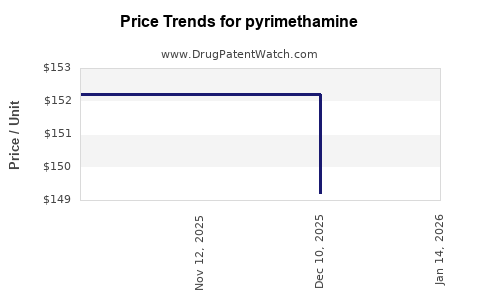
Last updated: May 13, 2026
Pyrimethamine Market Analysis and Price Projections: Sales, Pricing Trends, and Forecast for the Antimalarial
Pyrimethamine remains a niche, mostly off-patent antimalarial used primarily in combination regimens. Demand is concentrated in settings where pyrimethamine is used with a partner drug (commonly sulfadoxine or other agents depending on resistance patterns and local guidance), and in acquired toxoplasmosis regimens. Commercial pricing is shaped by (1) generic penetration, (2) public-sector procurement in endemic geographies, and (3) periodic supply disruptions that can temporarily lift unit prices. Predictable wholesale-to-net dynamics make long-range “list price” forecasting unreliable; the actionable forecast is by market segment: public-sector procurement versus private market sales, and by dosage form: tablet vs compounded/packaged single-source supply.
Because pyrimethamine is off-patent in essentially all major markets and is widely generically available, price projections should be modeled as a generic commodities market with episodic volatility rather than as a branded premium drug. Under that structure, the base case is stable-to-declining average net prices, with short-run spikes tied to procurement cycles and supply availability.
What is the current global market for pyrimethamine and how is it segmented by use?
Direct answer: Pyrimethamine is a low-revenue global drug with demand concentrated in malaria control programs and toxoplasmosis treatment, with additional use in hematologic/oncology-adjacent research settings but limited commercial pull.
Demand drivers
- Malaria endemic control: Use is regimen- and resistance-dependent, commonly paired in practice with sulfadoxine or other partner regimens depending on local resistance to pyrimethamine.
- Acquired toxoplasmosis and opportunistic infections: Clinical utilization persists where regimens use pyrimethamine-containing combinations, though prescribing patterns increasingly favor alternative pyrimethamine-sparing options in many countries.
- Public health procurement cycles: Bulk tenders and tender-awarded product requirements drive volume but not necessarily stable channel pricing.
Segment split that matters for pricing
- Public-sector tenders (highest volume impact): Price competition is intense and contract-based.
- Private/retail market (low volume impact): Price can remain higher than tender pricing due to distribution margins and smaller batch supply.
How do pyrimethamine prices behave in generic markets: tender pricing vs retail pricing?
Direct answer: In pyrimethamine, net price behavior largely follows tender dynamics. Retail and pharmacy pricing can exceed tender prices materially, but retail is a smaller share of total demand in endemic-use channels.
Key pricing mechanics
- Generic competition compresses net prices: Multiple suppliers create continuous downward pressure on tender awarded unit costs.
- Channel structure drives apparent “list price” volatility: Public tenders can lock in low unit prices for extended periods; short-term retail pricing can swing due to wholesaler substitution.
- Supply interruptions move prices discretely: When a limited supplier wins a tender or a manufacturer has production constraints, unit costs can jump until additional supply returns.
What generic companies supply pyrimethamine and how does supplier concentration affect prices?
Direct answer: Pyrimethamine is supplied by multiple generic manufacturers across regions. Price pressure correlates with the breadth of qualified suppliers in tender catalogs; concentration increases the chance of short-run price spikes.
Competitive structure
- Regulatory-qualified supply: For procurement, buyers often use prequalified supplier lists. New entrants face qualification and documentation lead times.
- Manufacturing scale: Because pyrimethamine is low demand globally, production scale is uneven across vendors. Lower utilization can raise marginal costs for smaller suppliers.
- Formulation variants: Pricing differs by package size and tablet strength; some buyers standardize to specific pack configurations for tendering.
When does pyrimethamine see pricing spikes and what causes them?
Direct answer: Price spikes typically occur around procurement tender cycles with constrained qualified supply, or after manufacturing disruptions that reduce available inventory.
Common spike triggers
- Tender award cycles: Buyers re-bid and retender; when fewer qualified bids arrive, awarded prices rise.
- Regulatory or quality actions: Lot rejections, GMP issues, or documentation constraints can shrink supply.
- Manufacturing lead time mismatch: Anticipated demand surges in procurement can outpace batch release schedules.
- Channel inventory resets: Wholesalers adjust stocking after prior inventory sells down, changing retail price.
What is the Orange Book status of pyrimethamine and what does off-patent status imply for pricing?
Direct answer: In the US, pyrimethamine is off-patent and marketed as generics with limited patent-driven pricing support. Off-patent status implies pricing is primarily competitive and contract-driven rather than exclusivity-driven.
Implication for projection modeling
- No sustained branded pricing premium: Pricing should trend toward market-clearing levels determined by generic competition.
- Low likelihood of patent life extension: Specialty formulation or method patents are unlikely to maintain market power in a commodity-like generic.
- Substitution risk remains high: Any supplier pricing increase can be offset quickly by alternative suppliers, especially in public-sector channels.
What patent estate risks exist for pyrimethamine that could affect generic entry and price?
Direct answer: Patent estate-driven price effects are unlikely to be durable for pyrimethamine because the product is mature and generics dominate. Any remaining IP tends to be narrow (specific formulations, manufacturing processes, or method-of-use claims) and typically does not block access at scale.
Where IP could still matter
- Certain fixed-dose combinations: Some markets prefer specific combo packs with regulatory and labeling-driven substitution constraints.
- Manufacturing method constraints: If a process is materially different, compliance and equivalency requirements can slow new entrants, temporarily affecting supply.
How do pyrimethamine dosage form and strengths influence pricing and tender competitiveness?
Direct answer: Pricing is sensitive to tablet strength and package configuration because tenders often specify exact presentations. Different pack sizes can change effective unit cost even when the active ingredient price is similar.
Key pricing determinants
- Tablet strength and count: Buyers standardize strength for dosing protocols.
- Pack configuration: Bulk tender packaging (e.g., blister vs bottle counts) affects logistics and cost.
- Stability and shelf life: Procurement contracts often favor suppliers with longer remaining shelf-life at delivery, which can move awarded costs.
How does pyrimethamine compare with alternative antimalarials and toxoplasmosis regimens on cost and access?
Direct answer: Pyrimethamine’s competitive position depends on whether it is used as a core component of malaria and toxoplasmosis regimens or replaced by alternative drugs in specific guidelines. Where it remains in recommended regimens, it competes mainly on procurement cost and supply reliability.
Cost competition vectors
- Malaria guideline shifts: Resistance-driven changes can reduce pyrimethamine reliance in certain regions, reducing procurement volumes and increasing price volatility for suppliers.
- Toxoplasmosis regimen evolution: Alternatives can displace part of the pyrimethamine combination demand, lowering overall market size.
- Access and distribution: Even when alternatives exist, local supply chains can favor whichever product is already qualified for procurement.
What is the forecast for pyrimethamine pricing through 2028 and 2030?
Direct answer: Base case is stable-to-declining average net pricing over the forecast horizon, with intermittent short-run spikes from supply constraints. Upside scenarios (higher pricing) require supply tightening or procurement reconfiguration that reduces qualified bids; downside scenarios require increased supply and margin compression.
Price projection framework (generic commodity model)
- Stable procurement share + multi-supplier availability: net price drifts down modestly with inflation offsets.
- Supply tightening (qualified supplier reduction): short-run spike, followed by normalization as additional manufacturing capacity returns.
- Guideline displacement: demand decline can raise per-unit costs if fixed costs dominate at low throughput, but it usually also increases tender competition and pushes prices down.
Scenario table (directional, procurement-relevant)
| Scenario |
Demand trend |
Supply trend |
Average net price (direction) |
Timing |
| Base case |
Flat to modest decline |
Broad generic availability |
Slight decline or flat |
2026-2028 |
| Tight supply |
Flat/slight decline |
Fewer qualified lots |
Spike then partial normalization |
2026-2027 |
| Demand displacement |
Decline |
Availability unchanged |
Decline (more competition) |
2027-2030 |
| Supply shock |
Volatile demand |
Reduced manufacturing |
Spike and prolonged elevated |
2026-2030 |
How should wholesalers, importers, and procurement buyers model pyrimethamine cost risk?
Direct answer: Model risk by tender-cycle timing, supplier qualification breadth, and shelf-life delivery conditions. Use contract-laddering to reduce exposure to single-supplier shocks.
Actionable risk controls
- Contract ladder: Stagger procurement lots across suppliers to reduce dependency.
- Safety stock tied to shelf-life economics: Maintain buffer aligned to remaining shelf-life at delivery.
- Qualification monitoring: Track supplier regulatory and quality status that can remove qualified supply lists.
- Formulation/pack substitution planning: Ensure tender alternatives can be swapped without re-approval delays.
What are the commercial implications for investors and new market entrants?
Direct answer: Entry economics for pyrimethamine are challenged by low average margins and strong substitution. The most viable entry paths are regional supply expansions where qualification and tender presence create protected bid flow, or manufacturing capacity additions that reduce COGS to stay competitive in commodity pricing.
Investment-relevant considerations
- Scale economics: Production cost per batch matters more than marketing.
- Regulatory/quality overhead: Qualification costs must be amortized over sustained tender volumes.
- Inventory and shelf-life: Working capital cycles can dominate returns.
Key Takeaways
- Pyrimethamine is a mature, off-patent generic with pricing driven by tender competition and supply availability rather than IP exclusivity.
- Forecast pricing should be treated as a commodity model: stable-to-declining average net prices with episodic spikes during supply or qualification disruptions.
- The highest commercial sensitivity lies in public-sector procurement timing, supplier qualification breadth, and shelf-life delivery constraints.
- Durable upside pricing requires sustained supply tightness or demand shifts that reduce qualified competition; durable downside follows continued generic supply expansion and guideline displacement.
FAQs
- Is pyrimethamine still used for malaria treatment in 2026?
- Which pyrimethamine combination regimens most influence commercial demand by region?
- How do shelf-life requirements affect pyrimethamine tender pricing and supplier eligibility?
- What supply chain events most commonly trigger pyrimethamine unit price spikes?
- How does tablet strength and packaging configuration change effective unit pricing in procurement?
References (APA)
- World Health Organization. (n.d.). Malaria treatment guidelines and updates.
- FDA. (n.d.). Drug approvals and Orange Book database.
- WHO. (n.d.). Toxoplasmosis and opportunistic infection guidance.
- Public procurement and tender databases (various national ministries). (n.d.). Pyrimethamine tender award records.