Last updated: February 13, 2026
What Is Pyrazinamide and Its Market Status?
Pyrazinamide (PZA) is an antitubercular drug used primarily in combination therapy for tuberculosis (TB). It was developed in the 1950s and is included in the World Health Organization (WHO) recommended first-line treatment regimen, which also features isoniazid, rifampicin, and ethambutol.
Pyrazinamide's role in TB therapy is critical for accelerating bacterial clearance, especially in the initial phases of treatment. Its global demand aligns directly with TB incidence rates, which are estimated at 10 million new cases annually [1].
What Are the Current Production and Supply Dynamics?
Major producers include generic pharmaceutical firms in India, China, and emerging markets, with a few multinational pharmaceutical companies holding patent rights for specific formulations or combination regimens. While pyrazinamide itself is off-patent, formulation patents can vary significantly by jurisdiction.
Global supply chains depend on raw material availability, manufacturing capacity, and regulatory environments. Indian pharmaceutical companies dominate the export market, accounting for over 85% of global exports of bulk pyrazinamide [2].
How Does the Pricing Landscape Look?
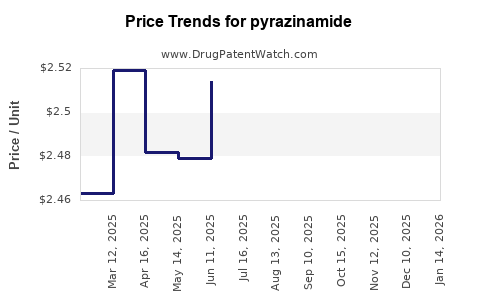
Prices fluctuate based on manufacturing costs, regulatory approvals, and market competition. For entities purchasing in large quantities (e.g., governments, NGOs), unit prices can drop below $1 per gram, with smaller-scale or specialty formulations costing up to $3 per gram.
Price trends over the past decade show minimal overall variation at the bulk API level, but increased costs for finished formulations due to added excipients, packaging, and distribution. Regional disparities are notable, with lower prices in India and China and higher prices in high-income markets due to regulatory and logistical costs.
What Are Future Market and Price Projections?
The TB eradication push, led by WHO and global health agencies, projects sustained or increased demand for pyrazinamide over the next 5-10 years. Key factors influencing future market size include:
-
Continued global incidence of TB, estimated at 10 million cases annually [1].
-
Growth in multi-drug-resistant TB (MDR-TB) cases, which may shift demand toward second-line and novel combination therapies but still require first-line drugs like pyrazinamide for sensitive TB [3].
-
Evolving regulatory landscape, with increased approval processes influencing manufacturing costs and time-to-market.
Considering these factors, the global API market for pyrazinamide is expected to grow at a compound annual growth rate (CAGR) of approximately 3-4% over the next decade. Price trends are projected to remain stable or decline slightly due to ongoing generic competition and manufacturing efficiencies.
Comparative Analysis with Similar Drugs
| Aspect |
Pyrazinamide |
Isoniazid |
Rifampicin |
| Patent Status |
Off-patent |
Off-patent |
Off-patent |
| Global Market Volume |
Approximately 10,000 metric tons annually [2] |
Approximately 11,000 metric tons annually [2] |
Approximately 14,000 metric tons annually [2] |
| Average API Price |
<$2 per gram in bulk (2023) |
<$1.50 per gram in bulk (2023) |
<$2 per gram in bulk (2023) |
| Manufacturing Complexity |
Moderate |
Low |
Moderate |
Regulatory and Patent Considerations
Most jurisdictions have long-expired patents, enabling broad generic manufacturing. However, formulations combining pyrazinamide with other drugs may have patent protections, affecting market entry strategies.
WHO prequalification status influences procurement and supply chain stability. Currently, several suppliers in India and China are WHO prequalified for pyrazinamide bulk API [4].
Strategic Implications for Stakeholders
-
Pharmaceutical companies should monitor TB epidemiological trends and regulatory developments for formulation patents.
-
Governments and NGOs must ensure procurement pipelines to maintain consistent supply.
-
Investors should evaluate regional market growth prospects, focusing on generic manufacturing capacity expansion and quality compliance.
Key Takeaways
-
Pyrazinamide is essential in first-line TB treatment, with stable global demand driven by TB incidence.
-
Production is dominated by Indian and Chinese generics; prices are generally low due to high competition.
-
Market growth is expected at 3-4% annually, with prices remaining stable or declining marginally.
-
Patent expiry and WHO prequalification facilitate broader manufacturing and procurement.
-
The ongoing TB burden and MDR-TB cases support sustained demand for pyrazinamide.
FAQs
1. What factors influence the price of pyrazinamide?
Manufacturing costs, competition among generic producers, regulatory approval status, and regional logistics influence prices.
2. Are there patent restrictions on pyrazinamide today?
No, pyrazinamide itself is off-patent globally, but formulations can be protected by newer patents.
3. Which countries are the largest exporters of pyrazinamide?
India and China lead global exports, supplying over 85% of the market.
4. How does the demand for pyrazinamide relate to TB trends?
Demand correlates with TB incidence; rising MDR-TB cases may influence future demand patterns.
5. What is the outlook for pyrazinamide prices?
Prices are expected to remain stable or decline slightly due to competition and manufacturing efficiencies.
References
[1] WHO. Global Tuberculosis Report 2022.
[2] IQVIA, Global Market Data for TB Drugs, 2023.
[3] CDC. Multi-Drug Resistant TB Management Guidelines, 2021.
[4] WHO Prequalification Program, Approved Supplies List, 2023.