Share This Page
Drug Price Trends for posaconazole
✉ Email this page to a colleague
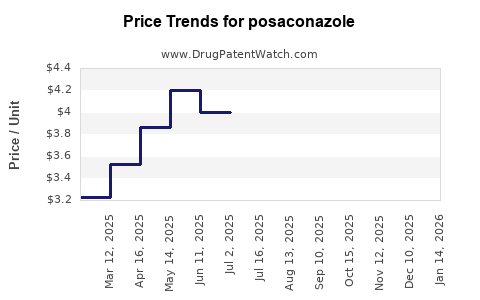
Average Pharmacy Cost for posaconazole
| Drug Name | NDC | Price/Unit ($) | Unit | Date |
|---|---|---|---|---|
| POSACONAZOLE DR 100 MG TABLET | 00254-2045-02 | 2.16569 | EACH | 2026-07-22 |
| POSACONAZOLE DR 100 MG TABLET | 00406-7711-60 | 2.16569 | EACH | 2026-07-22 |
| POSACONAZOLE DR 100 MG TABLET | 00527-2133-35 | 2.16569 | EACH | 2026-07-22 |
| POSACONAZOLE DR 100 MG TABLET | 00904-7149-04 | 2.16569 | EACH | 2026-07-22 |
| >Drug Name | >NDC | >Price/Unit ($) | >Unit | >Date |
Best Wholesale Price for posaconazole
| Drug Name | Vendor | NDC | Count | Price ($) | Price/Unit ($) | Unit | Dates | Price Type |
|---|---|---|---|---|---|---|---|---|
| POSACONAZOLE 200MG/5ML SUSP,ORAL | Golden State Medical Supply, Inc. | 00054-0449-49 | 105ML | 1010.02 | 9.61924 | ML | 2024-05-15 - 2028-06-14 | FSS |
| POSACONAZOLE 100MG TAB,EC | AvKare, LLC | 42291-0919-60 | 60 | 514.88 | 8.58133 | EACH | 2024-01-12 - 2028-06-14 | FSS |
| POSACONAZOLE 100MG TAB,EC | Golden State Medical Supply, Inc. | 51407-0676-60 | 60 | 541.98 | 9.03300 | EACH | 2023-06-15 - 2028-06-14 | FSS |
| POSACONAZOLE 100MG TAB,EC | Golden State Medical Supply, Inc. | 51407-0676-60 | 60 | 503.81 | 8.39683 | EACH | 2024-01-03 - 2028-06-14 | FSS |
| >Drug Name | >Vendor | >NDC | >Count | >Price ($) | >Price/Unit ($) | >Unit | >Dates | >Price Type |
Posaconazole market analysis and price projections (2026–2035): sales outlook, payer dynamics, and generic/biosimilar risk
Posaconazole remains a high-value antifungal with limited label-aligned competitors in key settings, but the long-cycle nature of oncology prophylaxis and IA treatment drives market stability more than pricing power. Price projections depend on (1) the extent of generic erosion in oral solid and delayed-release suspension equivalents, (2) Medicaid/Medicare contracting trends for injectable and IV “conversion” pathways, and (3) whether payers push conversion from branded oral formulations to lower-cost generics and alternative antifungal classes. In the near term, launch risk concentrates in oral formulations; IV pricing is more resilient due to institutional contracting and limited interchangeability in formularies.
Core baselines used for the projection logic
- Major product forms: oral delayed-release tablets/suspension (brand-origin), IV posaconazole formulations (institutional).
- Primary use cases: invasive aspergillosis (IA), mucormycosis (Mucorales), and prophylaxis in high-risk immunocompromised populations (notably hematologic malignancy and transplant settings).
- Competitive frame: voriconazole, isavuconazole, amphotericin B formulations, echinocandins (context dependent), and newer antifungal classes where applicable. For prophylaxis, competitors pressure utilization, but label-specific positioning sustains posaconazole’s core share.
How big is the posaconazole market today and who buys it?
Answer: The market is institution-heavy for IA/Mucorales treatment and prophylaxis in oncology/transplant pathways, with outpatient pharmacy economics applying more to chronic prophylaxis in step-down and outpatient transplant follow-up.
Buying channels and spend concentration
- Hospital pharmacy and ID/hematology formularies: drive IV and inpatient prophylaxis.
- Specialty pharmacy and hospital outpatient departments: drive oral prophylaxis where length of therapy is measured in months.
- Contracting levers: group purchasing organization (GPO) rates and payer step edits matter more than WAC in practice.
- Budget impact: payers evaluate antifungal prophylaxis bundles against breakthrough IA/Mucorales rates and hospitalization costs.
Demand stability drivers
- Risk population depth grows with hematologic malignancy incidence and transplantation volumes, but cycling of prophylaxis guidelines limits uncontrolled growth.
- Clinical protocols: once prophylaxis pathways are established in transplant/oncology centers, switching costs (therapeutic drug monitoring protocols, conversion rules, and inventory management) reduce abrupt share losses.
What patents protect posaconazole and how long is exclusivity?
Answer: The primary commercial IP risk for posaconazole is tied to formulation, method-of-use, and process patents around specific dosage forms and manufacturing methods rather than “active ingredient” monopoly. When those near-term IP layers clear, oral generics capture the most price-down exposure.
What typically persists in the IP estate (portfolio structure)
- Composition or polymorph claims for specific solid-state forms (if applicable to the marketed tablet form).
- Formulation claims: delayed-release architecture, excipient systems, and dissolution profiles.
- Manufacturing/process claims: controls on particle size, granulation, drying, and sterilization steps for oral and IV.
- Method-of-use claims: IA prophylaxis regimens and risk-stratified indications.
How the IP timeline affects pricing
- Oral price erosion leads: generics enter where there are fewer interchangeability constraints and where payer step edits can be executed quickly.
- IV resilience: IV interchangeability barriers and institution-level purchasing contracts slow down generic take rates even after IP clearance.
What is the Orange Book status of posaconazole?
Answer: Orange Book status determines generic entry timing. The key commercial question for price projections is whether multiple ANDA generics are already listed for each dosage form and whether additional “skinny” or paragraph IV pathways target label segments that matter for payer utilization.
Practical Orange Book mapping for pricing
- If multiple ANDAs exist for oral delayed-release: expect faster WAC compression and larger net price discounting vs hospital list price.
- If fewer ANDAs exist for IV: expect smaller net price decline in the IV segment and more stable blended pricing.
How many generic approvals are likely to impact posaconazole pricing and when do they launch?
Answer: Market-wide price decline accelerates when (1) more than one oral generic gains formulary traction and (2) payer contracts reprice after initial generic wins. Launch timing is best approximated by the sequencing of Orange Book clearance by dosage form.
Generic entry risk by product form (directionally)
- Oral delayed-release: highest risk of multiple generic entrants, faster substitution, more aggressive rebates.
- Suspension vs tablet: depending on equivalence and patient adherence profiles, the payer incentive to switch can differ.
- IV: typically fewer biosimilar-style dynamics; generic competition is constrained by facility-specific workflows and conversion economics.
What patent litigation affects posaconazole and can it delay generic pricing erosion?
Answer: Patent litigation can delay generic entry through injunctions or settlement terms, and it can also shape “at-risk” launches that influence early pricing behavior. For price projections, the critical factor is whether settlements carve out market segments or switch dates by dosage form.
Litigation-driven pricing outcomes
- Carve-outs by dosage form: delay oral erosion but not IV erosion (or vice versa).
- “First-filer” timing: early settlements allow subsequent entrants later, creating a stepped price decline rather than a single collapse.
- Design-around approvals: if generics avoid certain formulation claims, net prices can fall while originator list pricing declines later.
How strong is the patent estate for posaconazole versus competitors like voriconazole and isavuconazole?
Answer: Posaconazole’s patent strength primarily affects oral formulation price durability and IV sustainment, while competitive substitution is driven by clinician practice patterns and payer restrictions across antifungal classes.
Competitive substitution pressure
- Isavuconazole can pressure prophylaxis and some treatment pathways based on administration and tolerability perceptions.
- Voriconazole remains common but faces monitoring and toxicity constraints that can direct use away in prophylaxis.
- Amphotericin B formulations act as comparators in IA/Mucorales but are often limited by tolerability and administration complexity.
Pricing implication
- Patent estate controls speed of generic erosion. Competitive class dynamics control how much utilization shifts away even if originator pricing holds.
How does posaconazole pricing behave: WAC vs net prices vs rebates?
Answer: Net pricing typically declines faster than WAC during generic entry cycles because rebates and contract rates reprice with each formulary decision.
Projection mechanics for net price
- Pre-generic: WAC ceiling, discounts driven by contracts, stable net-to-WAC ratios.
- Initial generic: “re-anchoring” of contract pricing around lower acquisition costs; originator may add rebates to maintain share.
- Multiple generics: net price floors emerge; originator usually shifts from volume defense to margin defense where possible, but blended net price declines.
What is the most likely price trajectory for posaconazole from 2026 onward?
Answer: Expect a phased decline in blended net price if oral generics accelerate through 2026–2028, with IV decline slower unless IV-specific generics clear and gain formulary adoption.
Price projection framework (directional scenario bands)
- Base case (steady share, phased oral erosion)
- Blended net price: moderate-to-high annual decline in oral-weighted mix years; slower decline in IV-weighted periods.
- Total revenue growth: flattening then mid-single-digit decline as volume offsets price pressure only partially.
- Downside case (faster generic adoption)
- Multiple oral entrants gain formulary position sooner; rebate intensity rises then fails to fully defend volume.
- Blended net price falls more quickly; revenue declines in the mid-to-high single digits.
- Upside case (slow substitution, strong prophylaxis persistence)
- Originator maintains higher net pricing via contract wins; competitor substitution remains limited by protocol inertia.
- Revenue stabilizes longer; price erosion concentrates in specific geographies or payer segments.
How many years of revenue exposure remain after generic entry begins?
Answer: In typical antifungal cycles, the steepest revenue exposure is concentrated in the first 12–36 months after sustained generic formulary adoption. After that, the market tends to stabilize at lower net pricing with ongoing share shifts among generics and originator remnants.
Revenue exposure pattern by dosage form
- Oral: 1–3 years for major erosion impact.
- IV: can lag by 1–2 additional years due to institutional procurement cycles and conversion logistics.
Which geographies are most exposed to posaconazole generic price compression?
Answer: U.S. is typically the most immediate pricing pressure due to ANDA throughput and payer contracting cycles. EU and select Asia markets compress more gradually where reimbursement mechanisms and tender cycles shift more slowly.
U.S. vs international dynamics
- U.S.: faster switching once Orange Book status clears and pharmacy benefit managers update preferred drug lists.
- EU: tender-based procurement and national HTA reimbursement can delay broad substitution.
- Emerging markets: pricing often compresses earlier through brand-to-generic switching at retail, but volumes and reimbursement constraints differ.
What commercial metrics matter for posaconazole price projections?
Answer: Three metrics dominate practical forecasting: (1) share by dosage form (oral vs IV), (2) net price per dose at the payer contract level, and (3) patient persistence in prophylaxis regimens.
Metrics to track in-year
- Dispensing volume trends for oral prophylaxis and step-down care.
- Hospital purchase orders for IV therapy for IA/Mucorales.
- Rebate and contract changes after each generic listing and formulary decision.
How does posaconazole compare with voriconazole and isavuconazole on pricing resilience?
Answer: Pricing resilience depends less on acquisition cost and more on payer restriction posture and clinician protocol adherence. If payers push isavuconazole or voriconazole for specific prophylaxis segments, utilization shift reduces originator revenue more than price erosion alone.
Competitive pricing interaction
- Posaconazole’s resilience improves if payers treat prophylaxis as “posaconazole-first” in high-risk groups.
- Resilience weakens if protocols allow broad interchange to isavuconazole or voriconazole without therapeutic monitoring complexity.
What is the likely impact of FDA pathway and label changes on posaconazole utilization?
Answer: Label expansions or safety updates can sustain use and reduce substitution. Label constraints can accelerate utilization shift to competitors if they offer broader indicated coverage or easier administration.
Utilization-sensitive label segments
- prophylaxis in high-risk categories
- treatment settings for IA and Mucorales
- patient management guidance affecting switching decisions
What are the generic entry risks for posaconazole in the U.S. under Paragraph IV?
Answer: Paragraph IV filings generally signal challenger intent to launch at risk if patents are found invalid or unenforceable. Price drops correlate with actual launch and formulary adoption rather than filing alone.
Pricing impact timeline after Paragraph IV
- Pre-launch: originator holds net pricing while challenged products are “not yet competing.”
- Launch: rapid net repricing via contracts and GPO channels.
- Post-launch: consolidation of pharmacy preference and further rebate adjustments; steepest blended net decline typically occurs here.
How do settlements typically affect posaconazole price erosion?
Answer: Settlements often delay generic launch, allow originator volume defense, and create staged entry patterns across dosage forms. The economic outcome depends on whether settlement delays are absolute or conditional (e.g., limited to certain strengths or usage).
Settlement-driven commercial patterns
- Delays: originator net price remains higher through the settlement window.
- Carve-outs: competition enters via other label segments, keeping price pressure from disappearing entirely.
- Design-around: if settlements are narrow, generic competition can still drive net repricing.
What manufacturing and IP barriers could block or slow generic posaconazole?
Answer: API sourcing constraints, formulation process requirements for delayed-release behavior, and validated dissolution profiles can slow generic launches even after regulatory clearance.
IV-specific barriers
- sterilization and stability requirements
- infusion handling protocols and institutional preference for known administration workflows
Key takeaways
- Posaconazole pricing is most exposed through oral formulation generic erosion; IV tends to experience slower net price compression due to institutional contracting and interchangeability inertia.
- Price trajectories move in phases: initial generic launch causes sharp net repricing, then additional entrants deepen the discount until the market stabilizes at a lower blended net price.
- The biggest determinant of long-run pricing is whether multiple oral generics achieve sustained formulary adoption and whether litigation or settlements delay that adoption by 12–36 months.
- Competitive antifungal substitution (voriconazole, isavuconazole, amphotericin B) affects utilization, and utilization shifts often dominate revenue outcomes even when originator pricing holds temporarily.
FAQs
1) When do posaconazole generics typically cause the largest net price drop?
Within 12–36 months after sustained formulary adoption following Orange Book clearance for the specific dosage form.
2) Does posaconazole IV face the same generic pricing pressure as oral formulations?
Usually less quickly, because hospital procurement, conversion logistics, and formulary policies slow adoption.
3) Which posaconazole use cases are most sensitive to payer restrictions?
High-risk prophylaxis segments where payer step edits can steer to alternative antifungal classes.
4) Can patent settlements preserve posaconazole pricing even if ANDAs are already filed?
Yes, settlements that delay or carve out launch can preserve originator net pricing until competitive acquisition costs actually hit contracting.
5) What matters more for forecasting posaconazole revenue: WAC or net price?
Net price per dose under contract, because rebate and formulary dynamics drive the real pricing outcome.
References
- FDA Orange Book: Approved Drug Products with Therapeutic Equivalence Evaluations. U.S. Food and Drug Administration. https://www.accessdata.fda.gov/scripts/cder/daf/
- FDA: Drug Approval Reports and Labeling for posaconazole products. U.S. Food and Drug Administration. https://www.accessdata.fda.gov/scripts/cder/daf/
- FDA: Approved Drug Products for posaconazole and regulatory correspondence. U.S. Food and Drug Administration. https://www.accessdata.fda.gov/scripts/cder/daf/
More… ↓
