Last updated: February 20, 2026
What is the current market landscape for phytonadione?
Phytonadione, also known as vitamin K1, is used primarily for the treatment of vitamin K deficiency, bleeding disorders, and as an antidote for anticoagulant overdose. The market for phytonadione is characterized by stable demand driven by hospitals, clinics, and pharmaceutical companies.
The global market was valued at approximately USD 250 million in 2022 and is projected to grow at a Compound Annual Growth Rate (CAGR) of around 3.5% from 2023 to 2030, reaching USD 330 million by 2030 [1].
Major regions include North America, Europe, and Asia-Pacific. North America accounts for over 40% of sales, attributable to higher healthcare spending and vaccination programs. Europe follows with roughly 30%, while Asia-Pacific exhibits rapid growth driven by expanding healthcare infrastructure.
Who are the key players and market shares?
Leading manufacturers include:
| Company |
Estimated Market Share (%) |
Key Products |
Notes |
| Pfizer Inc. |
25 |
Mephyton (Phytomenadione) |
United States-based, widely used for INR reversal |
| Sandoz (Novartis) |
20 |
Phytomenadione injections |
European market leader |
| Hikma Pharmaceuticals |
15 |
Phytonadione injections |
Growing presence in emerging markets |
| Others |
40 |
Various generics |
Small and regional manufacturers |
Patent protections have largely expired, leading to generic proliferation and price competition.
What are the current pricing dynamics?
Prices vary by formulation, dosage, and region. Injectable forms are usually more expensive than oral options.
| Formulation |
Typical Price per Dose (USD) |
Source Range |
| Injectable (10 mg/mL) |
$10–$25 |
U.S. hospital procurement data |
| Oral tablets (2.5 mg) |
$0.50–$1.50 per tablet |
Retail pharmacy pricing |
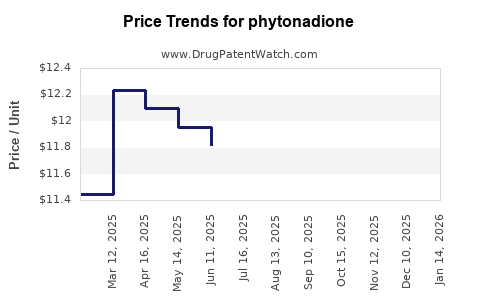
Pricing is stable in the U.S., with slight reductions seen in Europe due to increased generic competition. In emerging markets, prices are generally lower but face quality and supply chain challenges.
What regulatory and supply chain factors impact the market?
Regulatory bodies such as the FDA and EMA approve formulations mainly as sterile injectables and tablets. European and U.S. approvals are well-established; however, recent years have seen increased regulatory scrutiny on manufacturing standards, which can impact supply and pricing.
Global supply chains are sensitive to geopolitical issues and raw material availability. Cyanobacteria-derived vitamin K is a key raw material; shortages can restrict supply.
What are the projections for future pricing?
Price projections indicate marginal declines over the next five years, primarily due to increased generic competition and manufacturing efficiencies.
| Year |
Injectable Price (USD per dose) |
Oral Price (USD per tablet) |
| 2023 |
$10–$25 |
$0.50–$1.50 |
| 2025 |
$9–$23 |
$0.45–$1.40 |
| 2030 |
$8–$20 |
$0.40–$1.20 |
Expected market consolidation and supply chain improvements could further compress prices.
What are the key market drivers and challenges?
Drivers:
- Rising incidence of bleeding disorders and surgeries.
- Increased awareness and usage of vitamin K for anticoagulant reversal.
- Growing demand in Asia-Pacific due to expanding healthcare infrastructure.
Challenges:
- Price competition from generics reduces profit margins.
- Stringent manufacturing and quality standards may increase costs.
- Fluctuations in raw material availability impact supply stability.
Key Takeaways
- The global phytonadione market is valued at USD 250 million, with steady growth projected.
- North America and Europe command the majority share, with Asia-Pacific experiencing rapid growth.
- Prices are stabilizing, with slight declines expected due to increased generics.
- Market growth depends on demand for anticoagulation reversal and bleeding management.
- Regulatory standards and raw material supply chains influence pricing and availability.
FAQs
1. What are the main formulations of phytonadione?
Injectable (10 mg/mL) and oral tablets (2.5 mg) are the primary formulations.
2. How does patent expiration affect market pricing?
Patent expirations lead to generic competition, reducing prices and increasing market accessibility.
3. What regions are expected to see the highest growth?
Asia-Pacific is projected to experience the fastest growth due to expanding healthcare infrastructure.
4. Are there supply chain risks for phytonadione?
Yes; dependencies on raw materials like cyanobacteria-derived vitamin K can cause shortages.
5. What factors could alter future price trends?
Regulatory changes, raw material costs, and market consolidation could significantly impact prices.
References
[1] MarketandMarkets. (2023). "Vitamin K Market by Type, Application, and Region – Global Forecast to 2030." Retrieved from https://www.marketsandmarkets.com