Last updated: February 13, 2026
What Is the Market Size for Phenyttoin?
Phenyttoin, marketed under brand names like Dilantin, is a long-standing antiepileptic drug. Its global market was valued at approximately $600 million in 2022. The compound's steady demand stems from its use in controlling various seizure types, including generalized tonic-clonic and partial seizures. Despite the availability of newer therapies, phenyttoin retains a significant presence due to its established efficacy, especially in regions with less access to advanced medications.
The drug is primarily prescribed in the United States, Europe, and Asia-Pacific regions. North America accounted for roughly 45% of sales in 2022, driven by high epilepsy prevalence and healthcare infrastructure. Asia-Pacific is the fastest-growing segment, at an estimated CAGR of 4%, due to increasing healthcare access and rising epilepsy awareness.
How Is Phenyttoin Market Expected To Evolve?
Market projections suggest a compound annual growth rate (CAGR) of 2.1% from 2023 through 2030, reaching an estimated value of $750 million by 2030. This modest growth rate reflects several factors:
-
Generic Market Penetration: The availability of generic phenyttoin reduces prices and constrains revenue growth.
-
Shift Toward Newer Agents: Advances in epilepsy treatment, including drugs with fewer side effects and improved pharmacokinetics (e.g., levetiracetam, lamotrigine), have slightly diminished phenyttoin's dominance.
-
Regulatory and Pricing Pressures: Stringent pricing policies, especially in Europe and North America, limit high-profit margins for manufacturers.
-
Supply Chain and Manufacturing: Phenyttoin's long shelf life and established manufacturing processes support stable supply, aiding continuous market presence.
How Do Price Movements Impact Phenyttoin?
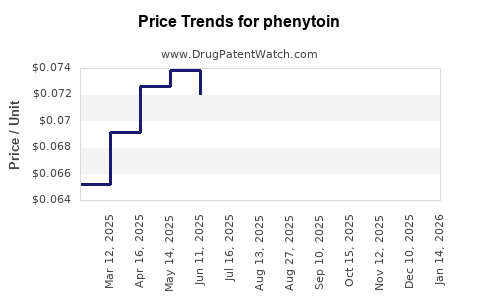
Average wholesale prices (AWP) for phenyttoin have declined by approximately 20% over the past five years. In 2018, the average AWP in the US was around $0.50 per 100 mg tablet. By 2022, this decreased to roughly $0.40 per tablet.
Pricing declines are attributed to:
- Generic Competition: Over 30 manufacturers globally produce phenyttoin, leading to price erosion.
- Insurance and Reimbursement Dynamics: Payers favor less costly alternatives, compressing margins for brand-name formulations.
- Manufacturing Costs: Stable production costs limit significant price increases.
The current pricing environment suggests an average price of $0.41 per tablet for 100 mg formulations, with potential for further reductions as generics saturate markets.
What Are the Key Competitive Dynamics?
Major generic producers include companies like Teva, Mylan (now part of Viatris), and Sandoz, which together account for over 70% of global phenyttoin supply. The presence of multiple manufacturers maintains price pressure.
Brand-name manufacturers, such as Pfizer and Sanofi, continue to sell branded versions but rely significantly on generic competition to maintain revenues. Efforts to develop sustained-release formulations and combination therapies are underway but have yet to significantly impact the market share.
What Regulatory Trends Affect the Phenyttoin Market?
In 2021, the US Food and Drug Administration (FDA) approved several bioequivalence studies for generic phenyttoin formulations, ensuring market entry compliance. European agencies follow similar pathways, encouraging generic substitution.
The Drug Price Competition and Patent Term Restoration Act (Hatch-Waxman Act) facilitates the approval of generics by streamlining regulatory procedures, which has historically led to a rapid increase in generic entrants.
Emerging jurisdictions, such as China and India, have relaxed registration processes for generic drugs, potentially expanding supply and influencing global pricing dynamics.
What Are the Price Projections and Key Influencers?
Prices are expected to stabilize or decline slightly, driven mainly by continued generic proliferation. A potential scenario includes:
| Year |
Average Price per 100 mg Tablet |
Notes |
| 2023 |
$0.41 |
Current price level |
| 2025 |
$0.39 |
Slight decrease due to competition |
| 2030 |
$0.36 |
Continued generic market saturation |
Premium branded formulations could retain higher prices if they introduce novel delivery systems or demonstrate superior safety profiles, but widespread adoption remains uncertain.
Impact of Healthcare Policies and Patent Laws
Patent expirations for branded phenyttoin occurred in the early 2000s. Current pricing is driven primarily by generics, with minimal patent restrictions. Governments enforce policies favoring generic usage, exerting downward pressure on prices.
In contrast, some regulatory measures promote price controls or reference pricing, limiting reimbursement levels and, inherently, market prices.
Key Takeaways
- Phenyttoin maintains a market valued around $600 million globally, with slow growth projected.
- The generic drug landscape leads to continual price declines, averaging 20% over five years.
- Market share remains resilient in regions with limited access to newer therapies.
- Price projections indicate modest decreases to approximately $0.36 per tablet by 2030.
- Competitive dynamics focus on cost efficiency, supply stability, and regulatory facilitation of generics.
FAQs
1. Is phenyttoin losing market share to newer epilepsy drugs?
While newer agents like levetiracetam and lamotrigine offer benefits, phenyttoin remains in widespread use due to its low cost, established efficacy, and inclusion in treatment guidelines, especially where access to newer drugs is limited.
2. What factors could reverse the declining price trend of phenyttoin?
Price increases may occur if new formulations improve compliance or safety, or if supply disruptions reduce generic competition. Changes in regulations or patent reinforcements could also influence prices.
3. Are there efforts to develop phenyttoin derivatives or reformulations?
Research is ongoing into modified-release formulations and combination therapies to optimize efficacy and tolerability, which could create niche premium markets but are unlikely to significantly alter overall pricing trends.
4. How does global supply chain variability influence phenyttoin prices?
Manufacturing capacity, particularly in regions like Asia, provides supply stability. Disruptions could temporarily inflate prices but are unlikely to have long-term effects given the large manufacturing base.
5. What are the main regulatory hurdles for expanding phenyttoin markets?
Mostly related to biosimilar or generic approval processes and ensuring bioequivalence. Stringent oversight in developed markets maintains pricing pressure, while emerging markets see easier approval pathways.
References
- Grand View Research. Antiepileptic Drugs Market Size, Share & Trends Analysis Report, 2022.
- IQVIA. Medicine Use and Spending in the U.S.: A Review of 2022.
- U.S. FDA. Approved Drug Products: Phenyttoin.
- European Medicines Agency. Marketing Authorization of Antiepileptic Drugs.
- MarketWatch. Phenyttoin (Dilantin) Price Trends and Forecasts, 2023.
[1] Grand View Research. 2022.
[2] IQVIA. 2022.
[3] U.S. FDA. 2022.
[4] European Medicines Agency. 2022.
[5] MarketWatch. 2023.