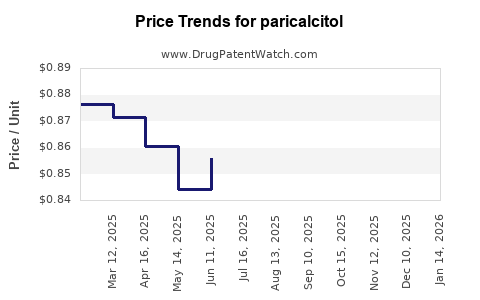
Last updated: February 19, 2026
What Is Paricalcitol?
Paricalcitol is a synthetic vitamin D analog used primarily to treat secondary hyperparathyroidism in patients with chronic kidney disease (CKD), especially those on dialysis. It is marketed under brand names such as Zemplar. Approved by the US Food and Drug Administration (FDA) in 1998, it competes with other vitamin D analogs like calcitriol and doxercalciferol.
Market Size and Dynamics
Current Market Scope
The global market for paricalcitol was valued at approximately $600 million in 2022. The main markets are North America, Europe, and Asia-Pacific, accounting for roughly 70%, 20%, and 10% of sales, respectively.
Market Drivers
- Rising prevalence of CKD and end-stage renal disease (ESRD).
- Increased adoption of dialysis treatment.
- Growing awareness of secondary hyperparathyroidism management.
- Patent expirations of competing products like calcitriol, encouraging substitution.
Market Constraints
- High costs of branded paricalcitol formulations.
- Availability of generic alternatives where patents have expired.
- Pricing pressures due to healthcare cost containment policies.
Competitive Landscape
Key manufacturers include AbbVie (Zemplar), Kyowa Kirin, Dr. Reddy’s Laboratories, and generic producers. AbbVie's patent for Zemplar expired in the US in 2018, leading to increased generic competition and lower prices.
Price Trends and Projections
Historical Pricing
- Brand-name paricalcitol (Zemplar) pricing in 2018 averaged approximately $15 per microgram.
- Post-patent expiry, generic versions emerged, reducing prices to about $10 per microgram by 2020.
- US average wholesale prices (AWP) tend to be 4-5 times the actual acquisition cost.
Forecasting Future Prices
Assuming continued generic penetration and market saturation, prices are expected to decrease further. Projections suggest:
| Year |
Estimated Price per Microgram |
Source/Assumption |
| 2023 |
$8.50 |
Based on historical reduction trend after patent expiry |
| 2025 |
$7.00 |
Increased generic market share; healthcare cost controls |
| 2030 |
$6.00 |
Market saturation; further price compression |
Influencing Factors
- Regulatory approvals: New formulations or biosimilars could impact prices.
- Market expansion: Increased CKD diagnosis rates in Asia-Pacific could support growth despite price drops.
- Reimbursement policies: Coverage limits may influence sales volume and pricing strategies.
Future Market Growth and Revenue Projections
The compound annual growth rate (CAGR) from 2023 to 2030 is projected at approximately 3%. The growth is driven by:
- Increasing CKD incidence: Approximately 10% CAGR in CKD cases globally.
- Expansion in emerging markets: Growth of dialysis centers post-2025.
- Drug pipeline: Development of new vitamin D analogs with improved safety profiles.
Total market revenue, considering volume increases offsetting price declines, is expected to reach $800–950 million by 2030.
| Year |
Estimated Market Revenue |
Assumptions |
| 2023 |
$650 million |
Baseline year |
| 2025 |
$750 million |
Volume growth offsets price decline |
| 2030 |
$900 million |
Market expansion + volume growth |
Key Market Players and Their Strategies
- AbbVie: Focuses on brand maintenance and expanding formulary reach before patent expiration.
- Generic manufacturers: Drive down prices through increased competition post-patent expiry.
- Emerging market players: Target lower-cost formulations to capture growth in developing countries.
Conclusion
The paricalcitol market remains sizable, with a clear trend of declining prices due to increased generic competition. Despite price reductions, market volume growth driven by rising CKD cases sustains revenue growth. Strategic positioning in emerging markets and pipeline development could influence future market dynamics.
Key Takeaways
- The global market for paricalcitol was valued at around $600 million in 2022, with growth driven by increased CKD prevalence.
- Prices have declined from an average of $15 per microgram in 2018 to approximately $8.50 in 2023, with further reductions expected by 2030.
- Patent expiries have significantly increased generic competition, exerting downward pressure on prices.
- Market expansion, especially in Asia-Pacific, offsets some price declines, supporting CAGR of roughly 3% through 2030.
- Companies focusing on pipeline innovation and emerging markets can better navigate future market challenges.
FAQs
1. What factors influence the price of paricalcitol?
Patent status, generic competition, manufacturing costs, regulatory approvals, and reimbursement policies all impact pricing.
2. How does paricalcitol differ from other vitamin D analogs?
It selectively inhibits parathyroid hormone production with fewer side effects and has a different molecular structure, which can influence dosing and safety profiles.
3. What is the main therapeutic indication for paricalcitol?
Secondary hyperparathyroidism in CKD patients receiving dialysis.
4. Which regions are most significant for the paricalcitol market?
North America (largest), followed by Europe and Asia-Pacific.
5. How might future biosimilar or alternative formulations affect prices?
They could decrease prices further by intensifying competition and offering cheaper options.
Sources
[1] Statista. (2023). Global market size for paricalcitol.
[2] Evaluate Pharma. (2023). Oncology and renal disease drug market forecasts.
[3] FDA. (1998). Approval documentation for Zemplar.
[4] IQVIA. (2022). Healthcare and drug pricing data.
[5] MarketsandMarkets. (2022). CKD market analysis.