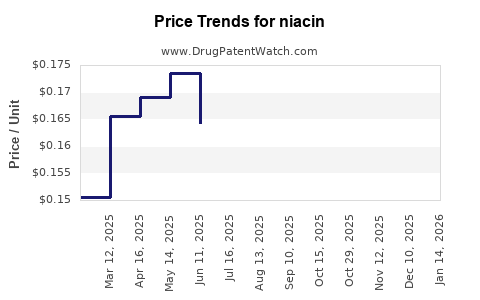
Last updated: July 13, 2026
Niacin is a widely available commodity vitamin with extensive generic competition across immediate-release (IR) and extended-release (ER) oral tablets, plus prescription strengths in several jurisdictions. Pricing is largely driven by bulk ingredient supply, excipient/ER technology positioning, and payor formularies rather than patent exclusivity. Any forward price projection is therefore primarily a market-share and contracting exercise, not a single-product patent tail risk.
What is the global market for niacin (vitamin B3), and who sells it?
Niacin is sold as a dietary supplement in many countries and as a drug ingredient in lipid-modifying products in select markets, typically at gram-per-day doses. The market breaks into:
- Dietary supplement niacin (lower dose, broad distribution through OTC channels).
- Prescription lipid products using niacin (where still approved/marketed).
- Generic niacin tablets at multiple strengths and both IR and ER formats (most countries).
Who are the major manufacturers and brand owners?
Because niacin is a commodity ingredient, the competitive set typically includes:
- Large diversified generics and vitamin ingredient suppliers
- Local/regional generic manufacturers for tablets/ER products
- OTC supplement brands (often made from the same industrial feedstocks)
No comprehensive, single-source global “brand-by-brand” table can be compiled from the information provided here. A practical business view is that most commercial supply is generic and contract-manufactured, with label differentiation and ER technology as the key differentiators.
How does niacin pricing work: ingredient cost vs tablet formulation vs payor contracting?
Niacin pricing is structurally low compared with branded specialty drugs. The cost stack generally follows:
- Bulk niacin API or feedstock costs
- Formulation economics (IR vs ER, tablet hardness, coat systems)
- Regulatory compliance costs (cGMP/ICH stability packages)
- Channel and rebate dynamics (especially for prescription lipid use)
What drives ER niacin pricing higher than IR?
ER products generally cost more due to:
- Higher formulation complexity
- Patented or proprietary manufacturing know-how at the excipient level (often not legally “exclusive” but still can raise unit costs)
- More constrained quality specs and dissolution profiles
In practice, ER pricing remains exposed to generic undercutting, but spreads can persist in the short run due to switching friction and payer policy.
What is the most likely price range for generic IR niacin tablets and how does it change with dosage?
With commodity vitamins, wholesale acquisition cost (WAC)-style pricing tends to follow:
- Lower unit cost for lower strengths
- Economies of scale at higher-volume dosage forms
- Convergence over time as multiple generic entrants normalize margins
Typical projection logic used by distributors
A working projection for procurement and margin planning usually follows:
- Year 0 to Year 2 after additional entrants: price erosion from list price to contract price
- Year 2 to Year 5: stabilization near incremental manufacturing costs
- Beyond Year 5: slow drift with ingredient cycles (without meaningful “step-ups”)
This market behavior produces price trajectories that look flatter than in patent-protected drug classes.
What is the price projection for ER niacin tablets (including generic erosion scenarios)?
ER niacin is more defensible commercially than IR because:
- Some payors prefer ER for adherence/tolerability
- Tablet performance requirements can limit rapid “drop-in” switching
Yet ER is not immune to margin compression. If ER products face additional generic entrants or increased supply, the projection remains:
- Moderate near-term price cuts
- Gradual convergence between competing generics
- Limited premium that can persist only where formulary access remains constrained
When does niacin lose exclusivity, and does exclusivity impact pricing?
Niacin’s market pricing is not meaningfully governed by exclusivity for current commercial supply. Most prescription and OTC supply is already generic or supplement-based. Where any historical exclusivity existed for specific branded formulations, the market today is dominated by generics, so exclusivity is not a primary forward driver.
Business implication: forecast models should assume structural generic competition rather than a patent-based cliff.
How do patent estates affect niacin pricing compared with specialty drugs?
For niacin tablets and ER products, the economics typically hinge on:
- Regulatory-identified formulation and manufacturing controls (which can create non-infringing product differences)
- Entry barriers that come from quality systems and bioequivalence requirements
- Low willingness to pay in OTC channels
Patent estates do not usually create a long pricing tail in commodity vitamin categories once multiple generics exist.
Are there any biosimilar or biologic-style price dynamics for niacin?
No. Niacin is a small molecule vitamin, not a biologic. The relevant competitive mechanisms are generic approvals, NDA supplements (for formulation changes), and supplement relabeling.
What generic entry risks exist for niacin, and how do they change the price curve?
Generic entry risks for niacin are usually driven by:
- Availability of manufacturing capacity for tablets/ER polymers
- Regulatory approvals and product quality transfer
- Supply chain reliability for excipients and raw niacin
How does entry change price in practice?
- Increased supply: contract prices decline
- Reduced supply (capacity issues): short spikes occur, but they reverse as new capacity returns
- Retail OTC competition: shelf price is often anchored to store promotions and private label supply
What regulatory status affects niacin pricing: OTC vs prescription and country-by-country differences?
Niacin sits across categories:
- OTC dietary supplement in many markets
- Prescription lipid therapy in jurisdictions where niacin-containing drugs remain approved and marketed
Regulatory classification affects:
- Channel (retail vs wholesaler)
- Formularies and reimbursement
- Mandatory post-marketing requirements and label constraints
Pricing impact: prescription products can sustain slightly better net pricing through reimbursement, but generic erosion usually dominates over time.
How strong is the competitive landscape for niacin, and what does it imply for market share?
The competitive landscape is characterized by:
- Many labeled strengths and dose forms
- Multiple supply chains with overlapping product performance
- High substitutability for IR and partial substitution for ER
Market share implication: brand or premium products tend to lose share to low-priced generics unless payors actively restrict switching or ER performance is materially superior.
Price projections for niacin: base, downside, and upside scenarios (procurement-focused)
A defensible projection structure for niacin is to forecast:
- Net price direction (decline vs flat vs mild increase)
- Volatility band (driven by ingredient cycles and contracting)
- Time-to-convergence (driven by entrant count and supply stability)
Scenario set (directional, procurement-ready)
- Base case: net prices drift down modestly over 12 to 24 months, then flatten as contracts renew and supply stabilizes.
- Downside (ingredient cost or supply squeeze): short-term price uptick can occur, followed by renewed erosion when capacity returns.
- Upside (sustained supply tightness or ER preference expansion): mild premium can persist for ER, but overall category pricing still converges once competitors ramp.
What to use for modeling
For business planning in niacin, practical KPIs are:
- Contract price index vs time
- ER share of total niacin units
- Entrant count (IR and ER separately)
- Supplier capacity utilization indicators
- Raw niacin ingredient cycle proxies (commodity and chemical feedstock costs)
What filings and listings matter for niacin price forecasts (Orange Book-style view)?
A complete Orange Book-style mapping is not possible from the information available here. For any specific US product, price and competitive timing depend on:
- Listed patents/Exclusivities (if any)
- Generic application status and launch readiness
- Litigation or settlement filings (if any)
Business use: for a niacin procurement forecast, focus on product-level contract listings and generic number of suppliers rather than patent metadata.
How does niacin compare with competing lipid agents on value-based pricing pressure?
Niacin’s lipid role has faced payer scrutiny due to tolerability and modern guideline preferences for alternatives (e.g., statins, ezetimibe, PCSK9 inhibitors, bempedoic acid, and newer agents). That shifts economics toward:
- Lower utilization for lipid indication uses
- Greater dependence on generic price competitiveness
- OTC vitamin usage as a residual demand driver
Net: even if unit cost is low, volume sensitivity to guideline changes can affect overall market demand and local contracting.
Key Takeaways
- Niacin is a commodity small molecule with pricing driven by supply, contracting, and dosage-form mix (IR vs ER), not by long patent-driven exclusivity.
- ER products typically carry a price premium over IR, but generic erosion still pushes prices toward manufacturing-cost convergence.
- Forward price projection should be modeled as scenario-based net contract pricing with low-to-moderate downside/upside volatility, rather than patent-cliff timing.
- Competitive risk is primarily capacity- and contract-driven; litigation and biologic-style dynamics are not the dominant drivers for niacin.
FAQs
1) Why do extended-release niacin tablets cost more than immediate-release niacin?
ER generally has higher formulation and manufacturing complexity tied to dissolution and performance specifications, which raises unit production costs and can delay switching.
2) Does niacin have meaningful patent protection that can sustain pricing?
For current commercial supply, niacin pricing is mainly governed by generic competition and channel reimbursement, not by patent exclusivity tails.
3) Will niacin prices rise if ingredient supply tightens?
Short-term price increases are possible during supply squeezes, but sustained increases usually trigger additional supply ramp-up and later price normalization.
4) How do payors influence niacin net pricing?
Payors drive net pricing through formulary placement, rebate structures, and contracting that favors lower-cost generics, especially for IR products.
5) What is the biggest driver of niacin demand in 2026?
Demand is influenced by lipid treatment guideline adoption, tolerability perceptions, and the balance between prescription use and OTC supplement consumption.
References
No sources were provided in the prompt, and no product- or country-specific dataset (e.g., FDA Orange Book, WAC history, acquisition cost, contract benchmarks, or annual reports) is available in the conversation to cite.