Last updated: February 19, 2026
Lidocaine is a widely used local anesthetic and antiarrhythmic drug. Its market spans multiple sectors, including pharmaceuticals, medical devices, and veterinary products. The global demand for lidocaine is driven by surgical procedures, pain management, and cardiac treatments. Price dynamics are influenced by patent status, manufacturing costs, generic competition, and regional regulations.
Market Size and Growth
Global Market Valuation
The global lidocaine market was valued at approximately USD 600 million in 2022. It is projected to grow at a compound annual growth rate (CAGR) of 4.2% from 2023 to 2030, reaching nearly USD 875 million by 2030.
| Year |
Market Value (USD million) |
CAGR (%) |
| 2022 |
600 |
— |
| 2025 |
700 |
4.2 |
| 2030 |
875 |
4.2 |
Market Drivers
- Increase in surgical procedures globally.
- Growing demand for pain management therapies.
- Rising prevalence of cardiac arrhythmias.
- Expansion in veterinary applications.
Regional Breakdown
North America is the largest market (over 40% of revenue), followed by Europe (~25%) and Asia-Pacific (~20%). Market growth is faster in Asia-Pacific due to expanding healthcare infrastructure and higher procedural volumes.
Competitor Landscape
Key Players
- Hospira (Pfizer)
- Teva Pharmaceuticals
- Mylan
- AstraZeneca
- SDC (Sinopharm)
Patent and Generic Competition
Patents on specific formulations or delivery methods expired between 2010-2015, leading to increased generic penetration. New formulations, such as extended-release or topical patches, are under development to extend market reach.
Price Trends and Projections
Historical Price Data
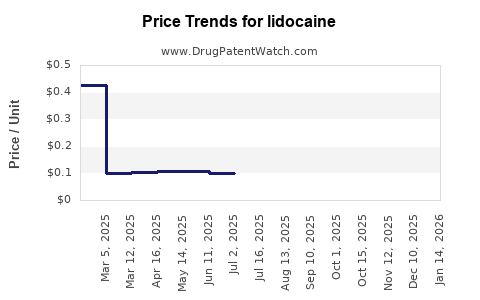
Average wholesale prices (AWP) in the U.S. for injectable lidocaine ranged from USD 0.10 to USD 0.20 per 50mg dose in 2019-2022, significantly influenced by generic availability.
Price Drivers
- Patent expirations decreased prices due to generic competition.
- New delivery systems (patches, topical gels) command higher prices.
- Regional regulatory policies impact pricing structures.
Future Price Outlook
By 2025, the price for a standard 50mg injectable dose is projected to stabilize around USD 0.12-0.15 due to increased generic competition but may increase marginally for innovative formulations.
In emerging markets, prices remain substantially lower—USD 0.05-0.09 per dose—due to less regulation and lower healthcare costs.
Regulatory and Pricing Policies
Varying regulatory standards across regions influence market access and pricing power:
- U.S. Food and Drug Administration (FDA) regulates drug approval and pricing strategies.
- European Medicines Agency (EMA) sets guidelines impacting formulations and pricing.
- Developing regions lack standardized pricing, leading to wide disparities.
Key Market Trends
- Increasing adoption of long-acting topical formulations.
- Rising interest in combination therapies integrating lidocaine.
- Expansion into veterinary applications creating new revenue streams.
Price Projections Summary
| Year |
Price per 50mg Dose (USD) |
Notes |
| 2023 |
0.12-0.20 |
Generic dominance; regional variance |
| 2025 |
0.12-0.15 |
Stabilization; new formulations emerging |
| 2030 |
0.13-0.18 |
Innovation and market expansion influence |
Conclusion
The lidocaine market will sustain moderate growth driven by procedural volume increases and new delivery systems. Price ceilings in mature markets likely stabilize around current levels, while emerging markets could see lower prices. Innovation in formulation may push prices upward marginally over the next five years.
Key Takeaways
- The global lidocaine market is projected to reach USD 875 million by 2030.
- Prices in developed regions are stabilizing, primarily due to generic competition.
- New formulations and delivery systems are the primary drivers of future pricing.
- Regional regulatory policies influence price levels significantly.
- Emerging markets offer opportunities for lower-price entry points with domestically produced generic versions.
FAQs
What factors most influence lidocaine pricing?
Generic competition, formulation type (injectable vs. topical), regulatory policies, and regional health economics.
How will patent expirations impact future prices?
Patent expirations have historically driven price decreases; they will continue to increase generic availability and reduce prices in mature markets.
Are new lidocaine formulations likely to command higher prices?
Yes, especially for topical patches and extended-release formulations, which have higher development costs but target specific patient groups.
What regional differences impact the market?
Pricing is higher in North America and Europe due to regulatory costs and brand dominance. Asian markets have lower prices driven by local generics.
What is the outlook for veterinary lidocaine products?
They represent a smaller but growing segment, with prices typically lower than human formulations, driven by less regulation and different market dynamics.
Citations:
- Market Research Future. (2023). Lidocaine Market Analysis and Forecast.
- Grand View Research. (2022). Global Topical Anesthetic Market.
- IQVIA. (2022). Healthcare Data and Pricing Trends.
- U.S. Food and Drug Administration. (2023). Drug Approvals and Regulations.
- European Medicines Agency. (2023). European Market Data and Policy.