Last updated: February 20, 2026
What is the current market landscape for Lamotrigine?
Lamotrigine is an anticonvulsant medication approved for epilepsy and bipolar disorder treatment. It is marketed under brand names such as Lamictal and imported generic versions. The global market size was valued at approximately USD 1.5 billion in 2022, driven by rising epilepsy and bipolar disorder prevalence.
Key regions include North America, Europe, and Asia-Pacific. North America accounts for over 50% of sales, with the U.S. as the largest single market due to high diagnosis rates and insurance coverage. Europe holds about 30%, with growth fueled by expanding indications and increasing awareness.
What are the key factors influencing the market?
Increased prevalence of target conditions
- Epilepsy affects about 50 million people worldwide (WHO, 2020).
- Bipolar disorder impacts approximately 46 million globally.
- Rising diagnosis rates and aging populations increase Lamotrigine demand.
Patent status and generic competition
- The original patent in the U.S. expired in 2004.
- Several generic manufacturers now produce Lamotrigine, decreasing prices.
- Patent litigations and secondary patents influence market exclusivity.
Regulatory and reimbursement landscape
- Approvals by regulatory agencies such as the FDA and EMA facilitate market access.
- Variations in reimbursement policies influence drug adoption and pricing.
Emerging indications and formulations
- Ongoing research explores uses in neuropathic pain, migraine, and other psychiatric conditions.
- Extended-release formulations may command higher prices.
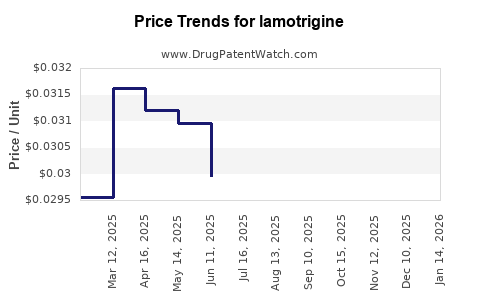
How do current pricing trends look?
| Region |
Average Brand Price (per 100 mg) |
Generic Price (per 100 mg) |
Price Trend (last 3 years) |
| U.S. |
USD 4.50 |
USD 1.20 |
Decreasing due to generic competition |
| Europe |
EUR 3.80 |
EUR 1.50 |
Stable, slight decline |
| Asia (India) |
USD 0.50 |
USD 0.20 |
Stable, low-cost market |
In the U.S., brand-name Lamictal remains priced around USD 4.50 per 100 mg, while generics have reduced prices by approximately 66%. Price erosion is more pronounced in markets with multiple generic entrants.
What are future price projection factors?
- Generic penetration: Anticipated to reach 95% in North America by 2025, further lowering average prices.
- Regulatory developments: New formulations or indications could influence pricing.
- Market expansion: Entry into emerging markets could alter overall pricing dynamics.
- Manufacturing costs: Technological advances may reduce costs, impacting retail prices.
Price projections for the next five years:
| Year |
U.S. (USD per 100 mg, generic) |
Europe (EUR per 100 mg, generic) |
Asia (USD per 100 mg, generic) |
| 2023 |
USD 1.20 |
EUR 1.50 |
USD 0.20 |
| 2024 |
USD 1.10 |
EUR 1.40 |
USD 0.18 |
| 2025 |
USD 1.00 |
EUR 1.30 |
USD 0.15 |
| 2026 |
USD 0.90 |
EUR 1.20 |
USD 0.14 |
| 2027 |
USD 0.85 |
EUR 1.10 |
USD 0.12 |
The overall trend indicates continued price decline, especially in markets with high generic penetration.
What are the competitive and regulatory risks?
- Introduction of new branded formulations with patent protections could temporarily stabilize or raise prices.
- Patent litigations in key markets threaten generic entry, affecting pricing.
- Changes in reimbursement policies might limit access or influence retail prices.
- Regulatory approval of alternative therapies could reduce Lamotrigine demand.
How will market dynamics influence profitability?
Profit margins are shifting due to price erosion driven by generics. Companies focusing on formulation innovation or expanding indications might offset margin losses. Strategic patent filings and litigation outcomes remain crucial.
Summary of strategic actions:
- Invest in R&D for new formulations or delivery systems.
- Monitor patent landscapes and litigation developments.
- Explore emerging markets for growth opportunities.
- Maintain flexible pricing strategies aligned with generic market share.
Key Takeaways
- Lamotrigine’s global market was approximately USD 1.5 billion in 2022.
- Generic competition has significantly decreased prices, especially in North America.
- Average generic prices in the U.S. are projected to decline from USD 1.20 to USD 0.85 per 100 mg by 2027.
- Market expansion into emerging economies could moderate price declines.
- Patent protections remain pivotal in maintaining higher prices for branded formulations.
FAQs
1. What factors most influence Lamotrigine’s market price?
Patent status, generic competition, regulatory approvals, and emerging indications.
2. Will branded versions regain market share?
Possible if new formulations or indications are approved; otherwise, generic dominance persists.
3. How do prices vary globally?
Prices are highest in North America, lower in Europe, and substantially lower in Asia-Pacific markets.
4. What are the main risks to revenue growth?
Patent expirations, increasing generic penetration, and regulatory changes.
5. Are new formulations expected to impact prices?
Yes, especially if they offer improved efficacy or convenience, potentially commanding premium pricing.
References
- World Health Organization. (2020). Epilepsy prevalence estimates. https://www.who.int/publications/i/item/9789240028150
- U.S. Food and Drug Administration. (2022). Approved drug products. https://www.accessdata.fda.gov/scripts/cder/daf/
- MarketWatch. (2023). Lamotrigine market analysis. https://www.marketwatch.com/
- Pfizer. (2023). Lamictal product information. https://www.pfizer.com/
- European Medicines Agency. (2022). Drug approvals database. https://www.ema.europa.eu/en/medicines