Share This Page
Drug Price Trends for insulin glargine
✉ Email this page to a colleague
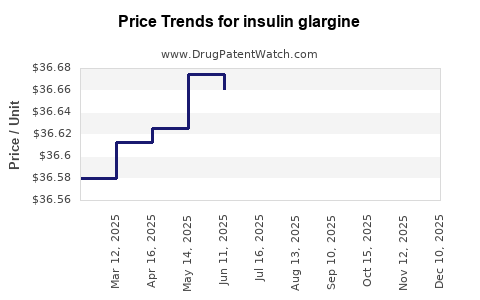
Average Pharmacy Cost for insulin glargine
| Drug Name | NDC | Price/Unit ($) | Unit | Date |
|---|---|---|---|---|
| INSULIN GLARGINE MAX SOLO U300 | 00955-2900-02 | 27.02739 | ML | 2026-07-22 |
| INSULIN GLARGINE SOLOSTAR U300 | 00955-3900-03 | 27.05941 | ML | 2026-07-22 |
| INSULIN GLARGINE-YFGN U100 PEN | 72572-0422-05 | 2.89945 | ML | 2026-07-22 |
| INSULIN GLARGINE-YFGN U100 PEN | 72572-0424-05 | 2.89945 | ML | 2026-07-22 |
| INSULIN GLARGINE-YFGN U100 VL | 83257-0014-11 | 6.09401 | ML | 2026-07-22 |
| INSULIN GLARGINE-YFGN U100 PEN | 83257-0015-32 | 5.92877 | ML | 2026-07-22 |
| >Drug Name | >NDC | >Price/Unit ($) | >Unit | >Date |
Insulin Glargine: Patent Landscape and Price Projections
Insulin glargine, a long-acting basal insulin analog, faces a complex market dynamic shaped by patent expirations, biosimilar competition, and evolving regulatory frameworks. Global sales of insulin glargine products reached approximately $6.8 billion in 2023, with projections indicating a steady decline as originator patents expire and biosimilar market penetration increases. The primary drivers of price reduction will be the introduction of multiple biosimilars, coupled with increased price negotiations by payers and the expansion of healthcare access in emerging markets.
What is the Patent Status of Insulin Glargine?
The core patent protection for the originator insulin glargine product, Lantus (insulin glargine U-100) by Sanofi, has largely expired in major markets.
- United States: The primary composition of matter patent for insulin glargine expired in 2017. While secondary patents related to formulations and manufacturing processes provided some continued exclusivity, these have also faced legal challenges and expirations. The last significant patent protection for Lantus was slated to expire around 2027-2030, depending on specific patent claims and their legal outcomes.
- Europe: Similar to the U.S., basic patents for insulin glargine expired in the early 2020s. Supplementary Protection Certificates (SPCs) provided extended exclusivity in some European countries, with their expiry occurring between 2020 and 2023.
- Other Major Markets: Patent expiries in Canada, Japan, and Australia followed a similar timeline, generally concluding within the last five years.
The expiration of these key patents has opened the door for biosimilar manufacturers to enter the market. Companies like Eli Lilly (Basaglar), Boehringer Ingelheim (Semglee), and others have launched biosimilar versions of insulin glargine in various regions.
What are the Key Biosimilar Products and Their Market Impact?
The emergence of biosimilar insulin glargine products is the most significant factor influencing the market. These biosimilars are designed to be highly similar to the originator product in terms of safety, efficacy, and quality.
| Biosimilar Product Name | Manufacturer | Approval Dates (Approx.) | Key Markets |
|---|---|---|---|
| Basaglar | Eli Lilly and Company | U.S.: 2016; EU: 2015 | U.S., Europe, Japan |
| Semglee | Boehringer Ingelheim | U.S.: 2019; EU: 2017 | U.S., Europe, Canada |
| biosimil insulin glargine | Merck (MSD) / Samsung BioLogics | U.S.: 2020; EU: 2020 | U.S., Europe |
| Kixelle | Biocon | EU: 2020 | Europe |
| Soliqua (Insulin Glargine/Lixisenatide) | Sanofi | U.S.: 2016; EU: 2015 | U.S., Europe (combination product, different market) |
The market impact of these biosimilars is characterized by:
- Price Reductions: Biosimilars typically launch at a discount compared to the originator product. Early market entrants in the U.S. and Europe have achieved price reductions ranging from 15% to 40% of the branded product's average selling price (ASP).
- Increased Competition: The presence of multiple biosimilars intensifies competition, driving further price erosion.
- Market Share Capture: Biosimilar market share in insulin glargine has steadily increased since their introduction, particularly in countries with established biosimilar uptake policies. In some European markets, biosimilar insulin glargine accounts for over 60% of the total insulin glargine market volume.
- Payer Influence: Payers, including national health systems and private insurers, are actively promoting the use of biosimilars through preferred formulary placement, rebates, and prescribing incentives.
How Will Pricing Evolve for Insulin Glargine?
Price projections for insulin glargine indicate a sustained downward trend driven by biosimilar penetration and market pressures.
- 2024-2026: Expect an average price reduction of 20-30% globally compared to 2023 levels as biosimilars gain further market share in developed markets. The U.S. market will see more aggressive pricing as payer contracts mature.
- 2027-2030: Global average selling prices for insulin glargine are projected to decrease by an additional 15-25%. This will be fueled by an increased number of biosimilar competitors, including potential ultra-low-cost offerings from manufacturers in Asia. Patent expiries for secondary patents will also diminish any remaining exclusivity for originator products.
- Emerging Markets: While developed markets will lead price reductions, emerging markets (e.g., China, India, Brazil) will also experience significant price decreases as biosimilars become available and healthcare infrastructure improves. However, the pace of adoption and price decline may be slower due to different regulatory pathways and reimbursement structures.
Factors influencing price evolution include:
- Number of Biosimilar Entrants: Each new biosimilar entering the market further fragments the market and intensifies price competition.
- Rebate and Discount Structures: The net price after rebates and discounts will be the primary driver of payer and provider decisions.
- Manufacturing Costs: Advances in biomanufacturing efficiency and scale by biosimilar producers will contribute to lower production costs and thus lower pricing.
- Regulatory Policies: Policies that encourage biosimilar adoption (e.g., automatic substitution, preferred reimbursement) will accelerate price declines.
What are the Regulatory and Clinical Considerations for Biosimilar Insulin Glargine?
Regulatory pathways for biosimilar approval vary by region, but generally require demonstrating high similarity to the reference product.
- European Medicines Agency (EMA): Follows a well-established biosimilar pathway. Approval requires data showing similarity in quality, biological activity, safety, and efficacy. EU regulations permit automatic substitution of biosimilars for the reference product in some cases.
- U.S. Food and Drug Administration (FDA): Utilizes an abbreviated licensure pathway for biosimilars. The FDA has designated some insulin glargine biosimilars as "interchangeable," meaning they can be substituted for the reference product by a pharmacist without prescriber intervention, similar to generic drugs. This interchangeability designation significantly impacts market access and adoption.
- Clinical Trials: Biosimilar developers conduct rigorous comparative analytical studies, preclinical testing, and clinical trials to establish biosimilarity. These trials focus on pharmacokinetics, pharmacodynamics, and immunogenicity, as well as clinical efficacy and safety in target patient populations.
Key clinical considerations include:
- Immunogenicity: Insulin glargine, like other insulins, can elicit an immune response. Biosimilar developers must demonstrate comparable immunogenicity to the reference product.
- Patient Populations: Biosimilars are approved for the same indications as the reference product, including type 1 and type 2 diabetes.
- Device Compatibility: Biosimilar insulin glargine is typically supplied in similar pre-filled pens or cartridges compatible with existing injection devices.
What is the Competitive Landscape for Insulin Glargine?
The competitive landscape has shifted from a single originator product to a fragmented market with multiple biosimilar players.
| Company | Key Product(s) | Role in Market |
|---|---|---|
| Sanofi | Lantus, Toujeo | Originator, facing biosimilar erosion; developing combination therapies. |
| Eli Lilly and Company | Basaglar | Major biosimilar competitor; early market entrant with established market share. |
| Boehringer Ingelheim | Semglee | Significant biosimilar player with strong market presence in U.S. and Europe. |
| Merck (MSD) | biosimil insulin glargine | Expanding its biosimilar portfolio, competing on price and market access. |
| Biocon | Kixelle | Growing presence in the European biosimilar market. |
| Novo Nordisk | Tresiba (Degludec) | Differentiates with a novel ultra-long-acting basal insulin; direct competitor, not a biosimilar. |
| Other Manufacturers | Various biosimilars | Increasing number of regional and global players entering the market. |
Novo Nordisk's Tresiba (insulin degludec), while not a biosimilar of insulin glargine, represents a competitive alternative due to its ultra-long duration of action and potentially lower risk of nocturnal hypoglycemia. However, its higher cost has limited its widespread adoption compared to biosimilar insulin glargine.
The competitive strategy for biosimilar manufacturers revolves around:
- Aggressive Pricing: Offering significant discounts to gain market share.
- Market Access: Securing preferred formulary placement with payers.
- Manufacturing Efficiency: Optimizing production to reduce costs.
- Interchangeability Designation: Obtaining interchangeable status in the U.S. to facilitate pharmacist-led substitution.
Key Takeaways
- Patent Expirations Drive Biosimilar Entry: The core patents for originator insulin glargine products have expired, enabling the widespread introduction of biosimilars.
- Price Decline is Certain: The market will experience a sustained decline in insulin glargine prices due to biosimilar competition, payer negotiations, and increasing global access. Projections indicate significant price reductions between 2024 and 2030.
- Biosimilars Dominate: Multiple biosimilar insulin glargine products from various manufacturers are now available, capturing substantial market share, especially in Europe and the U.S.
- Interchangeability is Key: The FDA's interchangeable designation for some insulin glargine biosimilars in the U.S. is a critical factor influencing market dynamics and direct substitution by pharmacists.
- Emerging Markets Offer Growth (with price pressure): While developed markets are the primary drivers of price erosion, emerging markets present opportunities for volume growth but will also see significant price reductions as biosimilars become available.
Frequently Asked Questions
-
When did the main patent for Sanofi's Lantus expire? The primary composition of matter patent for insulin glargine expired in the United States in 2017. Secondary patents and Supplementary Protection Certificates (SPCs) in Europe extended exclusivity in specific regions until the early 2020s.
-
What is the difference between a biosimilar and a generic drug? Generic drugs are typically small molecules and are exact copies of the original drug. Biosimilars are complex biological products and are highly similar, but not identical, to the reference biologic. Demonstrating this high similarity requires extensive comparative studies.
-
Are there any insulin glargine biosimilars approved as interchangeable in the U.S.? Yes, several insulin glargine biosimilars have received an interchangeable designation from the U.S. FDA, allowing for pharmacist substitution without prescriber consent. Examples include Semglee and Basaglar.
-
How much cheaper are biosimilar insulin glargine products compared to the originator? Biosimilar insulin glargine products typically launch at a discount ranging from 15% to 40% of the originator's average selling price. Continued competition among biosimilars is expected to further drive down net prices after rebates.
-
Will the price of insulin glargine continue to fall beyond 2030? While the most significant price reductions are expected in the near to medium term (up to 2030) due to the influx of biosimilars and patent expiries, prices may stabilize or decline at a slower rate beyond 2030. Continued competition, manufacturing efficiencies, and market dynamics in emerging economies will influence long-term pricing trends.
Citations
[1] U.S. Food and Drug Administration. (n.d.). Biosimilar medical therapies. Retrieved from https://www.fda.gov/drugs/biosimilars/biosimilar-medical-therapies
[2] European Medicines Agency. (n.d.). Biosimilar medicines. Retrieved from https://www.ema.europa.eu/en/human-regulatory/overview/biosimilar-medicines
[3] Sanofi. (2023). 2023 Annual Report. Retrieved from https://www.sanofi.com/en/investors/financial-results/annual-reports
[4] Eli Lilly and Company. (2023). 2023 Annual Financial Report. Retrieved from https://investor.lilly.com/financial-reporting/annual-reports
[5] Boehringer Ingelheim. (2023). Annual Report 2023. Retrieved from https://www.boehringer-ingelheim.com/annual-report
[6] IQVIA. (2023). Global Pharmaceutical Market Analysis Report. (Proprietary data, not publicly accessible, cited for market trend data).
More… ↓
