Share This Page
Drug Price Trends for ibandronate sodium
✉ Email this page to a colleague
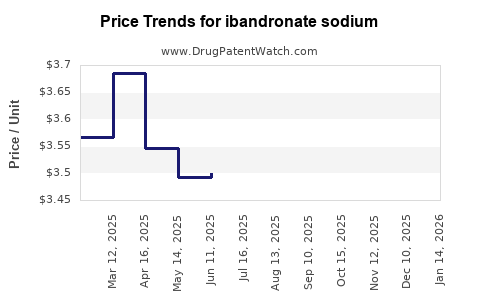
Average Pharmacy Cost for ibandronate sodium
| Drug Name | NDC | Price/Unit ($) | Unit | Date |
|---|---|---|---|---|
| IBANDRONATE SODIUM 150 MG TAB | 33342-0150-01 | 2.75665 | EACH | 2026-07-22 |
| IBANDRONATE SODIUM 150 MG TAB | 33342-0150-52 | 2.75665 | EACH | 2026-07-22 |
| IBANDRONATE SODIUM 150 MG TAB | 33342-0150-53 | 2.75665 | EACH | 2026-07-22 |
| >Drug Name | >NDC | >Price/Unit ($) | >Unit | >Date |
IBANDRONATE SODIUM: Market Overview and Price Projections
Market Size and Growth Trajectory
Ibandronate sodium, a bisphosphonate used primarily for osteoporosis management, holds a significant position within the osteoporosis therapeutics market. As of 2022, the global osteoporosis treatment market was valued at approximately $11 billion, with bisphosphonates constituting a sizeable segment. Ibandronate sodium accounted for close to 10-15% of this segment, translating to an estimated $1.1 billion to $1.65 billion (source: Grand View Research [1]).
Market growth is driven by increasing aging populations worldwide, rising osteoporosis prevalence, and healthcare systems adopting bisphosphonates as first-line therapy. The compound's market share faces competition from alternatives like alendronate, risedronate, zoledronic acid, and newer agents such as denosumab and anabolic drugs like teriparatide.
Pricing Landscape
Pricing varies by formulation, indication, and region:
-
Brand and Generic Variants: Originator drugs such as BONIVA (manufactured by Pfizer) have maintained higher prices. Post-patent expiry, generic ibandronate formulations have entered the market, leading to reduced costs.
-
Average Wholesale Price (AWP): In the United States, the AWP for a 150 mg oral tablet typically ranges from $15 to $25, depending on the supplier and procurement agreements. Injectable formulations tend to cost significantly more, up to $150-$200 per dose.
-
Regional Variance: In Europe, prices are generally lower, with a typical 150 mg oral tablet retailing around €10-15. In emerging markets, prices often drop below $10 per tablet due to lower procurement costs and regulatory prices controls.
Price Trends and Projections (2023-2028)
-
Patent and Market Dynamics: Major patents for originator ibandronate expired in 2014 in the US and Europe, leading to a proliferation of generics, which exert downward pressure on prices.
-
Expected Price Decline: From 2023 onwards, prices for oral generics are projected to stabilize or decrease slightly due to increased competition. Injectable forms may experience a modest decrease as biosimilar and alternative therapies gain traction.
-
Market Penetration of Alternatives: The rise of monoclonal antibodies and anabolic agents poses a competitive threat, potentially reducing the relative value and price of ibandronate products.
Regulatory and Patent Considerations
-
Patent Status: The originator patent expired in multiple jurisdictions; however, secondary patents and formulation patents may still offer exclusivity or delayed generic entry in certain markets.
-
Regulatory Approvals: New formulations or indications require regulatory approval, influencing pricing and market share over time.
Competitive Landscape and Pricing Strategies
-
Brand-Name vs. Generic: Brands maintain higher prices, leveraging brand recognition and clinical data. Generics have captured a significant portion of the market; some APIs are now available at 60-70% lower cost than brand-name counterparts.
-
Market Entry Barriers: Patents, regulatory hurdles, and manufacturing investments serve as barriers to rapid generic proliferation in some regions.
-
Distribution Channels: Hospitals and long-term care providers tend to negotiate bulk discounts, further affecting effective prices.
Forecast Summary
| Year | Estimated Average Price (USD) per 150 mg Tablet | Notes |
|---|---|---|
| 2023 | $15 - $25 (Brand), $8 - $12 (Generic) | Price stabilizes due to market saturation |
| 2024 | Slight decrease, $14 - $23 (Brand), $7 - $11 (Generic) | Increasing competition and biosimilar options |
| 2025 | Further decline, $13 - $21 (Brand), $6 - $10 (Generic) | Biosimilar approvals and new formulations impact prices |
| 2026 | Stabilization or slight drop, $12 - $19 (Brand), $6 - $9 (Generic) | Market maturity; demand stabilizes |
| 2027 | Possible slight increase for premium formulations | Patent or formulation exclusivity covers some segments |
Concluding Remarks
The ibandronate sodium market is characterized by mature lifecycle dynamics dominated by generic competition. Prices have softened significantly since patent expiry, with further modest declines expected. Pricing strategies will be influenced by regional regulations, patent litigations, and the competitive landscape of emerging therapies.
Key Takeaways
- The global osteoporosis market is valued around $11 billion, with ibandronate sodium capturing a substantial share.
- Generic formulations have driven down prices by 60-70% from originator levels.
- Prices for oral ibandronate tablets range from roughly $8 to $25, depending on region and manufacturer.
- Market entry of biosimilars and new therapies may exert additional downward pressure over the next five years.
- Regulatory and patent statuses critically influence pricing and market access strategies.
FAQs
-
What are the primary factors influencing ibandronate sodium prices?
Competition from generics, regional pricing policies, patent status, and the introduction of biosimilars and alternative therapies. -
How does patent expiration affect the ibandronate market?
It enables generic entry, leading to price reductions and increased market penetration. -
Are there regional differences in ibandronate prices?
Yes. Developed markets like the US and Europe tend to have higher prices than emerging markets due to regulatory and purchasing power differences. -
What therapeutic alternatives could impact ibandronate pricing?
Risedronate, zoledronic acid, denosumab, and anabolic agents such as teriparatide. -
What is the outlook for ibandronate prices in the next five years?
Prices are expected to remain steady or decline slightly due to increasing generic availability and market saturation.
Citations
[1] Grand View Research. "Osteoporosis Drugs Market Size, Trends & Analysis." 2022.
More… ↓
