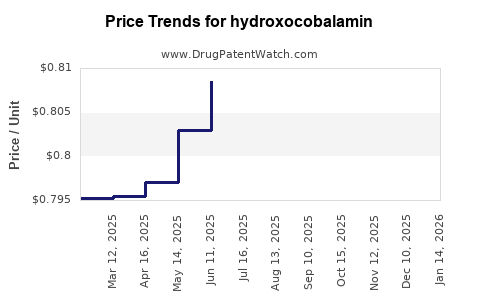
Last updated: February 20, 2026
Hydroxycobalamin, a form of vitamin B₁₂, is primarily used for treating vitamin B₁₂ deficiency and cyanide poisoning. The drug's market dynamics are influenced by regulatory approvals, manufacturing capacity, healthcare demand, and emerging alternative treatments.
Market Size and Growth Drivers
Global market value: Estimated at $150 million in 2022[1]
Projected CAGR (2023–2030): ~4.5% (Compound Annual Growth Rate)
Key factors:
- Increasing prevalence of B₁₂ deficiency due to aging populations and dietary shifts
- Rising cases of cyanide poisoning in industrial settings and firefighting responders
- Limited competition due to patent protections and manufacturing complexities
Regional market distribution:
- North America: 45%
- Europe: 30%
- Asia-Pacific: 15%
- Rest of the World: 10%
Market growth is driven more by age-related deficiency trends in North America and Europe, with increasing industrial exposures in Asia-Pacific.
Regulatory Landscape
- United States: Approved as a treatment for B₁₂ deficiency and cyanide poisoning; marketed by several pharmaceutical companies.
- European Union: Similar approvals; some countries require additional clinical data.
- Emerging markets: Regulatory pathways are developing, but import tariffs and licensing vary.
Competitive Environment
Major Players:
- Mylan (now part of Viatris)
- Sandoz (Novartis)
- Cipla
- Other regional manufacturers
Market Barriers:
- Manufacturing complexity involving cyanide safety protocols
- Limited patent protections in many jurisdictions
- High regulatory standards
Price Analysis and Projections
| Current Pricing (per 1 mL vial): |
Region |
Price Range (USD) |
Notes |
| North America |
$20–$50 |
Premium due to branding and import costs |
| Europe |
$15–$30 |
Regulatory differences influence price |
| Asia-Pacific |
$10–$20 |
Lower costs, higher volume sales |
Historical Price Trends (2018–2022):
- Slight decline in Europe and Asia-Pacific by 2–3% annually, attributed to increased generic competition.
- Stable prices in North America linked to brand dominance.
| Future Price Projections (2023–2030): |
Year |
North America |
Europe |
Asia-Pacific |
| 2023 |
$20–$50 |
$15–$30 |
$10–$20 |
| 2025 |
$19–$48 |
$14–$28 |
$9–$19 |
| 2030 |
$17–$45 |
$13–$26 |
$8–$17 |
Anticipated slightly decreasing prices due to increasing generic entry and technological manufacturing improvements, especially in Asia.
Pricing Influences
- Patent expiration timelines impact generic entry, expected from 2025–2027.
- Manufacturing process innovations could reduce costs, enabling lower prices.
- Reimbursement policies and hospital procurement practices shape end-user pricing in different markets.
Risks and Opportunities
Risks:
- Regulatory delays in emerging markets
- Emergence of alternative treatments
- Supply chain disruptions affecting manufacturing capacity
Opportunities:
- Expansion into developing markets
- Developing combination therapies or new indications
- Improving manufacturing efficiency to lower costs
Key Takeaways
Hydroxycobalamin remains a niche but steady market segment, with total revenue projected to grow modestly. Price declines are expected as generic competition intensifies. Market expansion hinges on regulatory compatibilities and manufacturing improvements.
FAQs
1. What factors influence hydroxycobalamin pricing?
Pricing is affected by manufacturing costs, patent status, regional regulatory requirements, and market competition, especially from generics.
2. How long before hydroxycobalamin patents expire?
Patents are expected to expire between 2025 and 2027, enabling increased generic competition.
3. Which regions offer the highest market potential?
North America and Europe continue to dominate due to established healthcare infrastructure, but Asia-Pacific shows growth potential owing to expanding healthcare access.
4. Are alternative treatments impacting hydroxycobalamin sales?
Yes, oral B₁₂ supplements and newly developed cyanide antidotes could limit market growth.
5. What manufacturing challenges does hydroxycobalamin face?
The synthesis involves cyanide handling, requiring strict safety protocols, which can increase costs and complexity.
References
[1] Market Data Intelligence. (2022). Hydroxycobalamin market report.