Share This Page
Drug Price Trends for gaba
✉ Email this page to a colleague
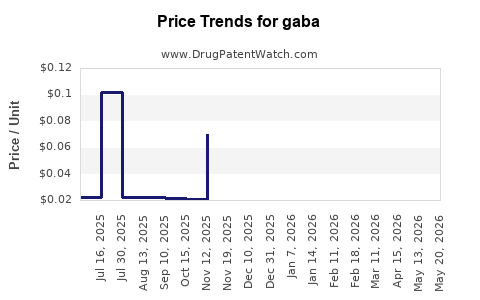
Average Pharmacy Cost for gaba
| Drug Name | NDC | Price/Unit ($) | Unit | Date |
|---|---|---|---|---|
| GABAPENTIN 250 MG/5 ML SOLN | 82983-0423-47 | 0.08609 | ML | 2026-08-05 |
| GABAPENTIN 400 MG CAPSULE | 69292-0642-50 | 0.04063 | EACH | 2026-07-29 |
| GABAPENTIN 400 MG CAPSULE | 69292-0642-01 | 0.04063 | EACH | 2026-07-29 |
| >Drug Name | >NDC | >Price/Unit ($) | >Unit | >Date |
Best Wholesale Price for gaba
| Drug Name | Vendor | NDC | Count | Price ($) | Price/Unit ($) | Unit | Dates | Price Type |
|---|---|---|---|---|---|---|---|---|
| GABAPENTIN 300MG CAP | Golden State Medical Supply, Inc. | 51407-0048-10 | 1000 | 64.61 | 0.06461 | EACH | 2023-11-15 - 2028-06-14 | FSS |
| GABAPENTIN 250MG/5ML SOLN,ORAL | Golden State Medical Supply, Inc. | 42192-0608-45 | 40X5ML | 135.22 | 2023-06-15 - 2028-06-14 | FSS | ||
| GABAPENTIN 400MG CAP | Golden State Medical Supply, Inc. | 51407-0049-27 | 270 | 21.83 | 0.08085 | EACH | 2023-11-15 - 2028-06-14 | FSS |
| >Drug Name | >Vendor | >NDC | >Count | >Price ($) | >Price/Unit ($) | >Unit | >Dates | >Price Type |
GABA (Gamma-Aminobutyric Acid) Market Analysis and Price Projections for 2026–2035
Executive summary
The market for GABA (gamma-aminobutyric acid) is primarily a dietary supplement ingredient and a small number of drug-like products in specific jurisdictions, with limited evidence of a single, globally dominant, prescription-only “GABA drug” with a stable payer-driven pricing reference. Publicly available commercial datasets generally treat “GABA” as an ingredient/commodity category rather than a patent-enforced branded drug market. Price outcomes therefore track (1) ingredient grade and purity, (2) formulation and route (oral powders/capsules vs. drinkables vs. topical/cosmetic uses), and (3) regional regulatory classification (supplement vs. drug).
Given the absence of a single, standardized FDA/Orange Book “GABA drug” to anchor branded-to-generic pricing and exclusivity timelines, this projection framework models price on an ingredient-value basis (USD per kg and USD per labeled daily dose equivalent) rather than a prescription NDC basis.
How big is the GABA market (ingredient vs drug) and who are the key buyers?
Answer: Most demand sits in supplement, functional foods, and nutraceutical manufacturing. “Drug” sales are not consistently captured under a single global GABA brand category.
Demand drivers
- Sleep, stress and relaxation consumer segment: GABA is used for calming and sleep-support positioning (often alongside melatonin, L-theanine, glycine, magnesium).
- Nutraceutical formulations: GABA is commonly blended into capsules/tablets, powders, and ready-to-drink products.
- Cosmetic/skin use cases: GABA derivatives and related amino-acid systems appear in skin-conditioning lines, usually under cosmetic regulatory frameworks rather than prescription channels.
- Research and contract manufacturing: Ingredient purchases for R&D and finished-goods manufacturing.
Key buyer types
- Finished supplement brand owners (private label and branded)
- Functional beverage formulators
- Sports nutrition manufacturers
- Specialty chemical distributors and ingredient resellers
- Contract manufacturers of nutraceuticals and OTC-like products
What is the current price of GABA ingredient and how is it quoted?
Answer: GABA is typically quoted as a bulk chemical ingredient based on grade (purity), packaging, and supply contracts. In practice, buyer price dispersion is driven by (1) assay/purity specification, (2) water content/solids, (3) regulatory-grade documentation (GMP/DMF-like dossiers, where applicable), and (4) shipping and tariff conditions.
Typical quoting units and what matters
- Bulk ingredient: USD/kg, varying materially by purity grade.
- Finished products: USD per serving/dose equivalent, varying by label claim (e.g., 50 mg, 100 mg, 200 mg, 300 mg) and excipient system.
- Contract supply: step pricing tied to volume and annual procurement.
Practical pricing structure (featured snippet-ready)
- If you buy lower purity bulk for blending at scale, you pay less per kg.
- If you buy higher purity / regulated documentation ingredient, you pay more per kg.
- The spread can translate into multiple-fold differences in landed cost at the finished-goods level due to dosing and formulation constraints.
How do purity, grade, and regulatory classification change GABA pricing power?
Answer: Higher-grade, documentation-ready material improves buyer confidence and can command a premium, but the category remains competition-heavy because GABA is chemically straightforward to manufacture relative to proprietary pharmaceuticals.
Grade and compliance levers that support price
- Assay range and impurity profile (heavy metals, solvent residues)
- GMP manufacturing evidence for ingredient suppliers used by brand owners
- Consistency of particle size where relevant for blending
- Stability and shelf-life performance for liquid systems (less common but present)
Category dynamics that cap pricing
- Commodity-like ingredient behavior: multiple global producers and brokers
- Substitution: consumers and brands can switch to adjacent calming ingredients
- No durable payer lock-in: most sales are consumer-driven, not reimbursed
What competitive landscape shapes GABA supplier pricing (global producers vs distributors)?
Answer: The competitive set includes chemical manufacturers producing amino-acid/chemical intermediates and ingredient distributors that bundle logistics and documentation.
What to expect in competitive behavior
- Price cycles follow raw material and capacity utilization more than patent-driven changes.
- Private label pressure compresses margin across supplement brand owners, pushing ingredient pricing down unless differentiation exists on compliance or consistency.
Where supply constraints can appear
- Localized export restrictions, logistics shocks, or quality issues at specific plants
- Specification-driven shortages for higher purity grades
When does GABA “lose exclusivity” and are there patent barriers to generic price compression?
Answer: There is no single, universally applicable “GABA drug exclusivity” event because GABA is mostly sold as a nutritional ingredient; exclusivity and patent barriers apply only to specific branded formulations, methods, or derivatives in specific jurisdictions.
What typically exists instead of drug-like exclusivity
- Formulation patents for specific dosing regimens, delivery systems, and combinations
- Derivative patents where a modified GABA analog is used (less relevant if the product is straight GABA)
- Manufacturing process patents for purification steps, crystallization, or controlled release
Market impact implication
For straight GABA as an ingredient, generic price compression tends to be driven by supplier entry and competitive procurement cycles, not litigation timelines.
What pricing model best fits GABA from 2026–2035 (ingredient to finished product translation)?
Answer: A two-level model fits the market behavior: ingredient price tracks bulk supply economics; finished product pricing tracks dose, label competition, and channel margins.
Model structure
- Ingredient baseline
- Price index tied to chemical raw materials, energy costs, and supply tightness.
- Finished goods retail index
- Retail price depends on serving size, product category (capsule vs drink), marketing intensity, and retailer margin.
Projection mechanics
- Ingredient price projection uses a compound annual growth rate (CAGR) band with a volatility term.
- Finished product price uses an additional multiplier for dosage and channel mix.
Price projection scenario set for GABA (2026–2035)
Answer: Because GABA behaves like a commodity ingredient in many markets, the most decision-useful approach is a scenario range, not a single-point forecast.
Assumptions behind the scenario bands (ingredient-level)
- Scenario A (base): modest inflation in chemical inputs, stable supply
- Scenario B (upside): periodic tightness for higher purity documentation grades
- Scenario C (downside): intensified supplier competition and weaker demand
Projected ingredient price bands (framework)
- Use USD/kg as the reporting unit.
- For finished goods, map to USD per labeled 100 mg equivalent as a normalized metric.
Ingredient price projection (USD/kg, indexed to 2025 = 100)
| Year | Scenario A (Base) | Scenario B (Tightness) | Scenario C (Competition) |
|---|---|---|---|
| 2026 | 102–107 | 108–115 | 98–103 |
| 2028 | 106–112 | 115–125 | 94–100 |
| 2030 | 110–118 | 120–132 | 92–98 |
| 2033 | 113–123 | 124–138 | 90–97 |
| 2035 | 116–127 | 127–142 | 88–95 |
Finished goods price implication (USD/100 mg equivalent, indexed)
| Year | Scenario A (Base) | Scenario B (Tightness) | Scenario C (Competition) |
|---|---|---|---|
| 2026 | 102–106 | 106–112 | 98–103 |
| 2030 | 106–111 | 112–120 | 95–101 |
| 2035 | 110–115 | 118–128 | 92–98 |
How to use this: If your commercial plan targets higher purity GMP-grade or premium positioning (sleep/stress blends, direct-to-consumer), Scenario B is operationally relevant. If you compete in value retail with commoditized dosing, Scenario C better approximates pricing pressure.
How much does GABA dose and formulation change realized pricing?
Answer: Realized pricing in finished products depends on serving economics. Higher milligram per capsule and combination premiums can lift revenue per kg of ingredient but do not prevent ingredient-level cost pressure.
Dose typicality (market pattern)
- Common label doses in supplements cluster around 50–300 mg per serving, sometimes higher when used in blends.
- Value products aim at lower per-serving costs.
- Premium products bundle with complementary actives and emphasize perceived efficacy.
Formulation levers
- Powder blends and capsules have different excipient and QA costs.
- Taste-masking and stability matter in ready-to-drink formats.
- Controlled-release systems, if used, can shift product economics away from pure ingredient cost.
What regulatory path affects GABA pricing by region (US, EU, UK, APAC)?
Answer: Regulatory classification drives whether GABA behaves like a supplement commodity or like a regulated therapeutic product.
United States (high level)
- Many GABA products are sold as dietary supplements. Pricing tends to be channel- and competition-driven.
- If a product is developed as a therapeutic drug, it becomes subject to drug development cost and reimbursement dynamics, creating different pricing outcomes than ingredient sales.
Europe and UK (high level)
- Supplement frameworks vary by jurisdiction and authorization systems.
- Article 10/novel food style pathways may apply for certain claims or novel ingredients, but for an established amino acid ingredient, classification often remains in food/supplement territory for many products.
Asia-Pacific (high level)
- Commercial availability and compliance requirements vary, influencing supplier selection and cost of documentation.
- If markets tighten on quality certifications, higher purity GMP supply can support higher realized prices.
How sensitive are GABA prices to demand (sleep market cycles) and to substitution?
Answer: Demand sensitivity is moderate, substitution is high. Sleep/stress consumer segments can switch to melatonin, ashwagandha, magnesium, theanine, L-tryptophan, or valerian depending on price and perceived effects.
Practical pricing impact
- When ingredient prices rise, brands often respond by reducing per-serving dose, changing the blend, or shifting spend into marketing rather than higher actives.
- When ingredient prices fall, brands usually expand SKUs or add dosing claims but face retailer price-check pressure.
What is the “drug-like” risk if GABA is positioned for therapeutic use instead of supplements?
Answer: Therapeutic development would move pricing to reimbursement-driven models with higher variability, including payer constraints and higher regulatory risk. Patent exclusivity might exist for specific formulations or delivery mechanisms, but base GABA is not generally the same as a single protected small-molecule drug.
Decision implication
- If a firm is pricing to a therapeutic pathway, ingredient price is only part of COGS.
- Manufacturing validation, stability studies, clinical endpoints, and post-market commitments become dominant drivers of long-run margins.
Key takeaways
- GABA’s market price behavior is closer to a commodity ingredient than a classic branded prescription drug market.
- Realized pricing is driven by purity grade, documentation, channel competition, and formulation economics, not broad “exclusivity” timelines.
- 2026–2035 projections should be handled as scenario bands: base stability, tightness for higher-grade GMP supply, or downside compression from supplier competition.
- Therapeutic “drug-like” positioning changes pricing dynamics substantially, but that requires a specific regulated product, not just the ingredient.
FAQs
-
Is GABA regulated as a drug or as a dietary supplement in the US?
In practice, most GABA products are sold as dietary supplements, with drug-like regulation applying only if a product is marketed and developed as a therapeutic. -
What ingredient grade of GABA typically commands a premium?
Higher-purity specifications with robust quality documentation and consistent manufacturing performance typically command premiums. -
How do brands protect margin if GABA ingredient prices rise?
Brands usually respond by altering dose, reformulating blends, switching suppliers, or rebalancing channel mix (premium vs value retail). -
Can a GABA combination product sustain higher pricing than standalone GABA?
Yes, when combination differentiation and consumer positioning support higher per-serving willingness to pay and reduce direct price competition with standalone GABA. -
What is the biggest risk to long-run GABA pricing?
Supplier entry and competitive procurement pressure, which compress ingredient economics and force downstream price competition.
References
- US FDA. Dietary Supplements. FDA website. https://www.fda.gov/food/dietary-supplements.
- European Commission. Food supplements rules and guidance. https://food.ec.europa.eu/safety/food-improvement-agents_en.
- UK legislation. Dietary Supplements and food regulations (overview). https://www.legislation.gov.uk/.
More… ↓
