Last updated: February 12, 2026
What Is the Current Market Size and Demand for Folic Acid?
Folic acid, a synthetic form of vitamin B9, is used primarily in dietary supplements, fortified foods, and pharmaceuticals to prevent neural tube defects and support overall health.
The global folic acid market was valued at approximately $1.2 billion in 2022. It is expected to grow at a compound annual growth rate (CAGR) of 6.2% from 2023 to 2030, reaching around $2 billion by 2030.
Key drivers include increasing awareness of maternal nutrition, rising prevalence of neural tube defects, and growth in dietary supplement consumption. Major markets are North America, Europe, and Asia-Pacific, with North America constituting about 35% of global demand in 2022, followed by Europe at 25%.
Who Are the Major Producers and Supply Chain Dynamics?
Leading producers include Wuxi Pharmatech, ZhejiangGarden, and Kayson Chemicals. These companies supply raw materials and finished products globally.
Supply chain factors affecting prices include raw material costs (p-aminophenol, para-aminobenzoic acid), production capacity, and regulatory compliance. Shortages or disruptions, such as those observed during the COVID-19 pandemic, temporarily increased prices.
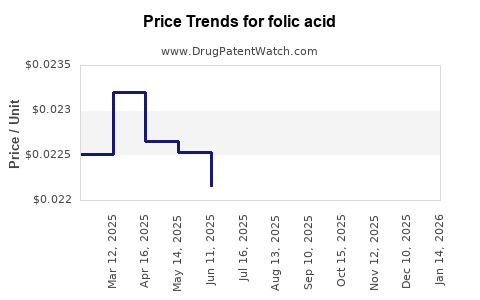
What Are the Current Pricing Trends and Factors Influencing Price?
The average price of bulk folic acid (USP grade) was approximately $25 to $30 per kilogram in late 2022. Prices range from $20 to $35/kg dependent on purity, grade, and supplier.
Factors influencing prices include:
- Raw material costs, notably p-aminophenol, which has seen price volatility.
- Regulatory policies in major markets, affecting production costs and compliance.
- Manufacturing capacity, with some producers consolidating, reducing competition.
- Global demand fluctuations, especially in prenatal supplement markets.
In comparison, generic supplements for individual consumers are priced between $0.10 to $0.50 per tablet, depending on dosage and branding.
What Are Future Price Projections and Market Trends?
Projected future pricing indicates a steady decrease in bulk prices owing to increased production capacity, technological improvements in synthesis, and market saturation.
By 2030, bulk folic acid prices are forecasted to decline to approximately $15–$20/kg. Meanwhile, retail supplement prices are likely to remain stable or slightly decrease, driven by mass production efficiencies and commoditization.
Market trends include:
- Growth in fortified foods and beverages, expanding the scope of folic acid applications.
- Increased regulatory approvals, especially in emerging markets, supporting broader distribution.
- Advances in synthetic manufacturing reducing costs, enabling competitive pricing.
- Rising consumer awareness of vitamin supplementation, supporting demand growth.
What Are Key Regulatory and Patent Considerations?
While folic acid itself is off-patent, certain formulations and delivery methods may be protected under patents. Regulatory standards vary:
- In the US, the FDA classifies folic acid as Generally Recognized As Safe (GRAS).
- EU regulations include strict standards for purity (e.g., EFSA standards).
- Some countries enforce restrictions on maximum allowable levels in fortified foods.
New patent applications focus on innovative delivery systems or combination products, potentially impacting market exclusivity in niche segments.
Final Market Outlook
The market for folic acid remains robust, driven by demographic trends and health awareness. Supply is increasingly commoditized, pushing prices downward. Companies optimizing sourcing and manufacturing could benefit from sustained demand and price stability.
Key Takeaways
- The global folic acid market was valued at ~$1.2 billion in 2022 and is projected to reach ~$2 billion by 2030.
- Raw material costs and manufacturing capacity influence bulk price fluctuations.
- Prices for bulk folic acid are expected to decline from $20–$35/kg in 2022 to $15–$20/kg by 2030.
- Market growth is supported by increased supplement use, fortified foods, and regulatory acceptance.
- Patent activity centers on delivery methods, not the active ingredient itself.
FAQs
1. What factors could disrupt the supply of folic acid?
Supply disruptions could occur due to raw material shortages, regulatory changes, or manufacturing capacity limitations.
2. How does the price of raw materials affect bulk folic acid prices?
Raw material costs, especially p-aminophenol, directly impact manufacturing expenses and, consequently, bulk prices.
3. Are there significant patent protections for folic acid?
Folic acid itself is off-patent; patents generally apply to formulation or delivery patents in specific markets.
4. What are key regulatory challenges for folic acid products?
Standards for purity, labeling, and maximum fortification levels vary; compliance costs can influence pricing and market entry.
5. How might future technological developments impact prices?
Improvements in synthetic processes could decrease manufacturing costs, leading to lower prices for bulk supplies.
Sources:
- Grand View Research, "Folic Acid Market Size, Share & Trends Analysis Report," 2023.
- US FDA, Dietary Supplement Labeling Guide, 2022.
- European Food Safety Authority, "Folic Acid Safety Assessment," 2022.
- Industry reports and market data, ScienceDirect, IBISWorld.