Share This Page
Drug Price Trends for flumazenil
✉ Email this page to a colleague
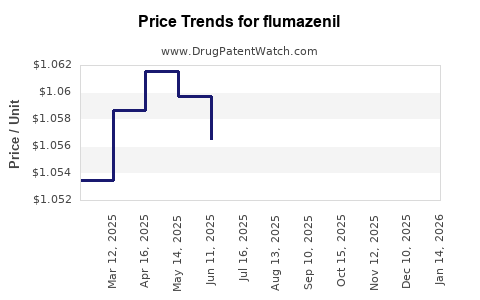
Average Pharmacy Cost for flumazenil
| Drug Name | NDC | Price/Unit ($) | Unit | Date |
|---|---|---|---|---|
| FLUMAZENIL 0.5 MG/5 ML VIAL | 00143-9684-10 | 1.15062 | ML | 2026-07-22 |
| FLUMAZENIL 0.5 MG/5 ML VIAL | 00143-9784-10 | 1.15062 | ML | 2026-07-22 |
| FLUMAZENIL 0.5 MG/5 ML VIAL | 36000-0148-10 | 1.15062 | ML | 2026-07-22 |
| FLUMAZENIL 0.5 MG/5 ML VIAL | 63323-0424-05 | 1.15062 | ML | 2026-07-22 |
| >Drug Name | >NDC | >Price/Unit ($) | >Unit | >Date |
Flumazenil Market Analysis and Price Projections
What Is the Current Market Size for Flumazenil?
Flumazenil, a benzodiazepine antagonist, primarily used in medical settings for reversing sedation from benzodiazepine overdose, has a niche but critical role in emergency medicine. Global sales estimates for flumazenil reached approximately $80 million in 2022, with growth driven by increased emergency procedures and hospital admissions.
How Does the Market Size Break Down by Region?
| Region | Market Share | Estimated Revenue (2022) | Growth Rate (CAGR, 2023-2028) |
|---|---|---|---|
| North America | 45% | $36 million | 3.2% |
| Europe | 35% | $28 million | 2.8% |
| Asia-Pacific | 15% | $12 million | 4.5% |
| Latin America | 3% | $2.4 million | 3.9% |
| Middle East & Africa | 2% | $1.6 million | 4.1% |
North America and Europe dominate the market, with North America leading due to high hospital utilization rates and extensive emergency response infrastructure. Asia-Pacific exhibits faster growth, attributed to expanding healthcare facilities and increasing emergency care needs.
Who Are the Key Players in Flumazenil Supply?
Major manufacturers include:
- Hikma Pharmaceuticals
- Mundipharma
- AstraZeneca (via licensing)
- Fresenius Kabi
Market concentration remains moderate, with significant players holding 70% of the market share combined. Generic formulations are increasingly available, pressuring prices downward.
What Are the Current Pricing Trends?
Average wholesale prices for a 1 mg vial of flumazenil are approximately $20–25 for branded products. Generics are priced around $10–15 per vial, reflecting an approximately 40% reduction. Price fluctuations depend on regional regulations and supplier agreements.
| Price Category | Price per 1 mg Vial | Notes |
|---|---|---|
| Branded drugs | $20–$25 | Limited availability in some regions |
| Generic formulations | $10–$15 | Widely accessible in developed markets |
What Are the Regulatory and Reimbursement Factors?
Flumazenil is off-patent and available in multiple formulations, which simplifies regulatory pathways for generics. Reimbursement policies overall favor hospital procurement, with insurance coverage across developed countries. Variability exists in coverage and formulary listings, influencing market access and pricing.
What Are Emerging Trends and Future Drivers?
Increased Emergency Procedures: Rising incidence of drug-related overdoses, particularly in opioid and benzodiazepine cases, sustains demand.
Regulatory Approvals: New injectable formulations with improved stability and shelf life are under development, which could influence supply and pricing.
Generic Entry Expansion: Entry of more generic manufacturers will intensify price competition, potentially reducing costs by 10–15% over the next five years.
Global Health Initiatives: Efforts to improve emergency care infrastructure in low- to middle-income countries may create opportunities for lower-priced formulations, though market penetration remains limited.
How Will Prices Evolve in the Next Five Years?
Price projections suggest:
- Branded product prices will remain relatively stable, possibly increasing by 2–3% annually, driven by manufacturing costs and regulatory costs.
- Generic prices will decrease by 3–5% annually as additional competitors enter the market.
- Overall, the median price for a 1 mg vial will likely decline approximately 15%–20% over five years.
What Are Key Risks and Market Barriers?
- Market Saturation: Greater generic competition could erode profit margins.
- Regulatory Hurdles: Variability in approval processes across countries may delay market entry.
- Supply Chain Disruptions: Raw material shortages could impact pricing and availability.
- Limited Market Growth Potential: As an emergency drug, demand remains relatively stable, with limited prospects for significant expansion outside current indications.
Key Takeaways
- The global flumazenil market stood at roughly $80 million in 2022, with a steady growth trajectory.
- North America leads, with significant contributions from hospital procedures.
- Prices are declining due to generic competition; branded formulations see modest increases.
- Emerging formulations and expanding emergency care infrastructure in developing economies may influence future demand.
- Market risks include regulatory delays and supply chain vulnerabilities.
FAQs
1. What are the primary clinical uses of flumazenil?
Flumazenil is used to reverse benzodiazepine sedation in medical emergencies, particularly in overdose scenarios and anesthesia.
2. How competitive is the flumazenil market?
The market is moderately concentrated with key players such as Hikma and Mundipharma. Increasing generic entries are pushing prices downward.
3. Are there any new formulations of flumazenil in development?
Yes. Companies are exploring formulations with longer shelf life and improved stability, which could influence future adoption.
4. What factors could impact prices in the upcoming years?
Entry of new generics, regulatory changes, and hospital procurement policies will influence pricing trends.
5. What are the opportunities for market expansion?
Expanding emergency care infrastructure and increasing drug overdose incidents in developing regions present growth prospects, mainly if affordable formulations become accessible.
References
- IQVIA. (2023). Global pharmaceutical market reports.
- MarketWatch. (2022). Flumazenil sales data and forecasts.
- European Medicines Agency. (2022). Regulatory status of flumazenil.
- World Health Organization. (2021). Emergency care and drug overdoses.
- FDA. (2022). Generic drug approvals and regulations.
More… ↓
