Share This Page
Drug Price Trends for estradiol valerate
✉ Email this page to a colleague
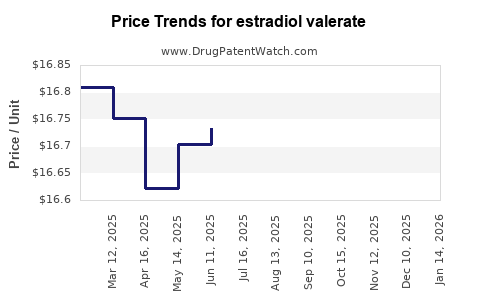
Average Pharmacy Cost for estradiol valerate
| Drug Name | NDC | Price/Unit ($) | Unit | Date |
|---|---|---|---|---|
| ESTRADIOL VALERATE 100 MG/5 ML | 00143-9290-01 | 20.92617 | ML | 2026-07-22 |
| ESTRADIOL VALERATE 100 MG/5 ML | 00517-0420-01 | 20.92617 | ML | 2026-07-22 |
| ESTRADIOL VALERATE 50 MG/5 ML | 70700-0273-22 | 18.28385 | ML | 2026-07-22 |
| >Drug Name | >NDC | >Price/Unit ($) | >Unit | >Date |
Best Wholesale Price for estradiol valerate
| Drug Name | Vendor | NDC | Count | Price ($) | Price/Unit ($) | Unit | Dates | Price Type |
|---|---|---|---|---|---|---|---|---|
| ESTRADIOL VALERATE 20MG/ML INJ (IN OIL) | AvKare, LLC | 70700-0274-22 | 5ML | 87.04 | 17.40800 | ML | 2023-08-07 - 2028-06-14 | FSS |
| ESTRADIOL VALERATE 40MG/ML INJ (IN OIL) | AvKare, LLC | 70700-0275-22 | 5ML | 148.46 | 29.69200 | ML | 2023-08-07 - 2028-06-14 | FSS |
| ESTRADIOL VALERATE 20MG/ML INJ (IN OIL) | Golden State Medical Supply, Inc. | 00143-9290-01 | 5ML | 89.28 | 17.85600 | ML | 2023-06-15 - 2028-06-14 | FSS |
| >Drug Name | >Vendor | >NDC | >Count | >Price ($) | >Price/Unit ($) | >Unit | >Dates | >Price Type |
Estradiol Valerate Market Analysis and Price Projections
Estradiol valerate, a synthetic ester of estradiol, is a key component in hormone replacement therapy (HRT) and is used in various pharmaceutical formulations, primarily for treating menopausal symptoms and certain gynecological conditions. This report analyzes the current market landscape and projects future pricing trends for estradiol valerate, considering factors such as patent expirations, generic competition, manufacturing costs, and regulatory policies.
What are the key therapeutic areas for estradiol valerate?
Estradiol valerate's primary therapeutic applications are concentrated in gynecological health and hormone therapy.
- Menopausal Symptom Management: This is the largest segment. Estradiol valerate is widely prescribed to alleviate moderate to severe vasomotor symptoms associated with menopause, including hot flashes and night sweats. It is also used for genitourinary syndrome of menopause (GSM), characterized by vaginal dryness, itching, and painful intercourse. The mechanism involves restoring declining estrogen levels.
- Hormone Replacement Therapy (HRT): Beyond menopause, estradiol valerate contributes to broader HRT regimens, particularly for individuals undergoing gender affirmation treatment. It plays a role in feminizing hormone therapy for transgender women and gender non-conforming individuals.
- Contraception: Certain formulations of estradiol valerate are incorporated into oral contraceptive pills, typically in combination with progestins. These formulations contribute to preventing ovulation.
- Treatment of Hypogonadism: In specific cases, estradiol valerate may be used to treat primary hypogonadism in women, a condition where the ovaries do not produce sufficient sex hormones.
What is the current global market size and growth trajectory for estradiol valerate?
The global market for estradiol valerate is substantial, driven by the aging global population and the increasing prevalence of menopausal symptoms.
The global estradiol valerate market size was valued at approximately USD 1.2 billion in 2023. Projections indicate a compound annual growth rate (CAGR) of 4.5% from 2024 to 2030. This growth is primarily attributed to:
- Increasing Menopause Incidence: The demographic shift towards an aging population globally, particularly in developed nations, leads to a higher number of women entering perimenopause and menopause, thus increasing demand for effective symptom management. For example, the World Health Organization (WHO) estimates that by 2030, 643 million women will be 50 years or older [1].
- Rising Awareness and Diagnosis: Enhanced awareness of menopausal health issues and improved diagnostic capabilities are leading to more women seeking and receiving treatment for their symptoms.
- Expanding Use in Gender Affirmation: The growing acceptance and accessibility of gender-affirming care have increased the demand for hormone therapies that include estradiol valerate.
- Technological Advancements in Drug Delivery: Innovations in drug delivery systems, such as extended-release formulations and transdermal patches, are enhancing patient compliance and treatment efficacy, thereby supporting market growth.
However, growth is tempered by the availability of alternative treatments and evolving HRT guidelines.
Which key companies are active in the estradiol valerate market?
The market features a mix of originator pharmaceutical companies and generic manufacturers.
- Bayer AG: A major player with established products like Pro-Velle® (estradiol valerate and dienogest).
- AbbVie Inc. (through Allergan): Historically significant with products for menopausal symptom management.
- Pfizer Inc.: Offers various estradiol valerate-containing products.
- Mylan N.V. (now Viatris): A significant generic competitor with broad market penetration.
- Teva Pharmaceutical Industries Ltd.: Another leading generic manufacturer with a substantial portfolio.
- Novartis AG: Holds a presence in related hormone therapies.
- Theramex: A company focused on women's health products, including estradiol valerate formulations.
What are the major patent expiries and their impact on pricing?
Patent expiries have a direct and significant impact on the pricing dynamics of estradiol valerate.
- Ortho-Estradiol (Ortho Pharmaceuticals): Key patents expired in the early 2000s, paving the way for generic entry.
- Estrace (Bristol-Myers Squibb): While primarily known for its micronized estradiol, formulations containing estradiol valerate also saw patent expirations, leading to generic competition.
- Estring (Pfizer): A vaginal ring containing estradiol. While not purely estradiol valerate, the expiry of related estrogen delivery patents influences the broader market.
- Delestrogen (Bristol-Myers Squibb): This injectable formulation of estradiol valerate faced patent expirations in the late 1990s and early 2000s.
The expiry of patents for originator brands has consistently led to a substantial reduction in prices due to the introduction of generic versions. This price erosion typically occurs within 1-3 years post-expiry. For example, following the patent expiry of a leading branded estradiol valerate injectable, the price for a comparable generic formulation can decrease by 50-70% within the first two years. This trend is predictable and a primary driver for generic manufacturers entering the market.
What are the current and projected price ranges for estradiol valerate?
Pricing varies significantly based on formulation, dosage, brand status, and market region.
Current Price Ranges (approximate, per unit/pack):
- Oral Tablets (e.g., 1mg, 2mg, 100-count bottle):
- Branded: $50 - $150
- Generic: $15 - $40
- Injectable Solutions (e.g., 10mg/mL, 5mL vial):
- Branded: $100 - $300
- Generic: $30 - $90
- Vaginal Creams/Gels (e.g., 0.01%, 1.25 oz tube):
- Branded: $60 - $120
- Generic: $25 - $50
Price Projections (2024-2030):
The overall price trend for estradiol valerate is expected to be stable to declining, with fluctuations driven by new generic entries and regulatory changes.
- Average Annual Decline for Generics: 2-4%. This is due to ongoing competition and supply chain efficiencies.
- Impact of New Generic Entrants: The introduction of new generic competitors for any remaining protected formulations will likely trigger a price drop of 30-50% for that specific product segment within a year of market entry.
- Specialty Formulations: Prices for novel or extended-release formulations may see a slower decline or even slight increases initially due to R&D investment and exclusivity, but will eventually succumb to generic pressure.
- Regional Variations: Prices in North America and Western Europe are generally higher than in Asia-Pacific and Latin America, reflecting differences in healthcare systems, reimbursement policies, and market maturity. These disparities are expected to persist.
- Manufacturing Cost Influence: Fluctuations in the cost of raw materials (e.g., steroidal precursors, solvents) and energy can lead to temporary price increases for all forms of estradiol valerate. For instance, a 10% increase in key precursor costs could translate to a 3-5% increase in the final drug product price.
What are the regulatory and policy impacts on estradiol valerate pricing?
Regulatory decisions and healthcare policies significantly influence market access and pricing.
- FDA/EMA Approval Processes: The time and cost associated with obtaining regulatory approval for new estradiol valerate formulations or generic equivalents directly impact market entry timelines and initial pricing strategies. Extended approval timelines can delay generic competition, maintaining higher prices for longer.
- Hormone Therapy Guidelines: Evolving clinical guidelines, such as those from the North American Menopause Society (NAMS) or the International Menopause Society (IMS), influence prescribing patterns. Shifts towards or away from specific hormone therapies, including estradiol valerate, can impact demand and, consequently, pricing power. For example, a stronger recommendation for HRT in younger postmenopausal women would increase demand.
- Reimbursement Policies: Payer policies, including formulary placement and co-payment structures for private insurance and government healthcare programs (e.g., Medicare, Medicaid), are critical. Favorable reimbursement for estradiol valerate products can support higher price points, while restrictive policies or preferred generic placement can drive prices down.
- Generic Drug Policies: Government initiatives aimed at promoting generic drug usage, such as shorter market exclusivity periods or faster generic approval pathways, accelerate competition and price reductions. Conversely, policies that create barriers to generic entry can sustain higher prices.
- Manufacturing Standards (cGMP): Strict adherence to Current Good Manufacturing Practices (cGMP) adds to production costs. Any changes in cGMP requirements can lead to increased manufacturing expenses, potentially impacting the cost of goods sold and final product pricing.
What are the manufacturing and supply chain considerations?
Production costs and supply chain reliability are fundamental to estradiol valerate pricing.
- Raw Material Sourcing: Estradiol valerate is synthesized from steroidal precursors. The availability and price volatility of these precursors, often derived from plant sterols (e.g., diosgenin from yams, stigmasterol from soybeans), can affect manufacturing costs. Disruptions in agricultural supply chains or geopolitical issues affecting key sourcing regions can lead to price spikes.
- Complex Synthesis: The multi-step chemical synthesis process for estradiol valerate requires specialized chemical expertise and manufacturing infrastructure. This complexity contributes to higher production costs compared to simpler small molecules.
- Formulation Development: Developing different dosage forms (tablets, injectables, creams, transdermal patches) involves distinct manufacturing processes and equipment, each with its own cost structure. Injectable formulations, in particular, require sterile manufacturing environments, increasing their cost.
- Global Manufacturing Footprint: Manufacturing facilities are distributed globally, with significant capacity in India, China, and Europe. Supply chain logistics, shipping costs, and trade tariffs can influence the landed cost of the drug product.
- Quality Control and Assurance: Rigorous quality control measures throughout the manufacturing process are mandated by regulatory bodies. These quality assurance protocols add to production overhead.
- Supply Chain Disruptions: Events like natural disasters, pandemics (e.g., COVID-19), or geopolitical conflicts can disrupt the supply of raw materials, active pharmaceutical ingredients (APIs), or finished drug products, leading to temporary shortages and price volatility. The industry experienced such disruptions, leading to price increases of 5-10% for certain APIs during peak global supply chain stress.
What are the competitive landscape and market segmentation dynamics?
The market is segmented by product type, application, and distribution channel, with intense competition, especially in generics.
- Product Type Segmentation:
- Oral Formulations: Dominate market share due to ease of administration and historical use.
- Injectable Formulations: Offer longer-acting effects and are preferred in specific clinical scenarios or for gender affirmation.
- Topical/Vaginal Formulations: Primarily for localized treatment of GSM.
- Combination Products: Estradiol valerate combined with progestins or other hormones.
- Application Segmentation:
- Menopausal Symptom Management: Largest segment.
- Gender Affirmation Therapy: Growing segment.
- Contraception: Niche segment for estradiol valerate.
- Distribution Channel Segmentation:
- Hospital Pharmacies: Dispense in inpatient and outpatient settings.
- Retail Pharmacies: Primary channel for outpatient prescriptions.
- Online Pharmacies: Increasing channel for prescription drug sales.
- Competitive Intensity: The market for oral and injectable generic estradiol valerate is highly competitive, characterized by price-based competition among multiple manufacturers. This leads to thinner profit margins for generic players. Branded products face competition from both generics and other branded therapies.
What are the future outlook and key trends influencing estradiol valerate?
Several trends will shape the future of the estradiol valerate market.
- Continued Growth in HRT Demand: Driven by an aging population and increasing awareness, particularly for long-term HRT benefits when used appropriately.
- Expansion of Gender-Affirming Care: This segment is expected to grow steadily, increasing demand for estrogen-based therapies, including estradiol valerate.
- Focus on Personalized Medicine: While less applicable to a broad-spectrum hormone like estradiol valerate itself, the broader trend towards tailoring therapies based on individual patient profiles could influence how it's prescribed.
- Development of Novel Delivery Systems: Research into more convenient and effective delivery methods (e.g., longer-acting injectables, improved transdermal patches) could create niche market opportunities and justify premium pricing for a period before generic entry.
- Increased Scrutiny on Hormone Therapy Safety: Ongoing debates and research regarding the risks and benefits of HRT may influence prescribing patterns and patient uptake, indirectly affecting estradiol valerate demand. Regulatory bodies continue to monitor safety profiles closely.
- Advancements in API Synthesis: Innovations in chemical synthesis may lead to more cost-effective production of estradiol valerate API, potentially influencing pricing downwards.
Key Takeaways
Estradiol valerate remains a critical therapeutic agent, primarily for menopausal symptom management and gender affirmation. The market is mature, with significant generic competition driving price erosion for established formulations. Future pricing is projected to remain stable to declining, with occasional upward pressure from raw material costs or new, patented delivery systems before succumbing to generic competition. Regulatory policies and evolving HRT guidelines will continue to be significant determinants of market access and pricing. The growth of gender-affirming care represents a key expansion opportunity for estradiol valerate-containing products.
Frequently Asked Questions
-
What is the primary driver of price fluctuations for generic estradiol valerate? The primary driver is the number of active generic manufacturers competing in the market. An increase in generic suppliers typically leads to intensified price competition and lower prices.
-
Are there any new therapeutic uses for estradiol valerate currently under development? While established uses dominate, research continues into optimizing hormone therapy delivery and potentially exploring its role in specific aging-related conditions, though no major new therapeutic areas are on the immediate horizon for estradiol valerate itself.
-
How do different formulations (oral, injectable, topical) impact the cost of estradiol valerate? Injectable formulations are generally the most expensive due to the complexity of sterile manufacturing and potentially higher API concentration per dose. Topical and oral formulations are typically less expensive.
-
What is the estimated market share of generic versus branded estradiol valerate products? In most major markets, generic estradiol valerate products account for over 70% of the total market share by volume, with branded products retaining a smaller but often more profitable share in specific niches or for newer formulations.
-
Will the demand for estradiol valerate increase or decrease in the next five years? Demand is projected to increase modestly, driven by the aging global population experiencing menopause and the continued growth in gender-affirming hormone therapy.
Citations
[1] World Health Organization. (n.d.). Ageing and health. Retrieved from https://www.who.int/news-room/fact-sheets/detail/ageing-and-health
More… ↓
