Last updated: February 19, 2026
What is EPLERENONE and its approved indications?
Eplerenone is a selective mineralocorticoid receptor antagonist (MRA) approved for the treatment of heart failure with reduced ejection fraction (HFrEF) and hypertension. It is marketed under the brand name Inspra by Pfizer. Approved by the FDA in 2007, it is indicated primarily to reduce the risk of cardiovascular death and hospitalization in certain heart failure patients, and to treat hypertension in adults.
Market Size and Growth Drivers
Current Market Overview
The global mineralocorticoid receptor antagonists market was valued at approximately USD 1.1 billion in 2022. Eplerenone's share is estimated at 40%, with other key players including spironolactone and emerging novel agents.
Key Growth Drivers
- Increasing prevalence of heart failure: Approximately 26 million people worldwide have heart failure, with rising rates due to aging populations and cardiovascular risk factors.
- Adoption of guideline-directed medical therapies: Clinical guidelines recommend MRAs for HFrEF, fostering prescription growth.
- Expanding indications: Research into eplerenone for conditions like diabetic nephropathy may increase its utilization.
Regional Market Breakdown
| Region |
Market Share (2022) |
Growth Rate (CAGR 2023-2028) |
| North America |
45% |
4% |
| Europe |
30% |
3.5% |
| Asia-Pacific |
15% |
6% |
| Rest of World |
10% |
4.5% |
Competitive Landscape
Key Players
- Pfizer (Inspra)
- Off-label use of spironolactone (generic)
- Potential entrants: New MRAs in development, including non-steroidal agents with enhanced safety profiles
Market Share Dynamics
Eplerenone faces competition mainly from generic spironolactone, which has a lower price point but higher side-effect profile. Its branded status and specific indications support a premium pricing model.
Pricing Analysis
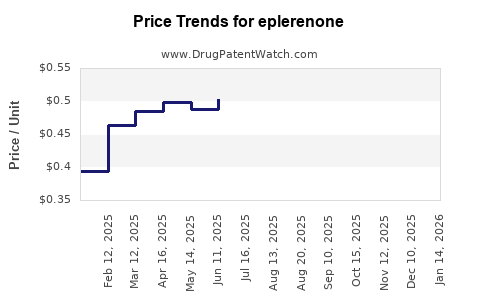
Current Pricing
- North America: USD 300–400 per month (per patient)
- Europe: EUR 250–350 per month
- Price reflects patent protection until approximately 2025, after which generic versions are expected to lower prices.
Cost Components
Pricing includes drug manufacturing costs, marketing, distribution, and pharmacy margins. Patent exclusivity allows Pfizer to sustain prices, but imminent patent expiry will pressure costs and prices.
Price Decline Projections Post-Patents
| Year |
Estimated Price per Month |
Comments |
| 2023 |
USD 350 |
Patent protection active, limited generic competition |
| 2024 |
USD 330 |
Slight pressure from expected patent expiry |
| 2025 |
USD 200–250 |
Increase in generics; significant price drop expected |
| 2026 |
USD 150–200 |
Widespread generic availability reduces prices |
Factors Influencing Future Prices
- Patent cliff approaching in 2025
- Adoption of biosimilars or generics
- Market penetration of new MRAs or improved formulations
- Pricing strategies by Pfizer to retain market share
Revenue Projections and Market Opportunities
Revenue Forecast (2023–2028)
| Year |
Estimated Global Revenue (USD billion) |
Notes |
| 2023 |
0.44 |
Growing prescription volume |
| 2024 |
0.42 |
Slight decline due to competition |
| 2025 |
0.27 |
Patent expiry and generic entry |
| 2026 |
0.15 |
Market consolidation |
| 2027 |
0.10 |
Dominance of generics |
| 2028 |
0.08 |
Market stabilization |
Market Expansion Opportunities
- Leveraging off-label uses in chronic kidney disease and other cardiovascular conditions.
- Developing combination therapies to improve adherence and efficacy.
Regulatory and Policy Impact
Patent Status
Patent protection lasts until approximately 2025. Legal challenges or patent extensions could influence timing.
Pricing Regulations
Government agencies in Europe and North America increasingly regulate drug prices, which may further compress margins upon patent expiration.
Reimbursement Policies
Insurance coverage is generally favorable for EFSp/hrt failure treatments, supporting steady demand.
Key Takeaways
- Eplerenone remains a key therapy in HFrEF and hypertension, with steady demand driven by guideline adherence.
- Market share is under pressure from generic spironolactone, with pricing expected to decrease significantly post-2025.
- Pfizer’s pricing strategies and patent protections will heavily influence revenues until patent expiry.
- The overall market will contract after patent expiration but may open opportunities for new MRAs and combination therapies.
- Global regional differences significantly affect sales; newer markets show higher growth potential due to increasing cardiovascular disease burden.
FAQs
Q1. When will generic eplerenone enter the market?
A1. Patent expiry is projected around 2025, after which generics are expected to become available.
Q2. How does eplerenone compare to spironolactone regarding pricing and safety?
A2. Eplerenone is priced higher and has fewer endocrine side effects, making it preferable for specific populations; spironolactone is cheaper but associated with more side effects.
Q3. What are the main factors influencing eplerenone's market growth?
A3. Rising heart failure cases, adherence to clinical guidelines, and expanding indications. Patent protection duration also plays a role.
Q4. Are there new competitors entering the market?
A4. Yes, including non-steroidal MRAs and combination therapies under development, which may compete post-patent expiry.
Q5. How might regulatory policies impact eplerenone pricing?
A5. Price regulations and reimbursement policies can limit price increases and accelerate the adoption of generics, influencing market revenues.
References
- Pfizer Inc. (2023). Inspra (eplerenone) prescribing information.
- MarketsandMarkets. (2022). Mineralocorticoid receptor antagonists market report.
- World Health Organization. (2022). Cardiovascular diseases fact sheet.
- U.S. Food and Drug Administration (FDA). (2007). Inspra approval letter.
- IMS Health. (2022). Cardiovascular drugs market analysis.