Last updated: March 2, 2026
What Is Dronabinol?
Dronabinol, marketed as Marinol, is a synthetic delta-9-tetrahydrocannabinol (THC). Approved by the U.S. Food and Drug Administration (FDA) in 1985, it is indicated for anorexia associated with weight loss in AIDS patients and nausea and vomiting related to chemotherapy in cancer patients. Dronabinol acts on cannabinoid receptors CB1 and CB2, influencing appetite, nausea, and pain pathways.
Current Market Status
- Regulatory approval: Approved in multiple countries, including the U.S., Canada, and several European nations.
- Market volume: Estimated global sales are around $150 million annually (IQVIA 2022).
- Pricing: Brand-name formulations like Marinol retail at approximately $60 to $90 per 1-milligram capsule.
- Generic availability: Limited, due to patent protection and regulatory hurdles.
- Competing products: Other cannabinoids, including nabilone and cannabidiol (CBD)-based medications, influence market share.
Market Dynamics and Drivers
Key Market Drivers
- Increasing use for chemotherapy-induced nausea (CINV): Growing acceptance of cannabinoids for supportive care.
- Rising prevalence of HIV/AIDS: Drives demand for appetite-stimulating therapies.
- Potential approval for broader indications: Including chronic pain and multiple sclerosis (MS).
Challenges
- Regulatory variability: Some jurisdictions classify dronabinol as a controlled substance, constraining distribution.
- Availability of alternative therapies: Such as newer cannabinoid formulations (e.g., nabiximols) and non-cannabinoid drugs.
- Pricing pressure: From generics and biosimilars.
Competitive Landscape
| Company |
Product Name |
Patent Status |
Market Share (Estimated) |
Key Advantage |
| AbbVie (Meda) |
Marinol |
Expires 2022 |
60% |
Established brand, extensive supply |
| Other manufacturers |
Synthetic THC variants |
Patents vary |
20% |
Price competition |
Price Projections
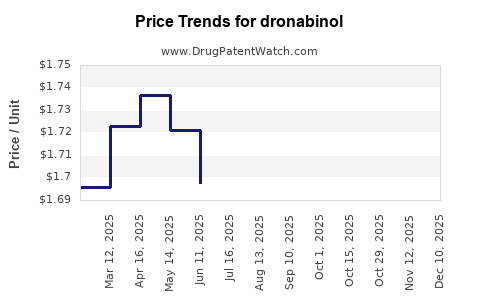
Historical Pricing Trends
| Year |
Price per 1mg Capsule |
Notes |
| 2015 |
$80 |
Peak prices before generics |
| 2020 |
$70 |
Slight decline, increased competition |
| 2022 |
$65 |
Further pressure from generics and biosimilars |
Future Price Trends (Next 5 Years)
| Year |
Estimated Price per 1mg Capsule |
Rationale |
| 2023 |
$65 |
Stable, minor reductions from generics |
| 2025 |
$55-$60 |
Entry of biosimilars and generics, potential policy shifts |
| 2030 |
$50 or lower |
Increased generic penetration, reformulations |
Price Drivers
- Patent expiration: Expected around 2022-2023, leading to price erosion.
- Regulatory reforms: Possible declassification or rescheduling could expand access, affecting pricing.
- Market expansion: Broader indications like pain management could increase volume, offsetting price declines.
Market Forecasts
Estimates suggest a compound annual growth rate (CAGR) of 2-3% over the next five years but could vary depending on regulatory and technological developments.
| Year |
Projected Market Size |
Notes |
| 2023 |
$155 million |
Slight growth, stabilization |
| 2025 |
$160-$165 million |
Market expansion, increased acceptance |
| 2030 |
$170-$180 million |
Growth driven by new indications |
Regulatory and Policy Outlook
- Controlled substance status: Currently Schedule III in the U.S., with potential shifts to Schedule II or lower. Changes could influence prescribing practices and pricing.
- Legalization trends: Increasing medical cannabis legalization worldwide could impact demand for synthetic alternatives.
Key Takeaways
- Dronabinol remains a niche product with steady but limited growth.
- Price erosion is expected with patent expiry and generic competition.
- Expanding indications and shifting regulations could alter market dynamics.
- Current brand prices around $60-$90 per milligram are likely to decline to $50-$60 within five years.
- The overall market is small relative to broader cannabinoid therapeutics, but strategic positioning could identify growth opportunities.
FAQs
1. Will patent expiration reduce dronabinol prices significantly?
Yes. Patent expiry typically leads to increased generic competition, driving down prices by 30-50% over 2-3 years.
2. Can regulatory changes affect dronabinol market dynamics?
Yes. Rescheduling or declassification can increase access and prescriptions, potentially offsetting price reductions with volume growth.
3. Are there new formulations or delivery methods for dronabinol?
Oral capsules remain dominant; however, research into inhaled or transdermal formulations could influence future pricing and uptake.
4. How does the competition from cannabis-based products impact dronabinol?
Legal cannabis products, especially in jurisdictions with deregulated markets, present an alternative, potentially limiting growth for synthetic cannabinoids.
5. What are the main barriers for expanding dronabinol’s approved indications?
Lack of additional clinical trials, regulatory resistance, and the presence of other approved medications in overlapping segments.
References
[1] IQVIA. (2022). Global Pharmaceutical Market Data.
[2] U.S. Food and Drug Administration. (2022). Marinol (Dronabinol) Prescribing Information.
[3] European Medicines Agency. (2021). Product information for Dronabinol.
[4] GlobalData. (2022). Cannabinoids Market Report.
[5] U.S. Drug Enforcement Administration. (2022). Controlled Substance Schedules.