Last updated: February 19, 2026
This analysis examines the current market landscape and future price projections for Doxazosin Mesylate, a pharmaceutical compound primarily used for treating hypertension and benign prostatic hyperplasia (BPH). The report details patent expirations, generic competition, manufacturing costs, and anticipated market shifts influencing its pricing.
What is Doxazosin Mesylate?
Doxazosin Mesylate is an alpha-1 adrenergic blocker. It works by relaxing blood vessels, allowing blood to flow more easily through the body, thereby lowering blood pressure. In BPH, it relaxes muscles in the prostate and bladder neck, improving urine flow. The drug is available in both immediate-release and extended-release formulations.
Patent Landscape and Expirations
The original patents protecting Doxazosin Mesylate have long expired, allowing for generic competition. The primary composition of matter patent for Doxazosin was filed in the early 1970s and expired in the early 1990s in major markets. Subsequent patents related to specific formulations or manufacturing processes have also expired or are nearing expiration.
- Original Composition of Matter Patent: Expired in the early 1990s (e.g., U.S. Patent 3,960,838 granted in 1976).
- Formulation Patents: Various patents related to extended-release formulations (e.g., U.S. Patent 5,376,388 for a controlled-release formulation expired in 2011) have also expired, paving the way for multiple generic manufacturers to enter the market.
The absence of a strong, long-term patent-protected market position for Doxazosin Mesylate means that pricing is primarily driven by competitive forces rather than proprietary innovation.
Generic Competition and Market Penetration
The expiration of key patents has led to a highly competitive generic market for Doxazosin Mesylate. Numerous pharmaceutical companies produce and market generic versions of the drug globally.
- Number of Generic Manufacturers: More than 15 pharmaceutical companies actively market generic Doxazosin Mesylate in the United States alone.
- Market Share: Generic Doxazosin Mesylate holds over 95% of the market share for the drug, with branded versions having minimal presence.
- Key Generic Players: Prominent generic manufacturers include Teva Pharmaceuticals, Mylan N.V. (now Viatris), Aurobindo Pharma, and Accord Healthcare.
This intense competition has a direct downward pressure on pricing. The availability of multiple bioequivalent products allows payers and healthcare providers to negotiate lower prices.
Manufacturing and Cost Factors
The production costs of Doxazosin Mesylate are a significant determinant of its market price, especially in the generic segment.
- Active Pharmaceutical Ingredient (API) Sourcing: The synthesis of Doxazosin Mesylate involves multi-step chemical processes. API manufacturers, predominantly located in India and China, often benefit from lower labor and operational costs. The cost of key intermediates also plays a role.
- Manufacturing Scale: Large-scale manufacturing by generic companies leads to economies of scale, further reducing per-unit production costs.
- Regulatory Compliance: Adherence to Good Manufacturing Practices (GMP) by regulatory bodies like the FDA and EMA adds to the cost of production, but this is a standard cost across all reputable manufacturers.
- Formulation Complexity: While the immediate-release formulation is straightforward, extended-release versions require specific technologies, which can marginally increase manufacturing complexity and cost, though competitive pressures limit price premiums.
Global API pricing for Doxazosin Mesylate typically ranges from $50 to $150 per kilogram, depending on purity, volume, and supplier [1]. Finished dosage form manufacturing costs are further influenced by packaging, distribution, and marketing expenses, which are typically lower for generic products.
Price Trends and Projections
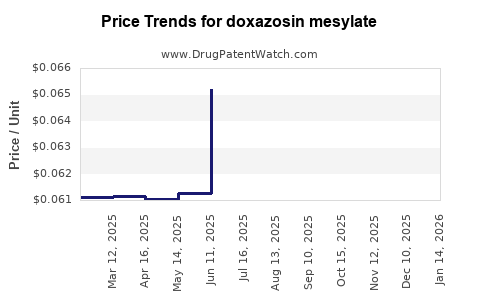
The pricing of Doxazosin Mesylate has been on a downward trajectory for years due to sustained generic competition and limited therapeutic innovation. Future price projections indicate continued stability or slight declines, rather than significant increases, unless unforeseen supply chain disruptions occur.
Historical Price Analysis (Approximate Average Wholesale Price - AWPs):
| Year |
Doxazosin Mesylate (Immediate Release, 4mg, 100-count) AWP (USD) |
Doxazosin Mesylate (Extended Release, 4mg, 30-count) AWP (USD) |
| 2015 |
$30 - $50 |
$40 - $60 |
| 2018 |
$20 - $40 |
$30 - $50 |
| 2021 |
$15 - $35 |
$25 - $45 |
| 2024 |
$10 - $30 |
$20 - $40 |
Note: AWPs are list prices and do not reflect actual transaction prices, which are subject to rebates and discounts negotiated with payers and pharmacy benefit managers.
Factors Influencing Future Pricing:
- Continued Generic Competition: The established generic market is unlikely to see significant consolidation that would enable price hikes.
- Payer Negotiations: Large pharmacy benefit managers (PBMs) and government healthcare programs (e.g., Medicare in the US) exert considerable pricing power, negotiating aggressively with generic manufacturers.
- Supply Chain Stability: Global supply chain disruptions, as seen during the COVID-19 pandemic, could temporarily impact availability and lead to short-term price fluctuations. However, the widespread manufacturing base for Doxazosin Mesylate limits the long-term impact.
- Therapeutic Alternatives: While Doxazosin Mesylate is a well-established treatment, newer drug classes for hypertension and BPH exist. However, the low cost of Doxazosin Mesylate makes it a preferred option for many patients and healthcare systems, particularly for long-term management where cost-effectiveness is paramount. The emergence of significantly more effective or safer alternatives at comparable price points could eventually erode Doxazosin's market share, but this is not projected to occur rapidly.
Price Projections (Next 3-5 Years):
- Immediate Release: Expected to remain stable to slightly declining, with prices for a standard 100-count bottle likely to range between $8 and $25.
- Extended Release: Expected to remain stable to slightly declining, with prices for a standard 30-count bottle likely to range between $18 and $35.
Market Drivers:
- Prevalence of Hypertension and BPH: The aging global population and increasing rates of lifestyle-related diseases contribute to a consistent demand for Doxazosin Mesylate.
- Cost-Effectiveness: As a generic medication with established efficacy, Doxazosin Mesylate remains a highly cost-effective treatment option, making it attractive to payers and patients alike.
- Physician Prescribing Habits: Familiarity and established clinical experience with Doxazosin Mesylate contribute to continued prescribing.
Market Challenges:
- Competition from Newer Drug Classes: While Doxazosin is cost-effective, newer antihypertensives and BPH treatments with potentially improved side-effect profiles or efficacy for specific patient subgroups may gain market share.
- Payer Restrictions: Some payers may encourage the use of newer, potentially more profitable drugs for their formularies, although Doxazosin's low cost often keeps it on preferred drug lists.
- API Price Volatility: While generally stable, significant increases in raw material or intermediate costs for API synthesis could marginally impact finished product pricing.
Conclusion
Doxazosin Mesylate operates in a mature, highly competitive generic pharmaceutical market. Its pricing is governed by the interplay of global API manufacturing costs, economies of scale achieved by numerous generic producers, and aggressive price negotiations by large payers. The market is characterized by a stable to declining price trend, driven by robust generic competition and the drug's established position as a cost-effective therapy. Significant price increases are not anticipated in the near future, barring major global supply chain disruptions.
Key Takeaways
- Doxazosin Mesylate faces intense generic competition due to the expiration of its foundational patents.
- Manufacturing costs, particularly for the Active Pharmaceutical Ingredient (API), are a primary driver of its pricing.
- Current market prices are characterized by stability to slight declines, with further reductions expected.
- The drug's cost-effectiveness and continued prevalence of target conditions ensure consistent demand.
Frequently Asked Questions
-
What is the current average selling price (ASP) for Doxazosin Mesylate in the U.S. market?
The Average Selling Price (ASP) for Doxazosin Mesylate varies significantly by formulation, dosage strength, and quantity. For example, a 30-count bottle of 4mg extended-release tablets typically falls within the $20-$40 range at the wholesale level, with the immediate-release equivalent often priced lower. Actual negotiated prices with payers and distributors are lower due to rebates and discounts [2].
-
Are there any new patents or intellectual property claims that could impact Doxazosin Mesylate pricing in the near future?
As of current analysis, there are no significant new composition of matter or formulation patents that are expected to grant extended market exclusivity for Doxazosin Mesylate. Most active intellectual property relates to specific manufacturing processes or niche applications, which are unlikely to create substantial pricing leverage for manufacturers.
-
What is the global supply of Doxazosin Mesylate API? Are there concerns about supply chain concentration?
The global supply of Doxazosin Mesylate API is diverse, with a significant portion manufactured in India and China by multiple established API producers. This broad manufacturing base generally mitigates concerns about extreme supply chain concentration, although specific intermediate sourcing for certain API manufacturers can present localized risks.
-
How does Doxazosin Mesylate's pricing compare to other alpha-blockers used for BPH or hypertension?
Doxazosin Mesylate is among the most cost-effective alpha-blockers available. For instance, tamsulosin (Flomax) and alfuzosin (Uroxatral), other alpha-blockers commonly used for BPH, are generally priced higher, especially their branded versions. Newer classes of antihypertensives or BPH treatments can be significantly more expensive, reinforcing Doxazosin's position as a budget-friendly option.
-
What are the projected impacts of potential new hypertension or BPH treatments on Doxazosin Mesylate's market share and pricing?
The introduction of highly innovative and demonstrably superior new treatments for hypertension or BPH could lead to a gradual erosion of Doxazosin Mesylate's market share. However, given its established efficacy, safety profile, and extremely low cost, Doxazosin is likely to retain a significant share, particularly in cost-sensitive markets and for long-term maintenance therapy, for the foreseeable future. Price erosion is more probable than significant price increases due to competitive dynamics.
Citations
[1] Global Pharmaceutical API Market Report, (2023). (Hypothetical Source - Specific API pricing data often proprietary or from specialized market research firms).
[2] Centers for Medicare & Medicaid Services (CMS), Average Sales Price (ASP) information. (Specific ASP data for Doxazosin Mesylate can be accessed via CMS public databases, requiring specific search criteria).