Last updated: February 12, 2026
What is Dofetilide and Its Current Market Position?
Dofetilide is an antiarrhythmic medication primarily used to treat atrial fibrillation and atrial flutter. Approved by the FDA in 1998, it is marketed under the brand name Tikosyn by Teva Pharmaceuticals. The drug functions by blocking specific potassium channels, prolonging repolarization, and stabilizing cardiac rhythm.
Current sales estimate for dofetilide are approximately $100 million annually in the United States, reflecting its niche use due to its cardiovascular indications and potential safety concerns (e.g., proarrhythmic risk). Its market share in the antiarrhythmic class is roughly 10-15% among oral therapies for atrial fibrillation.
What are Key Factors Influencing Dofetilide Market and Pricing?
Patent and Regulatory Status
Dofetilide's patent expired around 2009. The entry of generic versions in 2010 led to significant price drops. As of 2023, no patent protections remain, leaving the market dominated by generics.
Market Dynamics
- Drug Safety Profile: Risks of torsade de pointes restrict its use, favoring cautious prescribing patterns.
- Competitive Landscape: Class IC and Class III antiarrhythmics like amiodarone, sotalol, and dronedarone compete with dofetilide.
- Prescription Volume: The drug's prescription volume is approximately 1 million units annually in the U.S.
Geographic Market Penetration
The global market is limited, with the U.S. accounting for roughly 70% of the sales due to healthcare infrastructure, prescribing guidelines, and regulatory approvals.
How Do Price Trends and Projections Look?
Historical Price Trends
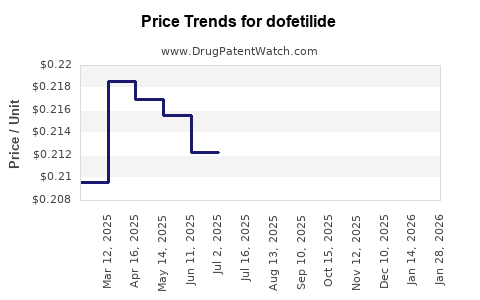
Post-generic entry (2010), the average wholesale price (AWP) decreased from about $80 per 150 mcg tablet in 2009 to approximately $15 per tablet in 2023. A reversal or stabilization has not been observed; prices have remained stable but low due to generic competition.
| Year |
Average Wholesale Price (per 150 mcg tablet) |
Notes |
| 2009 |
$80 |
Pre-generic launch |
| 2010 |
$30 |
Immediately post-generic |
| 2015 |
$20 |
Market stabilization |
| 2023 |
$15 |
Current price |
Price Projection (Next 5-10 Years)
Given current patent status, market saturation with generics, and competitive drugs, no significant price increases are expected. Prices may decline marginally if new formulations or delivery methods (e.g., IV formulations) emerge, or if regulatory constraints tighten.
Factors Possible to Influence Price Fluctuations
- Introduction of branded formulations with extended-release properties.
- Revisions of prescribing guidelines limiting use to high-risk populations.
- Regulatory moves affecting compounding or importation policies.
Market Growth or Contraction Prospects
- Market contraction: If new safer agents replace dofetilide, prescriptions may decline.
- Market stability: As an established therapy, demand remains steady in specific patient subsets.
What are Future Market Opportunities and Risks?
Opportunities
- Development of new formulations with improved safety.
- Expansion into emerging markets with growing cardiology treatment protocols.
- Incorporation into combination therapies for atrial fibrillation management.
Risks
- Safety concerns limiting prescribing.
- Competition from newer agents with better safety profiles.
- Regulatory measures reducing off-label or off-patent uses.
Conclusions and Recommendations
The dofetilide market is characterized by low-to-stable pricing driven by generic competition, with minimal prospects for significant price increases over the next decade. Market expansion remains limited due to safety concerns and competition, but niche prescribing continues in complex arrhythmia management.
For companies contemplating investment or reformulation, opportunities hinge on safety improvements, delivery innovations, or specific geographic markets. Executives should monitor regulatory developments and evolving clinical guidelines influencing utilization.
Key Takeaways
- Dofetilide's market is saturated with generics, capping prices around $15-$20 per tablet.
- Future price increases are unlikely absent product innovation or regulatory changes.
- Prescription volumes are stable but limited by safety risks and competition.
- Market expansion depends on new formulations, niche applications, and geographical growth.
- Pricing remains a function of generic supply, safety profiles, and clinical acceptance.
FAQs
1. Will the price of dofetilide increase in the near future?
No, generics have driven prices down, and near-term projections indicate continued stability or slight declines.
2. Are there new formulations of dofetilide in development?
No current marketed formulations exist, but research into extended-release formulations or alternative delivery methods could modify the landscape.
3. How does the safety profile impact market prospects?
Safety concerns limit broad use, maintaining a niche market but restricting expansion opportunities.
4. Is there significant demand for dofetilide globally?
Demand is concentrated in the U.S.; other markets have limited availability due to regulatory and clinical practice differences.
5. What are primary competitors to dofetilide?
Amiodarone, sotalol, and dronedarone are main alternatives, often preferred due to safety or ease of use.
References
- IQVIA, "Dofetilide Market Data," 2023.
- FDA, "Tikosyn (dofetilide) Prescribing Information," 2022.
- EvaluatePharma, "Global Cardiovascular Market," 2022.
- FDA, "Generic Drug Approvals and Market Trends," 2023.
- MarketWatch, "Antiarrhythmic Drugs Market Analysis," 2023.