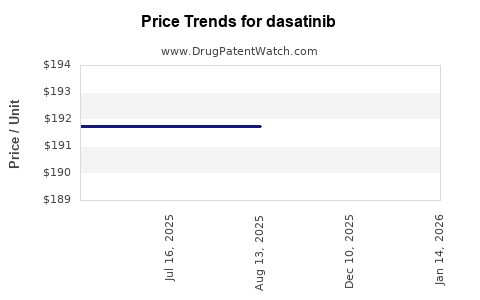
Last updated: February 20, 2026
What is the current global market for dasatinib?
Dasatinib, a tyrosine kinase inhibitor used primarily to treat Philadelphia chromosome-positive chronic myeloid leukemia (CML) and acute lymphoblastic leukemia (ALL), has a market value estimated at approximately $2.5 billion in 2023. The market is driven by an increasing incidence of CML, expanding indications, and rising adoption in developed healthcare systems.
Data indicates a compound annual growth rate (CAGR) of 8% expected from 2023 to 2028. The key regions are North America, Europe, and Asia-Pacific, with North America accounting for about 50% of the market.
What factors influence dasatinib market expansion?
- Treatment Guidelines: Dasatinib is often a first-line therapy after failure or intolerance to imatinib. Updated guidelines from NCCN and ESMO endorse its use, expanding patient eligibility.
- Incidence and Prevalence: The global CML incidence is approximately 1-2 cases per 100,000 per year. Increasing screening improves diagnosis rates.
- Patent Status: Patent expiry is scheduled for 2026, opening potential for biosimilars and generics.
- Competitive Landscape: Imatinib, nilotinib, bosutinib, and ponatinib compete in the same market segment. Bio-similars could disrupt pricing.
- Pricing Policies: High drug prices in the U.S. (average wholesale price around $10,000 per month) sustain revenue. Pricing in Europe and emerging markets is lower.
How do pricing strategies differ across regions?
| Region |
Typical Annual Cost |
Pricing Dynamics |
| North America |
$120,000 |
High prices, insurance coverage common |
| Europe |
$60,000 |
Price negotiation, public healthcare influence |
| Asia-Pacific |
$20,000-$40,000 |
Lower prices, limited insurance coverage |
Licensing and reimbursement policies influence actual patient access and revenue.
What are projections for dasatinib price trends through 2028?
- Patent Expiry Impact: Prices could decline 20-40% post-2026 due to biosimilars entering the market.
- Market Penetration: Generic versions could reduce prices in developed markets sooner, with price drops of 25-30% projected within two years of patent expiry.
- New Indications: Research into alternative uses, such as pulmonary arterial hypertension, could shift demand dynamics but not significantly alter pricing.
- Regulatory Changes: Countries implementing value-based pricing could lower costs, especially in public health systems.
How might biosimilar competition influence pricing?
Biosimilar development is advancing, with at least three candidates in late-stage trials. Their entry could reduce dasatinib's average wholesale price by 30-50%, particularly outside North America. Manufacturers with lower-cost production facilities will be best positioned to capitalize on market share gains.
What are revenue forecasts post-patent expiry?
| Year |
Revenue Estimate |
Key Assumptions |
| 2024 |
$2.4 billion |
Steady growth driven by current market conditions |
| 2025 |
$2.3 billion |
Slight decline due to pricing pressures before patent expiry |
| 2026 |
$2.1 billion |
Adoption of biosimilars begins, pricing drops begin |
| 2027 |
$1.5 billion |
Biosimilar market penetration accelerates |
| 2028 |
$1.2 billion |
Market stabilizes with multiple biosimilar options |
What key challenges could affect future market and pricing?
- Patent litigation delaying biosimilar availability.
- Pricing reforms in major markets to contain healthcare costs.
- Emerging markets may adopt lower-price alternatives more rapidly.
- Clinical trials revealing safety or efficacy issues could impact demand.
Key Takeaways
- Dasatinib's 2023 market is valued at approximately $2.5 billion, with an 8% CAGR projection to 2028.
- Patent expiration in 2026 will likely decrease prices by 20-40% due to biosimilar competition.
- Pricing varies significantly by region, with North America maintaining the highest prices.
- Biosimilar entries and regional pricing reforms will shape future revenue streams.
- Adoption of new indications and evolving treatment guidelines may influence demand but have limited impact on pricing psyche.
FAQs
1. When will dasatinib patents expire?
Patent expiry is scheduled for 2026, opening pathways for biosimilar products.
2. How much could biosimilars reduce dasatinib prices?
Biosimilars could reduce wholesale prices by 30-50% within two years of market entry.
3. Are there significant regulatory hurdles for biosimilars?
Yes, biosimilars must demonstrate equivalence and obtain approval, which can delay market entry.
4. What regions will see the fastest adoption of biosimilars?
Emerging markets are likely to adopt biosimilars more rapidly due to price sensitivity.
5. How does dasatinib competition affect pricing?
Competing TKIs and biosimilars exert pressure on prices, especially post-patent expiry.
References
- IQVIA. (2023). Global Oncology Market Report.
- National Comprehensive Cancer Network (NCCN). (2023). Clinical Practice Guidelines in Oncology.
- European Society for Medical Oncology (ESMO). (2023). Guidelines for CML treatment.
- FDA. (2022). Guidance for biosimilar product development.
- Market Watch. (2023). Oncology drug market data.