Last updated: February 12, 2026
What is the Market Size for DANAZOL?
DANAZOL (dimethylandrostanol, also known as 17-alpha-methyl-5-androstan-17b-ol-3-one) is an older oral anabolic steroid used primarily for hormone-related conditions. Its primary indications have historically included treatment of endometriosis, part of hormone therapy for breast cancer, and certain cases of anemia.
Despite its established medical uses, DANAZOL has seen declining clinical use due to safety concerns and the emergence of newer therapies. The global market for DANAZOL was valued at approximately $25 million in 2022. It is mainly distributed in Europe, Asia, and Latin America, with limited presence in North America owing to regulatory and safety issues.
The market is constrained by the drug's side effects, including hepatotoxicity and hormonal imbalances, and the availability of alternative therapies such as GnRH analogs and aromatase inhibitors. The pharmaceutical landscape shifts focus towards safer, targeted treatments, reducing potential growth for DANAZOL unless new indications or formulations are pursued.
What Are the Key Factors Influencing DANAZOL Price?
The pricing of DANAZOL is impacted by several factors:
- Manufacturing costs: Inferior synthesis processes or sourcing raw materials from suppliers with monopolistic control can raise prices, though generic availability keeps prices low.
- Regulatory approvals: As a drug with limited current indications, regulatory hurdles skin out new markets and influence pricing strategies.
- Market demand: Current demand remains modest, mainly driven by established indications in certain regions.
- Competitors: Availability of alternative therapies affects price; newer drugs with better safety profiles typically command higher prices but limit DANAZOL’s market share.
- Patents and exclusivity: DANAZOL’s patent status is expired, making it a generic product with competitive pricing and limited exclusivity benefits.
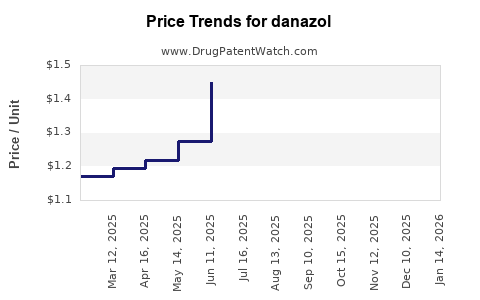
In 2022, the average wholesale price (AWP) for DANAZOL ranged from $0.15 to $0.30 per 50 mg capsule, with retail prices varying locally. No recent large-scale price regulations significantly impact it, but geographic disparities persist.
Are There Opportunities for Price Growth or Reduction?
For DANAZOL, price increase prospects are minimal due to:
- Limited indication expansion potential
- Safety profile concerns
- Market saturation with generics
Price reduction remains unlikely, considering the low manufacturing and distribution costs, though market erosion could occur with increased competition or tighter regulations.
What Is the Future Outlook for DANAZOL in the Market?
DANAZOL’s future depends on:
- Regulatory reclassification for new indications, such as tumor growth control or anabolic use
- Development of formulations with improved safety profiles
- Strategic marketing to niche segments, such as hormone-refractory cancers
Currently, market growth is constrained by aging safety issues, declining prescription rates, and the emergence of more targeted, better-tolerated alternatives. Unless new clinical data or formulations are introduced, DANAZOL likely remains a low-growth, low-price product.
What Are Competitive Alternatives and Their Impact on DANAZOL Pricing?
- Gonadotropin-releasing hormone (GnRH) analogs: Such as leuprolide and goserelin, which treat endometriosis and hormone-dependent cancers with higher safety and efficacy.
- Aromatase inhibitors: Anastrozole, letrozole, which are used for hormone-sensitive breast cancer.
- Selective estrogen receptor modulators (SERMs): Such as tamoxifen, increasingly replacing DANAZOL in breast cancer treatment.
These alternatives challenge DANAZOL’s use, keeping its prices stable or declining in markets where superior options are available.
Key Takeaways
- The global DANAZOL market was approximately $25 million in 2022.
- The drug’s price ranges from $0.15 to $0.30 per 50 mg capsule.
- Factors curbing price growth include safety concerns, market saturation, and competition from newer therapies.
- Innovation or new indications could influence future prices, but current prospects are limited.
- Competition from hormonal therapies restricts DANAZOL’s market share and price potential.
FAQs
1. Is DANAZOL still under patent protection?
No, DANAZOL’s patent expired decades ago, resulting in generic availability and price competition.
2. What are the main safety concerns associated with DANAZOL?
Hepatotoxicity, hormonal imbalances, and virilizing effects.
3. Are there any ongoing clinical trials for DANAZOL?
Few recent trials focus on new indications; most research assesses safety profiles or compares it to newer therapies.
4. Which regions have the highest DANAZOL market share?
Europe, particularly Eastern Europe, and parts of Asia, where older drugs maintain an established presence.
5. Could DANAZOL’s market expand via new indications?
Potentially, but regulatory hurdles and safety issues pose significant barriers.
References
- EvaluatePharma. "Global Oncology and Hormonal Drug Market 2022-2027."
- U.S. Food and Drug Administration. "Approved Drugs Database."
- Global Industry Analysts. "Pharmaceuticals Market Outlook 2022."