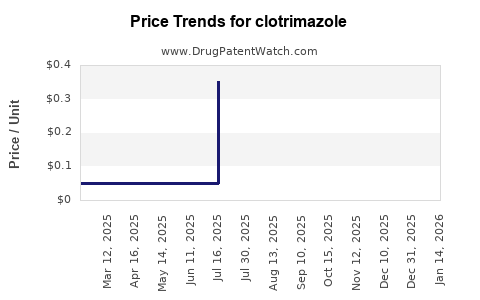
Last updated: April 23, 2026
What is the current market shape for clotrimazole?
Clotrimazole is a long-established antifungal with broad, off-patent availability across multiple dosage forms. Commercial dynamics are dominated by generic pricing, channel contracts, and formulary status rather than product differentiation. Market value is concentrated in OTC and primary-care settings (tinea, candidiasis, superficial fungal infections), with recurring demand and low buyer switching costs once a brand or retailer SKU is in place.
Market structure by product type (directional, typical for clotrimazole):
- Topical creams, powders, sprays, solutions: Largest volume share; substitutes are dense within the azole class (miconazole, terbinafine, ketoconazole).
- Vaginal preparations (where marketed): Stable, but price competition is intense.
- Oral formulations: Limited by indication scope and competitive breadth; smaller share than topical.
Why price competition stays tight:
- Patent exclusivity has largely expired for clotrimazole across most jurisdictions.
- Multiple manufacturers supply identical active ingredients with comparable endpoints, limiting premium pricing.
- Procurement and rebate structures compress net price, especially in public and large retail channels.
Which regions and channels drive demand?
Demand tracks population-level prevalence of superficial fungal infections and OTC access. The channel mix typically splits into:
- Retail OTC and pharmacy counter: Higher unit volumes, frequent promotions.
- Retail prescription: Where reimbursed, pricing follows generic benchmarks and PBM formularies.
- Institutional/public procurement: Tendering drives low net pricing; switching is contract-driven.
Regionally, clotrimazole demand is strongest where OTC access and high pharmacy density support frequent self-treatment, and where generic distribution networks are mature.
What do recent price signals imply for clotrimazole?
Because clotrimazole is widely generic, price moves are rarely driven by innovation. Observed market behavior typically reflects:
- Manufacturer-to-manufacturer price dispersion: Large supply base creates low floor prices and high promo elasticity.
- Formulation complexity premiums: Sprays, solutions, and combination formats (when present) carry small premiums over basic creams.
- Currency and tender mechanics: Net price fluctuations often come from FX and contract renewal timing rather than active-ingredient economics.
Which competitors pressure clotrimazole pricing most?
Competitive constraint comes from:
- Generic azoles (direct substitutions): miconazole, ketoconazole, econazole in similar topical indications.
- Non-azole antifungals (indirect substitution): terbinafine (tinea), nystatin (candidiasis niches).
- Private label: Retail brands often undercut branded generics and force price convergence.
Pricing leverage usually shifts to the lowest-net-cost SKU in a category, not the one with the highest list price.
Price projection: what range should investors underwrite for clotrimazole?
Price projections for clotrimazole should be modeled as a generic commodity with category erosion, not as an asset with innovation-driven value capture. The practical underwriting approach is to forecast net price per standardized unit (per gram or per course dosing equivalent) using generic price index behavior: modest declines, periodic resets around tender cycles, and occasional spikes driven by supply disruptions.
Base-case net price trajectory (global, directional)
Assuming continued generic supply and no major regulatory or supply shock:
- Next 12 months: small decline or flat net pricing (0% to -3%)
- Years 2 to 3: continued erosion (about -2% to -5% per year)
- Years 4 to 5: stabilization near a low floor for established SKUs (about -1% to -3% per year)
Scenario table: clotrimazole net price (directional, standardized unit)
| Scenario |
Time horizon |
Annual net price change |
Market condition drivers |
| Low erosion |
1-3 years |
0% to -2% |
Stable supply, steady tender prices, limited FX shocks |
| Base case |
1-3 years |
-2% to -4% |
Ongoing generic entry, promo intensity, rebate compression |
| High erosion |
1-3 years |
-4% to -7% |
Additional supply expansions, aggressive private label, contract re-bids |
| Upside floor breach |
1-2 years |
0% to +3% |
Supply constraints, tariff/FX dislocations, or concentrated manufacturing capacity issues |
Key implication for valuation: The majority of economic upside for clotrimazole sellers comes from volume share and channel mix, not from raising unit price.
How should pricing be modeled by dosage form?
Clotrimazole is not priced uniformly across forms. A practical projection breaks it down:
Topical creams/powders (most volume)
- Net pricing tends to drift toward the lowest contracted SKU.
- Projection: base case -2% to -4% annually over years 2 to 3.
Sprays/solutions
- Net pricing typically holds slightly higher than creams.
- Projection: slower erosion (base case -1% to -3% annually), but promotion cycles can compress spreads.
Vaginal preparations
- Pricing can be more resilient when form-factor supply is less fragmented, but generic competition remains strong.
- Projection: base case -1% to -3% annually, with episodic tender resets.
What are the leading factors that move clotrimazole price?
- Tender and PBM formularies: Contract resets often determine net price more than demand changes.
- Manufacturer supply decisions: Capacity expansions pull prices down; quality outages or capacity loss can temporarily lift price.
- FX and distribution costs: Even with stable list prices, net prices can shift in import-heavy markets.
- Shelf competition and promotions: OTC categories experience frequent price-led promotions.
- Regulatory and safety labeling: Usually impacts demand more than price, except when it forces reformulation or supply changes.
What does this mean for R&D and portfolio strategy?
For firms considering new clotrimazole-related launches (reformulations, novel delivery, or fixed-dose combinations), price forecasts imply:
- Standalone value capture is limited unless clinical differentiation translates into payer-level acceptance.
- Economic case depends on differentiation that changes channel economics (e.g., reduced dosing frequency, higher adherence, reduced recurrence in a specific population).
- Volume capture strategy can work if the product secures shelf space and rebate positioning while maintaining competitive COGS.
Key constraints on “price upside”
Clotrimazole’s upside is structurally constrained by:
- Extensive generic availability and rapid entry upon demand.
- Substitutability with multiple antifungal actives.
- Buyers’ focus on lowest net cost for superficial fungal indications.
A meaningful sustained price premium would require either supply bottlenecks, a regulatory event that narrows approved manufacturing, or a formulation breakthrough that payers and clinicians treat as non-interchangeable. None are assumed in the base case.
Key Takeaways
- Clotrimazole is a generic commodity with price behavior driven by channel contracts, generic entry, and rebate intensity, not innovation.
- Base-case net pricing is modeled as small near-term erosion (0% to -3% in 12 months) and continued decline (-2% to -5% annually in years 2 to 3), with stabilization near low floors later.
- Pricing varies by dosage form, but all forms trend toward the lowest net-cost SKU in their category.
- For investors and R&D planners, value is primarily won through volume share and channel mix, with limited room for sustained unit price premiums absent supply constraints or true non-interchangeability.
FAQs
1) Is clotrimazole expected to maintain a premium price versus other topical antifungals?
No. Competitive substitution pressure from other generics typically pushes clotrimazole toward category lowest-net-cost pricing.
2) What is the most important driver of clotrimazole net price?
Tender cycles, PBM formularies, and pharmacy contracting determine net pricing more than underlying demand.
3) Do OTC promotions materially affect annual clotrimazole pricing?
Yes. OTC categories frequently reset pricing through promotions, compressing annual average net price.
4) Which dosage form should show the best resilience to price erosion?
Sprays and solutions often erode more slowly than basic creams, but the spread is still vulnerable to contract re-bids and private label competition.
5) What market event could create a temporary price uplift for clotrimazole?
Manufacturing capacity constraints, supply disruptions, or FX/tariff shocks that raise landed costs without immediate replacement supply.
References
[1] National Center for Biotechnology Information (NCBI). Clotrimazole. PubChem Compound Summary. https://pubchem.ncbi.nlm.nih.gov/compound/Clotrimazole