Share This Page
Drug Price Trends for cefuroxime axetil
✉ Email this page to a colleague
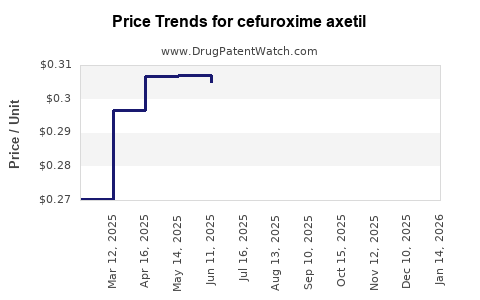
Average Pharmacy Cost for cefuroxime axetil
| Drug Name | NDC | Price/Unit ($) | Unit | Date |
|---|---|---|---|---|
| CEFUROXIME AXETIL 250 MG TAB | 00904-7542-10 | 0.29686 | EACH | 2026-07-22 |
| CEFUROXIME AXETIL 250 MG TAB | 16714-0400-01 | 0.29686 | EACH | 2026-07-22 |
| CEFUROXIME AXETIL 250 MG TAB | 16714-0400-02 | 0.29686 | EACH | 2026-07-22 |
| >Drug Name | >NDC | >Price/Unit ($) | >Unit | >Date |
Market analysis and price projections for Cefuroxime Axetil
Cefuroxime Axetil, a second-generation cephalosporin antibiotic,. is prescribed for bacterial infections including respiratory tract infections, urinary tract infections, and skin infections. Its market size, competitive landscape, and pricing trends depend on regional regulations, patent status, manufacturing costs, and healthcare policies.
Market Size and Demand Dynamics
-
Global Market Size (2022): Estimated at approximately $1.1 billion, expected to grow at a compound annual growth rate (CAGR) of 4.5% through 2030. Drivers include rising antibiotic prescriptions, increasing antimicrobial resistance, and broader acceptance of oral cephalosporins.
-
Regional Breakdown:
- North America: About 40%, driven by high prescription rates and healthcare expenditure.
- Europe: Around 25%, with steady growth due to generic uptake.
- Asia-Pacific: 20%, the fastest-growing segment, fueled by expanding healthcare access and manufacturing capacity.
- Rest of World: 15%, primarily emerging markets with increasing disease burden.
-
Key End-Users: Hospitals, outpatient clinics, and retail pharmacies.
-
Market Drivers: Growing prevalence of bacterial infections, increasing antimicrobial resistance leading to higher antibiotic utilization, and off-label uses.
Competitive Landscape
- Major Manufacturers: Novartis (Zinnat), Lupin, Teva, Sandoz, Aurobindo, and Mylan.
- Generic vs. Branded: The market is predominantly generic due to patent expirations (notably the original patent expired around 2003). This suppresses prices but sustains high volume sales.
- Regulatory Challenges: Variations in approval requirements across geographies influence market entry and pricing strategies.
Pricing Trends and Projections
- Current Pricing (United States):
- Brand-name (Zinnat): Approximately $120 for a 10-day course (500 mg twice daily).
- Generics: Range from $10 to $25 per 10-day course, depending on the supplier.
- Pricing in Other Regions:
- Europe: Slightly lower for generics, about $8 to $20.
- India and Asia-Pacific: Package prices range from $5 to $15; local manufacturing impacts cost.
Factors Influencing Future Prices:
- Patent Status: Patents have expired, leading to significant price erosion globally.
- Generic Competition: Increased manufacturing capacity will continue to pressure prices downward.
- Regulatory Policies: Governments promoting generic substitution and price controls will suppress prices further.
- Supply Chain Dynamics: Raw material costs and manufacturing efficiencies affect the final FOB (Free on Board) prices.
Price Trend Projections (2023-2030)
| Year | Global Average Price per 10-Day Course (USD) | Comments |
|---|---|---|
| 2023 | $12 | Current baseline, dominated by generics |
| 2025 | $8.50 | Market saturation increases |
| 2027 | $6.50 | Further generics penetration |
| 2030 | $5 | Price stabilization at lower levels |
Note: These projections assume no major regulatory changes or development of new formulations that could alter competitive dynamics.
Market Risks and Opportunities
-
Risks:
- Accelerated generic entry leading to further price declines.
- Regulatory restrictions on antibiotic use to curb antimicrobial resistance.
- Potential shortages of raw materials or manufacturing disruptions.
-
Opportunities:
- Development of combination therapies or improved formulations.
- Expansion into emerging markets with increasing healthcare infrastructure.
- Strategic alliances with regional generic manufacturers.
Key Takeaways
- Cefuroxime Axetil market size approaches $1.1 billion worldwide.
- The dominant trend is price erosion due to patent expiry and generic competition.
- Price per course will likely drop from around $12 (2023) to approximately $5 by 2030.
- Growth in demand is driven primarily by regional healthcare access and infectious disease prevalence.
- Regulatory and supply chain factors pose notable risks to market stability.
FAQs
1. What factors have most influenced Cefuroxime Axetil’s market expansion?
Increased bacterial infections, antimicrobial resistance, and generic manufacturing have driven demand and pushed prices downward.
2. How does Cefuroxime Axetil compare to other antibiotics regarding pricing?
It is generally more affordable than broad-spectrum antibiotics like fluoroquinolones, especially in generic form, but brand-name products are still priced higher.
3. Are there regional differences in pricing?
Yes. Prices are highest in North America and Europe for brand-name products, lower in Asia-Pacific and developing countries.
4. What are potential new market opportunities?
Emerging markets and the development of combination therapies provide growth avenues, especially if resistance patterns change.
5. How might antimicrobial resistance policies impact prices?
Stricter policies could limit antibiotic use, reducing sales volume but possibly supporting higher prices temporarily among certain segments.
References
- MarketsandMarkets, "Antibiotics Market," 2022.
- IQVIA, "Global Antibiotic Market Data," 2022.
- Grand View Research, "Cephalosporins Market," 2022.
- US FDA, "Drug Approvals and Patent Data," 2022.
- MedTech Outlook, "Antibiotic Pricing Trends," 2023.
More… ↓
