Last updated: February 19, 2026
What is Carisoprodol and How is It Regulated?
Carisoprodol is a muscle relaxant marketed primarily under the brand name Soma. It is used to treat acute musculoskeletal pain. Originally approved by the U.S. Food and Drug Administration (FDA) in 1959, the drug was available over-the-counter until 2012, when it was reclassified as a Schedule IV controlled substance due to concerns over abuse and dependence (FDA, 2012).
Regulatory status varies globally. The drug remains prescription-only in the United States, Canada, and many European countries, with some jurisdictions imposing tighter restrictions on dispensing and online sales.
Market Size and Key Players
Global Market Overview
The global muscle relaxant market, which includes drugs like carisoprodol, was valued at approximately USD 3.2 billion in 2021. The market for centrally acting muscle relaxants is expected to grow at a compound annual growth rate (CAGR) of about 4.2% from 2022 to 2030.
Carisoprodol holds an estimated 12% share within the muscle relaxant segment, trailing behind drugs such as cyclobenzaprine and methocarbamol. Its decline in some markets due to regulatory restrictions has been partially offset by increased use in countries with looser controls.
Key Manufacturers
Major pharmaceutical companies producing or distributing carisoprodol include:
- Mylan (subsidiary of Viatris): Manufactures generic formulations.
- Alphapharm (Australia): Supplies local generics.
- Teva Pharmaceuticals: Has a market presence with generic versions.
- Impax Laboratories: Coordinates distribution in select markets.
Some markets have seen the entry of online and unregulated suppliers, affecting pricing dynamics.
Current Pricing Landscape
Retail and Wholesale Prices
In the United States, the average retail price for a 30-tablet pack of 350 mg carisoprodol ranges from USD 15 to USD 25. Generic forms dominate the market, which keeps prices relatively low compared to branded equivalents.
Wholesale prices are variable but approximate USD 10 per 30-tablet pack, depending on quantity and supplier.
Impact of Regulatory Changes
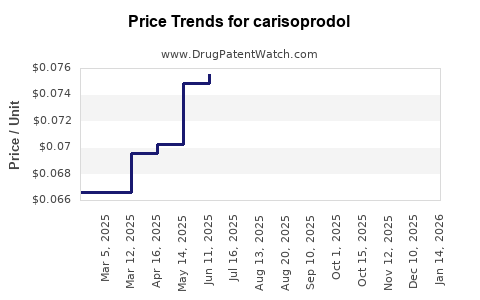
Following its Schedule IV classification in 2012, prices spiked temporarily due to supply constraints. Currently, the market stabilizes around pre-regulation levels but with increased scrutiny on distribution channels.
In countries with looser regulations (e.g., some Latin American nations), prices range from USD 8 to USD 12 per 30-tablet pack, with less formal pricing controls.
Price Trends and Key Influences
- Regulatory Restrictions: Tightened controls in the U.S. and Europe push prices upward in formal markets.
- Generic Competition: Increased generic manufacturing reduces prices.
- Online Sales: Unregulated online sources often sell lower-priced, possibly illicit, products, impacting formal market prices.
- Manufacturing Costs: Ingredient costs and production complexities remain stable, but supply chain disruptions (e.g., during the COVID-19 pandemic) have caused price fluctuations.
Market Dynamics and Future Projections
Demand Drivers
- Orthopedic and pain management clinics: Continued prescription volume due to widespread musculoskeletal conditions.
- Regulatory transition in emerging markets: Some countries are liberalizing drug access, potentially increasing consumption.
- Abuse potential leading to regulatory scrutiny, which could reduce access and demand.
Risks and Constraints
- Regulatory Actions: Stricter controls, including prescription-only policies, could reduce availability, suppress prices, and impact sales volumes.
- Competitive Landscape: The introduction of newer muscle relaxants with fewer abuse issues might displace carisoprodol.
- Legal and Safety Concerns: Increased legal restrictions in multiple jurisdictions could further limit market access.
Price Projection (Next 5 Years)
| Year |
Price Range (USD per 30-tablet pack) |
Notes |
| 2023 |
15-25 |
Current stability, with minor fluctuations |
| 2025 |
16-27 |
Slight increase due to inflation and regulatory tightening in some markets |
| 2027 |
17-30 |
Potential price stabilization in markets with strict controls, slight growth in some regions |
| 2030 |
18-33 |
Global trend toward tighter regulation may limit price hikes; prices in emerging markets may remain lower |
Conclusion
Carisoprodol remains a moderately priced muscle relaxant with a global market subject to regulatory influence. Prices are stable but susceptible to increases due to enforcement of prescription controls and supply chain disruptions. The drug's future market size is constrained by its abuse potential and regulatory restrictions but maintains demand in orthopedic treatment contexts.
Key Takeaways
- Carisoprodol's global market is valued at approximately USD 3.2 billion (2021) with a 12% market share within muscle relaxants.
- In the U.S., current retail prices hover between USD 15–25 for a 30-tablet pack.
- Regulatory reclassification as a Schedule IV drug in key markets has influenced pricing dynamics and availability.
- Price projections suggest modest increases over the next five years, contingent on regulatory and market conditions.
- Emergence of tighter controls may limit market size and impact pricing, especially in developed markets.
FAQs
What is the primary regulatory challenge faced by carisoprodol?
Its potential for abuse has led to reclassification as a Schedule IV controlled substance in the United States and similar restrictions elsewhere, reducing availability and increasing oversight.
Which markets represent the largest growth opportunities for carisoprodol?
Emerging markets with less restrictive drug policies and expanding healthcare infrastructure offer potential growth, though local regulations may vary.
How does generic competition impact the price of carisoprodol?
Increased generic manufacturing drives prices down, maintaining affordability but reducing profit margins for manufacturers.
Are there any legal risks associated with online sales of carisoprodol?
Yes. Unregulated online sources often sell illicit or counterfeit products, posing legal and safety risks for consumers.
What alternative drugs could replace carisoprodol in the market?
Other muscle relaxants like cyclobenzaprine and methocarbamol, which have similar efficacy and potentially lower abuse risk, are replacing carisoprodol in certain regions.
References
[1] U.S. Food and Drug Administration. (2012). FDA removes prescribing information for carisoprodol from labeling due to misuse. https://www.fda.gov/drugs/drug-safety-and-availability/fda-removes-prescribing-information-carisoprodol-labeling-due-misuse