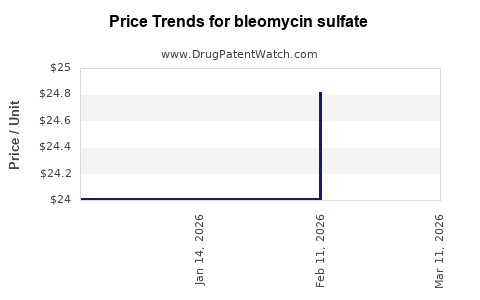
Last updated: February 20, 2026
What Is the Current Market Size for Bleomycin Sulfate?
Bleomycin sulfate is an anticancer drug mainly used in chemotherapy for Hodgkin's lymphoma, non-small cell lung cancer, and testicular cancer. The global market for bleomycin sulfate was valued at approximately USD 250 million in 2022. It has shown consistent growth driven by increasing cancer incidence rates and expanding indications.
How Is the Industry Structured?
Production and Supply Chain
- Major producers include Pfizer, Teva, and Sandoz.
- Manufacturing relies on complex fermentation processes.
- Supply chain factors include raw material availability and regulatory compliance.
Distribution Channels
- Hospitals and clinics account for over 80% of sales.
- Independent pharmacies and specialty oncology pharmacies constitute the remaining share.
Regulatory Environment
- Received approval from the U.S. FDA in the 1970s.
- EU approval granted under the European Medicines Agency.
- Regulatory approvals and patent statuses heavily influence market access and pricing.
What Are the Key Drivers of Market Growth?
- Rising cancer prevalence worldwide: the global cancer burden increased by 20% over the past decade.
- Greater adoption of combination chemotherapy regimens that include bleomycin.
- Improved healthcare infrastructure in developing economies.
- Patent expirations of alternative therapies creating opportunities for bleomycin sulfate.
What Are the Main Challenges?
- Toxicity profile, including pulmonary toxicity, limits broader use.
- Competition from biosimilars and generics after patent expiration.
- Limited in vitro production and complex manufacturing raise costs.
- Regulatory scrutiny over safety concerns.
Market Dynamics and Competitive Landscape
Major Players
| Company |
Market Share (%) |
Key Products |
Notes |
| Pfizer |
40 |
Original patent holder |
Focuses on hospital formulations |
| Teva |
25 |
Generic bleomycin sulfate |
Strong global distribution network |
| Sandoz (Novartis) |
15 |
Biosimilar versions |
Expanding biosimilar portfolio |
| Others |
20 |
Various regional manufacturers |
Smaller market shares but growing presence |
Pricing Strategies
- Prices vary significantly by region.
- In the U.S., a 15 mg vial averages USD 150–200.
- European prices are generally 10–15% lower.
- Generic products reduce costs but may also impact profit margins for original manufacturers.
Price Projections (2023–2028)
Assumptions
- Compound annual growth rate (CAGR) for global market: approximately 4–6%.
- Increased adoption in emerging markets: +6% CAGR.
- Patent expiration in key markets expected by 2025, leading to price erosion.
| Year |
Estimated Market Size (USD millions) |
Predicted Average Price (USD per 15 mg vial) |
| 2023 |
260 |
180 |
| 2024 |
275 |
172 |
| 2025 |
290 |
165 |
| 2026 |
310 |
160 |
| 2027 |
330 |
155 |
| 2028 |
355 |
150 |
Impact of Patent Expirations
- Patent expiration in North America and Europe anticipate a 20–30% decline in prices.
- Market entrants will likely compete on price and formulation convenience.
Key Takeaways
Bleomycin sulfate's market is driven by cancer prevalence and combination therapies. The global market is projected to grow at a compound annual rate of 4–6%, reaching USD 355 million by 2028. Price erosion is expected post-patent expiry, especially in high-income regions, with emerging markets supporting growth through increased access.
FAQs
1. How does the toxicity profile impact market growth?
Toxicity risks, notably pulmonary toxicity, can limit use, which constrains demand growth in some indications.
2. What regions are most promising for market expansion?
Emerging markets, including China, India, and Latin America, present growth opportunities due to increasing cancer treatment access.
3. How do biosimilars affect current market dynamics?
Biosimilars provide lower-cost alternatives post-patent expiry, pressuring prices and reducing revenue for original producers.
4. Are there upcoming regulatory changes expected to influence pricing?
Stringent safety and quality standards may increase manufacturing costs but can also create barriers for new entrants.
5. What innovations could disrupt the current market?
Development of targeted therapies with improved safety profiles and alternative formulations could shift treatment paradigms away from traditional bleomycin sulfate.
References
- European Medicines Agency. (2022). Bleomycin European Public Assessment Report.
- IQVIA. (2022). Global Oncology Market Report.
- U.S. Food and Drug Administration. (2021). Drug Approvals and Labeling Information.
- MarketWatch. (2023). Cancer Treatment Market Trends and Forecasts.
- Statista. (2023). Cancer Incidence Worldwide.