Share This Page
Drug Price Trends for avanafil
✉ Email this page to a colleague
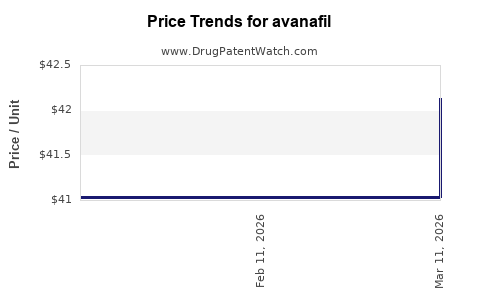
Average Pharmacy Cost for avanafil
| Drug Name | NDC | Price/Unit ($) | Unit | Date |
|---|---|---|---|---|
| AVANAFIL 200 MG TABLET | 31722-0442-30 | 49.02401 | EACH | 2026-07-22 |
| AVANAFIL 200 MG TABLET | 31722-0442-30 | 49.00574 | EACH | 2026-06-17 |
| AVANAFIL 200 MG TABLET | 31722-0442-30 | 47.46635 | EACH | 2026-05-20 |
| AVANAFIL 200 MG TABLET | 31722-0442-30 | 44.78391 | EACH | 2026-04-22 |
| >Drug Name | >NDC | >Price/Unit ($) | >Unit | >Date |
Market Analysis and Price Projections for Avanafil
Executive Summary
Avanafil, marketed primarily under the brand name Stendra (or Stendra, in some regions), is a phosphodiesterase type 5 (PDE5) inhibitor approved for the treatment of erectile dysfunction (ED). Developed by Vivus Inc., Avanafil entered the market in 2012, offering a rapid-onset alternative to existing PDE5 inhibitors such as sildenafil (Viagra), tadalafil (Cialis), and vardenafil (Levitra).
This report provides an in-depth analysis of Avanafil's current market landscape, competitive positioning, and future price projections. It evaluates key factors influencing market dynamics, including patent status, regulatory environment, competitive alternatives, and emerging trends in ED treatment.
Market Overview
Global Erectile Dysfunction Market
| Aspect | Details |
|---|---|
| Market Size (2022) | ~$4.9 billion (Global) [1] |
| CAGR (2022–2027) | 7.0% (expected) [1] |
| Major Players | Pfizer (Viagra), Eli Lilly (Cialis), Bayer (Levitra), Vivus (Avanafil) |
| Key Growth Drivers | Aging populations, increasing awareness, lifestyle factors |
Positioning of Avanafil
- Market Share (2022): Approx. 3–5% of ED drug market [2]
- Unique Selling Points: Fast onset (15 minutes), fewer side effects, oral convenience
- Pricing Strategy: Premium initial pricing, with generics impacting prices over time
Patent and Regulatory Status
| Patent Status | Details | Implication |
|---|---|---|
| Patent Expiry | Expected around 2025 in major markets | Potential for generics thereafter |
| Regulatory Approvals | FDA (2012), EMA (2012), other regional approvals | Broad market access, but patent expiry risks |
Patent protections have contributed to higher prices. Once patents expire, generic competition typically leads to significant price reductions (up to 80%).
Current Pricing Landscape
Brand vs. Generic Pricing
| Product | Approximate Cost per Dose | Notes |
|---|---|---|
| Stendra (Brand) | $30–$50 (US) | Premium pricing, marketed on fast onset |
| Generic Avanafil | $5–$15 | Pricing declines post-patent expiry [3] |
Pricing by Region
| Region | Brand Price (per dose) | Generic Price (per dose) | Regulatory & Market Factors |
|---|---|---|---|
| United States | $30–$50 | $5–$15 | Patent protection, insurance coverage varies |
| Europe | €20–€40 | €3–€10 | National reimbursement policies |
| Asia-Pacific | $10–$25 | $2–$8 | Price sensitivity, local generics |
Distribution Channel Impact
| Channel | Impact | Details |
|---|---|---|
| Pharmacy/OTC | Dominant | Direct sales, higher margins |
| Hospitals | Moderate | Bulk procurement, price negotiation |
| Online | Growing | Competitive pricing, privacy preferences |
Market Dynamics and Drivers
Factors Supporting Market Growth
- Growing Prevalence: Adult male ED affects over 300 million globally [4].
- Preference for Fast-Acting Drugs: Convenience of rapid onset positions Avanafil favorably.
- Patient Awareness & Acceptance: Increasing acceptance of oral ED treatments.
- Healthcare Access: Improved access in emerging markets.
Barriers and Challenges
- Patent Expirations: Exposure to price erosion with generic entry.
- Competitive Pressure: Sildenafil, tadalafil, and vardenafil offer lower-cost alternatives.
- Regulatory Hurdles: Variability in approval processes may delay market expansion.
Price Projection Models
Assumptions
- Patent expiry occurs in 2025 in major jurisdictions.
- Post-expiry market share distribution favors generics.
- No major regulatory or manufacturing disruptions.
- Healthcare reimbursement policies remain relatively stable.
Price Trajectory Forecast (2023–2030)
| Year | Brand Price (per dose) | Generic Price (per dose) | Notes |
|---|---|---|---|
| 2023 | $30–$50 | $5–$15 | Near peak brand pricing, early generic entry |
| 2024 | $28–$45 | $3–$10 | Slight decrease, increased generic availability |
| 2025 | $25–$40 | $2–$8 | Patent expiry, generics dominate |
| 2026–2030 | $10–$20 | $1–$5 | Market stabilized with generics |
Factors Influencing Price Trends
- Generic Market Penetration: Rapid decrease in brand prices post-patent expiry.
- Market Penetration Strategies: Brand manufacturers may introduce new formulations or formulations with added benefits.
- Healthcare Policies: Reimbursement and prescribing guidelines affect retail prices.
Comparative Analysis with Other PDE5 Inhibitors
| Drug | Onset of Action | Duration | Price (per dose) | Patent Status | Market Share (2022) |
|---|---|---|---|---|---|
| Sildenafil (Viagra) | 30–60 min | 4–6 hrs | $10–$30 | Expired (generics available) | 40–50% |
| Tadalafil (Cialis) | 30–60 min | 24–36 hrs | $15–$40 | Valid until ~2023–2025 | 30–40% |
| Vardenafil (Levitra) | 25–60 min | 4–6 hrs | $10–$25 | Expired | 10–15% |
| Avanafil (Stendra) | 15–30 min | up to 6 hrs | $30–$50 | Valid until ~2025 | 3–5% |
Avanafil’s faster onset remains its primary differentiator, but price sensitivity limits its market penetration compared to older generics.
Strategic Market Opportunities
- Emerging Markets: High growth potential due to increasing awareness and healthcare access.
- Special Formulations: Development of combination therapies or long-acting formulations.
- Patient Segments: Targeting users prioritizing speed and minimal side effects.
- Digital and Telemedicine Platforms: Enhancing direct-to-consumer access and adherence.
Key Considerations for Stakeholders
| Stakeholder | Actionable Insights |
|---|---|
| Manufacturers | Focus on cost-efficient manufacturing and strategic patent management to maximize profitability before generic entry. |
| Investors | Monitor patent expiration dates, emerging generics, and regional regulatory changes for valuation insights. |
| Healthcare Providers | Consider therapy preferences; educate patients on options beyond cost. |
| Policymakers | Balance affordability with innovation incentives, especially during patent transition periods. |
FAQs
Q1: When is the patent expiration for Avanafil in major markets?
A1: Patent protections are expected to expire around 2025 in key jurisdictions like the U.S. and Europe, opening the market for generics.
Q2: How does Avanafil compare in price to other ED drugs?
A2: Brand Avanafil typically costs $30–$50 per dose, significantly higher than older PDE5 inhibitors like sildenafil, which range from $10–$30. Post-generic entry, prices may fall below $5.
Q3: What factors influence the price decline of Avanafil post-patent expiry?
A3: Entry of generic versions, increased competition, regulatory approvals, and healthcare reimbursement policies.
Q4: Are there regional differences in Avanafil pricing?
A4: Yes. Prices are higher in the U.S. and Europe due to patent protections and healthcare systems, while prices are lower in Asia-Pacific markets where generics are dominant.
Q5: What are the main risks to Avanafil's future market positioning?
A5: Patent expiration, aggressive generic pricing, competition from established PDE5 inhibitors with broader market share, and regulatory delays.
Key Takeaways
- Patent Protection & Market Timing: Avanafil's market exclusivity is near its end, with patent expiry approaching in 2025, which will drastically alter its price landscape.
- Pricing Trajectory: Expect a sharp decline in per-dose prices from $30–$50 down to below $5 within a few years post-patent expiration.
- Competitive Positioning: The drug’s rapid onset remains a key differentiator, but price sensitivity favors generics.
- Market Opportunities: Emerging markets and innovative formulations present growth avenues before patent expiry.
- Strategic Focus: Stakeholders should prepare for price erosion, consider market entry timing, and innovate to maintain competitiveness.
References
[1] Market Research Future, "Global Erectile Dysfunction Market Analysis," 2022.
[2] IQVIA, "Prescription Data and Market Share Reports," 2022.
[3] GoodRx, "Average Cost of Erectile Dysfunction Drugs," 2023.
[4] World Health Organization, "Global Prevalence of Erectile Dysfunction," 2021.
This article provides a comprehensive, data-driven view of the current and projected market landscape for Avanafil, assisting stakeholders in strategic decision-making and investment planning.
More… ↓
