Last updated: February 19, 2026
This report analyzes the global market for atovaquone, a synthetic naphthoquinone antiprotozoal and antibacterial drug. It examines market drivers, restraints, segmentation, competitive landscape, and provides price projections based on patent expiries and market dynamics.
What is Atovaquone?
Atovaquone is an antiparasitic medication used to treat and prevent Pneumocystis jirovecii pneumonia (PCP) and toxoplasmosis in individuals with compromised immune systems, such as those with HIV/AIDS. It is also used in combination with azithromycin for the treatment of malaria. The drug works by inhibiting mitochondrial electron transport in parasites and protozoa. The primary branded product containing atovaquone is Mepron, originally developed by Medicure.
Market Drivers
Several factors are contributing to the demand for atovaquone. The global prevalence of HIV/AIDS, despite advancements in treatment, continues to necessitate prophylaxis against opportunistic infections like PCP. The World Health Organization (WHO) reported approximately 39 million people living with HIV globally in 2022 [1]. The incidence of these infections directly correlates with the demand for atovaquone.
Furthermore, atovaquone's efficacy in treating and preventing specific parasitic infections remains critical. Its use in combination therapy for malaria, particularly in regions with high malaria burden, provides a consistent demand stream. The Centers for Disease Control and Prevention (CDC) recommends atovaquone-proguanil for the prevention of malaria in travelers to endemic areas [2].
The increasing focus on treating opportunistic infections in immunocompromised patients, beyond HIV/AIDS, such as transplant recipients and those undergoing chemotherapy, also supports market growth. As cancer therapies advance, the number of immunocompromised patients is expected to rise, creating a sustained need for effective prophylactic treatments.
Market Restraints
Patent expiries and the subsequent genericization of atovaquone products represent a significant restraint on market value. The original patents for atovaquone have expired, allowing for the introduction of multiple generic versions. This competition typically leads to a substantial decrease in drug prices and revenue for originator companies. For instance, the patent for Mepron (atovaquone) has long expired, paving the way for generic manufacturers to enter the market.
The development of alternative treatments for PCP and toxoplasmosis also poses a challenge. Research into new prophylactic and therapeutic agents with potentially improved efficacy, fewer side effects, or different mechanisms of action could erode atovaquone's market share over time.
Regulatory hurdles and the stringent approval processes for new drugs can slow the introduction of novel therapies, but the availability of existing generic options for atovaquone means that the cost-effectiveness of generics will likely be a primary consideration for payers and healthcare providers.
Market Segmentation
The atovaquone market can be segmented by:
-
Indication:
- Pneumocystis Pneumonia (PCP)
- Toxoplasmosis
- Malaria
- Other (e.g., Babesiosis)
-
Route of Administration:
- Oral (Suspension, Tablets)
- Intravenous
-
End-User:
- Hospitals
- Clinics
- Retail Pharmacies
- Government Health Programs
-
Geography:
- North America
- Europe
- Asia Pacific
- Latin America
- Middle East & Africa
Competitive Landscape
The competitive landscape for atovaquone is characterized by the presence of both branded and generic manufacturers. Following patent expiries, a number of pharmaceutical companies have entered the market with generic atovaquone products. Key players involved in the production and distribution of atovaquone and its formulations include:
- Generic Manufacturers: Companies like Teva Pharmaceuticals, Cipla, Sun Pharmaceutical Industries, and Aurobindo Pharma are significant players in the generic atovaquone market. They focus on cost-effective production and broad market distribution.
- Branded Products: Medicure (through its subsidiary Mylan, acquired by Viatris) is associated with the branded product Mepron. However, the market dominance has shifted towards generics due to pricing pressures.
The competitive strategy primarily revolves around pricing, market access, and supply chain reliability. Generic manufacturers compete aggressively on price to gain market share.
Price Projections and Patent Expiries
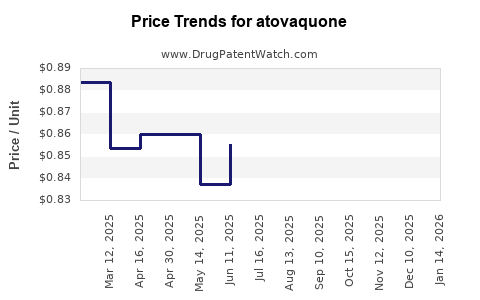
The pricing of atovaquone has been significantly impacted by patent expiries and the subsequent influx of generic competition.
Historical Pricing Trends:
Prior to patent expiry, the branded atovaquone (Mepron) commanded a premium price. For example, a 300mg/5mL oral suspension typically cost several hundred dollars for a standard bottle.
Impact of Genericization:
Upon patent expiry, the price of atovaquone has decreased dramatically. Generic formulations are typically priced at 70-90% less than their branded counterparts. This trend is consistent across most pharmaceutical markets globally.
Current Market Pricing (Estimated):
As of late 2023/early 2024, the average wholesale price (AWP) for a generic atovaquone oral suspension (e.g., 750 mg/5 mL, 210 mL bottle) can range from approximately \$50 to \$150, depending on the manufacturer, region, and contract terms. Generic atovaquone tablets (e.g., 250 mg) are even more cost-effective, with prices often in the range of \$1 to \$5 per tablet.
Price Projections:
- Short to Medium Term (1-3 Years): The price of generic atovaquone is expected to remain relatively stable, with minor fluctuations driven by supply-demand dynamics and manufacturer competition. Price reductions are unlikely to be substantial unless there is a significant increase in manufacturing capacity or a new competitor with a lower cost structure emerges. The established price floor set by multiple generic suppliers will limit further significant price erosion.
- Long Term (3-5+ Years): The long-term price trajectory for atovaquone will be primarily influenced by:
- Continued Generic Competition: As long as multiple generic manufacturers maintain production, prices will remain at a competitive low.
- Emergence of Alternative Therapies: The introduction of new, more effective, or safer treatments for PCP, toxoplasmosis, or malaria could lead to a gradual decline in atovaquone demand and, consequently, its market value and pricing. However, given atovaquone's established efficacy and cost-effectiveness in its approved indications, a complete displacement is unlikely in the near to medium term.
- Manufacturing Costs: Fluctuations in raw material costs and manufacturing overheads could lead to marginal price adjustments.
- Regulatory Landscape: Any changes in regulatory requirements for atovaquone production or approval of new indications could influence market dynamics.
Specific Projection Scenarios:
- Stable Demand & Competition: If current demand patterns for PCP prophylaxis and malaria treatment persist and generic competition remains robust, the average price for a 210 mL bottle of oral suspension will likely stay within the \$50-\$150 range.
- Emergence of Significant Alternatives: If a highly effective and cost-competitive alternative therapy for PCP emerges, demand for atovaquone could decrease by 10-20% over a 3-5 year period, potentially leading to a similar percentage decrease in average pricing as manufacturers attempt to clear inventory and maintain market share.
- Supply Chain Disruptions: Unexpected global supply chain disruptions or manufacturing issues could temporarily increase prices by 5-15% before stabilizing.
Atovaquone-Proguanil (e.g., Malarone):
For combination products like atovaquone-proguanil (e.g., Malarone), pricing is influenced by the patents and manufacturing costs of both active pharmaceutical ingredients. However, the genericization of atovaquone itself has also driven down the cost of these combination therapies. Generic atovaquone-proguanil tablets are now widely available, significantly reducing the price compared to branded Malarone. Projections for these combination drugs will mirror atovaquone's trajectory, with continued price pressure from generics.
Key Takeaways
The global market for atovaquone is characterized by steady demand driven by its established efficacy in treating opportunistic infections and malaria, particularly in immunocompromised populations. However, significant price erosion has occurred and will continue due to patent expiries and robust generic competition. The market is highly price-sensitive, with generic formulations offering substantial cost savings compared to branded products. Future price projections indicate stability in the short to medium term, with potential declines contingent on the emergence of superior alternative therapies.
Frequently Asked Questions
-
What is the primary market driver for atovaquone?
The primary market driver is the persistent need for prophylaxis against opportunistic infections like Pneumocystis jirovecii pneumonia (PCP) in immunocompromised individuals, notably those living with HIV/AIDS.
-
How has patent expiry affected atovaquone pricing?
Patent expiry has led to the introduction of numerous generic versions, significantly reducing the average selling price by 70-90% compared to branded formulations.
-
Are there any new indications for atovaquone under development?
While atovaquone is established for its current indications, research continues into its potential applications for other parasitic and protozoal infections, though no major new indications are currently poised for imminent market entry that would substantially alter demand.
-
What is the projected price trend for generic atovaquone over the next five years?
Generic atovaquone prices are projected to remain relatively stable in the short to medium term. Long-term price declines are possible if more effective and cost-competitive alternative therapies emerge, or if manufacturing costs decrease significantly.
-
What are the main competitive factors in the atovaquone market?
The main competitive factors are pricing, market access through distribution channels, and the reliability of the supply chain for generic manufacturers.
Citations
[1] World Health Organization. (2023). Global HIV & AIDS statistics — Fact sheet. https://www.unaids.org/en/resources/fact-sheet
[2] Centers for Disease Control and Prevention. (2021). Malaria: Prevention. https://www.cdc.gov/malaria/travelers/prevention.html