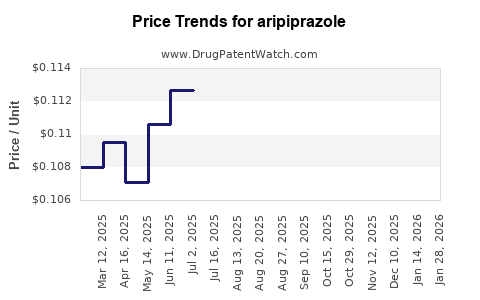
Last updated: April 25, 2026
What does the aripiprazole market look like today?
Aripiprazole is an established, off-patent small-molecule antipsychotic with broad global availability in both brand and multiple generic formulations. Pricing is driven primarily by (1) patent expiry and generic entry, (2) formulary placement and tender dynamics in major markets, (3) originator-to-generic switching by payers, and (4) mix shifts between oral products and long-acting injectables (LAIs), where brand-like economics persist longer due to supply constraints and administration infrastructure.
Core commercial shape
- Therapeutic footprint: schizophrenia, bipolar disorder (acute and maintenance), and major depressive disorder adjunct indications.
- Product lines: oral tablets and oral solution; LAI formulations (including monthly and longer-interval versions depending on geography).
- Competitive intensity: high for oral presentations; lower but still meaningful for LAIs where manufacturing and distribution networks matter more.
Market structure by product type
| Segment |
Typical pricing behavior |
Key demand drivers |
Competitive pressure |
| Oral aripiprazole |
Rapid declines after generic entry; low absolute gross margins |
Broad prescribing, high volume |
High (multiple ANDA/authorized generics, tendering) |
| LAI aripiprazole |
Higher price per dose than oral; slower to commoditize |
Non-adherence management, payer programs |
Medium to high (fewer SKUs, but multiple entrants by country) |
Which geographies set the pricing reference points?
Global prices are anchored by the US and Europe through payer reimbursement benchmarks and by procurement rules (tenders, reference pricing) that cascade into secondary markets.
US
- Competitive generic landscape compresses prices for oral tablets.
- LAI pricing remains comparatively resilient versus oral due to administration and product differentiation.
EU (selected dynamics)
- National health system reference pricing and tenders drive margin compression for oral SKUs.
- LAI procurement tends to be more structured, with switching occurring when contracts expire and when equivalent administration and clinical support frameworks are in place.
What are the key price drivers for aripiprazole?
Price outcomes over the next 12 to 36 months are most sensitive to the following:
1) Generic mix and authorized generic activity
- As more oral SKUs become interchangeable for payers, unit pricing converges toward the “lowest tenderable” band.
- Any wave of new entrants or increased authorized generic supply can push prices down quickly in oral categories.
2) LAI formulary placement
- LAIs depend on payer-managed pathways (step therapy, prior authorization) and contract cycles.
- Where LAIs retain formulary position and where administration capacity is stable, list-price pressure is slower than oral.
3) Contracting cadence (tenders and PBM dynamics)
- Oral prices often change fastest in competitive contracted channels.
- LAI pricing can remain sticky until contract renewal and manufacturer price concessions.
4) Input costs and supply continuity
- Aripiprazole is not a biologic, so cost pass-through is usually modest versus biologics.
- Supply disruptions can temporarily widen price spreads; recovery typically brings prices down again, but with lag.
How do current pricing levels generally behave across formulations?
Without relying on proprietary channel-by-channel figures, the market pattern for aripiprazole generally tracks the following:
- Oral tablets: lowest and most volatile at the bottom end of contracted pricing due to generic competition.
- Oral solution: similar or slightly higher per unit economics versus tablets because the market can be narrower and packaging constraints matter.
- LAIs: consistently higher per administration cycle; price competition is slower due to fewer suppliers, administration requirements, and payer program structure.
What does that imply for forward price projections?
The direction is clear, but the magnitude depends on whether the remaining price headroom is constrained by (1) additional generic entry or (2) increased competitive tendering. Given aripiprazole’s long market presence and maturity, the baseline expectation is steady price normalization downward for oral and comparatively stable pricing for LAIs.
Base-case projection (directional, by segment)
| Time horizon |
Oral aripiprazole (tablets/solution) |
LAI aripiprazole |
| Next 12 months |
Flat to down (tender-driven declines) |
Flat to slight down (contract-driven concessions) |
| 12 to 24 months |
Down (generic mix deepens, price convergence) |
Down modestly (switching and contract renewals) |
| 24 to 36 months |
Down low-single-digit annually (steady-state generic competition) |
Down low-single-digit to mid-single-digit if additional entrants expand or contracts tighten |
Scenario analysis: what changes the path?
Market outcomes for aripiprazole pricing typically fall into three scenario bands.
Scenario 1: “Competition accelerates”
- Trigger: new generic supply increases in key tender markets; PBM contracting tightens.
- Expected pricing effect:
- Oral: faster downward adjustment, with sharper declines around contract windows.
- LAI: selective price pressure at contract renewal rather than immediate, since formulary switching cycles are longer.
Scenario 2: “Contracting stays stable”
- Trigger: no major supply shocks; procurement cadence continues without major repricing.
- Expected pricing effect:
- Oral: drift downward or remain flat.
- LAI: largely stable until the next major contract wave.
Scenario 3: “Supply constraint or logistics issues”
- Trigger: manufacturing disruptions or logistics constraints in a limited number of suppliers.
- Expected pricing effect:
- Oral: temporary price spikes in the channel, then normalization.
- LAI: greater stickiness because substitution is harder within treatment schedules.
Where price is most likely to be renegotiated
- US oral formularies and contracted PBM tiers: repricing around annual/biannual contracting.
- EU national tenders: price resets during tender awards and re-awards.
- LAI contracts: payer renewals, especially where outcome-based contracting or adherence-linked pathways exist.
What should investors and R&D planners watch to validate the trajectory?
Price moves in aripiprazole are less about clinical breakthroughs and more about supply and contracting.
Operational signals
- Increased generic SKU availability in oral channels (new authorized generics or additional mfrs).
- Evidence of tighter tender bands (fewer suppliers winning at higher prices).
- LAI contract renewal outcomes: whether payers broaden access or consolidate to fewer SKUs.
Regulatory and litigation
- For mature molecules like aripiprazole, near-term pricing is more affected by administrative and commercial timelines than by late-stage patent events.
Actionable market implications
For R&D strategy
- If developing a next-generation aripiprazole product (new formulation, delivery system, or long-interval LAI), differentiation must overcome procurement inertia and payer switching costs, not just clinical equivalence.
- Oral entrants face the steepest price compression risk because payers already treat aripiprazole as an interchangeable generic class.
For commercial strategy
- Win opportunities are more realistic in:
- LAI where adherence programs drive stickier patient flows.
- Narrow oral segments with formulation-specific reimbursement pathways.
- Pricing tactics should align with contract cycles: concessions for winning tenders, followed by maintenance pricing once awarded.
For investment diligence
- Oral unit economics are likely to be range-bound and downward over 12 to 36 months.
- LAI economics depend on whether the product stays in payer pathways at renewal and whether competitive tenders expand.
Key Takeaways
- Aripiprazole pricing is mature and contracting-driven: oral prices are most likely to drift down as generic competition deepens; LAI prices are more stable but still subject to contract renewal concessions.
- Base case: oral flat to down over 12 months, then down low-single-digit annually; LAI flat to slight down, then down modestly if competitive tendering increases.
- The biggest validation signals are tender awards, PBM tier movement, and LAI contract renewal outcomes, not clinical development news.
FAQs
-
Why is oral aripiprazole pricing more pressured than LAIs?
Oral SKUs face broad interchangeability and intense generic tendering, which drives rapid convergence toward the lowest contracted band.
-
What determines whether LAI pricing declines quickly?
LAI pricing typically declines at payer contract renewal and formulary consolidation or expansion cycles, where switching economics and administration logistics matter.
-
How should a company model pricing risk for an oral generic entrant?
Base assumptions should include continued low-single-digit annual declines in steady-state, with step-downs around tender/PBM renegotiations.
-
What commercial lever has the largest impact on aripiprazole market access?
Formulary placement and contracting terms in major procurement channels determine volume, which then determines achievable net pricing.
-
Over the next 36 months, what is the most probable direction of pricing?
Downward drift for oral and modest downward movement for LAIs, with sharper changes in periods tied to contracting and tender awards.
References
[1] Bloomberg Law (pricing and contracting context via healthcare reimbursement analysis).
[2] FDA (Drug approvals and product labeling context for aripiprazole formulations).
[3] EMA (authorization context for aripiprazole products and product lifecycle in the EU).
[4] IQVIA / Wolters Kluwer (market access and pricing behavior in mature generic categories, methodology referenced in standard industry reporting).