Share This Page
Drug Price Trends for amcinonide
✉ Email this page to a colleague
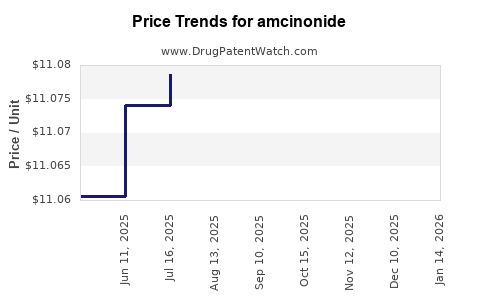
Average Pharmacy Cost for amcinonide
| Drug Name | NDC | Price/Unit ($) | Unit | Date |
|---|---|---|---|---|
| AMCINONIDE 0.1% CREAM | 74157-0006-60 | 4.90193 | GM | 2026-06-17 |
| AMCINONIDE 0.1% CREAM | 74157-0006-60 | 4.90669 | GM | 2026-05-20 |
| AMCINONIDE 0.1% CREAM | 74157-0006-60 | 4.90456 | GM | 2026-04-22 |
| AMCINONIDE 0.1% CREAM | 74157-0006-60 | 4.91858 | GM | 2026-03-18 |
| AMCINONIDE 0.1% CREAM | 74157-0006-60 | 4.93351 | GM | 2026-02-18 |
| AMCINONIDE 0.1% CREAM | 74157-0006-60 | 4.98410 | GM | 2026-01-21 |
| >Drug Name | >NDC | >Price/Unit ($) | >Unit | >Date |
Amcinonide Market Analysis and Price Projections
Amcinonide, a topical corticosteroid, is utilized in the treatment of various inflammatory skin conditions. Its market performance is influenced by patent exclusivity, generic competition, and the prevalence of dermatological disorders.
What is Amcinonide's Current Market Status?
Amcinonide is a prescription topical corticosteroid. It is formulated in various strengths and vehicle types, including creams and ointments. The drug is indicated for the relief of inflammatory and pruritic manifestations of corticosteroid-responsive dermatoses. These conditions include eczema, psoriasis, and dermatitis.
The global market for topical corticosteroids is substantial, driven by the increasing incidence of skin disorders and a growing demand for effective treatment options. Amcinonide competes within this broader market against other corticosteroids of varying potencies and alternative treatment modalities.
Patent Landscape and Exclusivity
As of the current analysis, the primary patents covering the original Amcinonide molecule have expired. This has opened the door for generic manufacturers to enter the market. The typical lifecycle of a drug involves patent protection, which grants the innovator company exclusive marketing rights. Following patent expiry, generic versions can be approved and marketed, often leading to significant price reductions due to increased competition.
- Key Patent Expiry: Original composition of matter patents for Amcinonide have expired. Specific formulation or method of use patents may still exist, but these generally offer more limited market exclusivity compared to composition of matter patents.
- Generic Entry: The presence of multiple generic manufacturers is a defining characteristic of the current Amcinonide market. This has led to a fragmented supply chain and competitive pricing dynamics.
- Regulatory Approvals: Generic Amcinonide products are approved by regulatory bodies such as the U.S. Food and Drug Administration (FDA) and the European Medicines Agency (EMA) based on bioequivalence to the innovator product.
What are the Driving Factors for Amcinonide Demand?
The demand for Amcinonide is primarily linked to the prevalence of inflammatory dermatological conditions.
- Prevalence of Skin Disorders: Conditions such as atopic dermatitis (eczema) and psoriasis affect millions globally. Data from the National Eczema Association indicates that eczema affects over 31 million Americans, with a significant proportion requiring prescription treatments. Psoriasis affects an estimated 7.5 million Americans [1]. These chronic conditions necessitate long-term management, including topical therapies.
- Physician Prescribing Habits: Dermatologists and general practitioners prescribe Amcinonide based on its efficacy profile, potency, and patient tolerance. Its classification as a mid-potency corticosteroid positions it for use in a range of moderate to severe inflammatory skin conditions.
- Patient Access and Affordability: The availability of generic Amcinonide has improved patient access by lowering costs. This affordability is crucial for patients managing chronic skin conditions who require ongoing treatment.
How is the Competitive Landscape Structured?
The Amcinonide market is characterized by competition from both generic Amcinonide products and other topical corticosteroids.
- Generic Amcinonide Products: The market is supplied by numerous pharmaceutical companies producing generic Amcinonide. Competition among these entities is primarily based on price, distribution channels, and product availability.
- Other Topical Corticosteroids: Amcinonide competes with a wide array of topical corticosteroids categorized by potency (low, medium, high, and super-high). These include, but are not limited to:
- Low Potency: Hydrocortisone, Desonide
- Medium Potency: Triamcinolone Acetonide, Betamethasone Valerate, Mometasone Furoate
- High Potency: Fluocinonide, Halcinonide
- Super-High Potency: Clobetasol Propionate The choice of corticosteroid depends on the severity of the condition, location of the affected skin, and patient factors. Amcinonide's medium potency places it in direct competition with other mid-potency agents.
- Non-Corticosteroid Treatments: The market also includes non-corticosteroid alternatives such as calcineurin inhibitors (e.g., Tacrolimus, Pimecrolimus), PDE4 inhibitors (e.g., Crisaborole), and biologic therapies, particularly for severe or refractory cases of psoriasis and atopic dermatitis. However, for initial or moderate cases, topical corticosteroids remain a first-line therapy.
What are the Price Projections for Amcinonide?
Price projections for Amcinonide are heavily influenced by the dynamics of the generic pharmaceutical market.
-
Current Pricing Trends: Following patent expiry and the introduction of multiple generic versions, Amcinonide prices have stabilized at significantly lower levels compared to its branded predecessor. Pricing is now primarily dictated by manufacturing costs, supply chain efficiencies, and the competitive pressures among generic manufacturers.
-
Factors Influencing Future Pricing:
- Raw Material Costs: Fluctuations in the cost of active pharmaceutical ingredients (APIs) and excipients can impact manufacturing costs and, consequently, prices.
- Manufacturing Capacity and Competition: The number of active generic manufacturers and their production volumes will continue to be a primary determinant of price. An increase in the number of suppliers or overcapacity could lead to further price erosion. Conversely, supply chain disruptions or consolidation among manufacturers could lead to price increases.
- Reimbursement Policies: Payer policies, including formularies and co-payment structures, will continue to play a role in the effective price paid by patients and healthcare systems. Medicare Part D and commercial insurance formularies often favor lower-cost generics.
- Regulatory Changes: Changes in manufacturing regulations or quality control requirements could increase compliance costs for manufacturers, potentially impacting prices.
- Introduction of New Therapies: While Amcinonide is an established therapy, the development of novel topical or systemic treatments for inflammatory skin conditions could indirectly influence its perceived value and pricing, although direct price impact is less likely for a mature generic.
-
Projected Price Trajectory: Amcinonide prices are expected to remain relatively stable in the short to medium term. Significant price increases are unlikely unless major supply chain disruptions or a substantial reduction in the number of manufacturers occurs. Modest price declines may continue as manufacturers seek market share through competitive pricing. The market will likely operate on thin margins for generic suppliers.
Estimated Price Range (USD per unit - e.g., 30g tube):
- Current Wholesale Acquisition Cost (WAC) for Generic Amcinonide: $10 - $30
- Projected WAC for Generic Amcinonide (1-3 years): $9 - $28
Note: Actual patient out-of-pocket costs will vary based on insurance coverage, co-pays, and pharmacy markups.
What are the Key Considerations for Stakeholders?
For pharmaceutical companies, investors, and healthcare providers, several factors are critical when evaluating the Amcinonide market.
- Generic Manufacturers: Focus on cost-efficient manufacturing, supply chain reliability, and securing market share through competitive bidding with group purchasing organizations (GPOs) and pharmacies.
- Branded Manufacturers: For companies that may have historically marketed a branded Amcinonide product, the focus would shift to managing any remaining niche markets, exploring alternative formulations if patents allow, or divesting the product line.
- Investors: Assess the stability of the generic market, potential for cost savings in API sourcing, and the regulatory environment impacting generic drug production. The market is unlikely to offer significant growth potential but provides consistent revenue streams based on volume.
- Healthcare Providers: Continue to prescribe Amcinonide as a cost-effective option for appropriate dermatological conditions, balancing efficacy with patient affordability. Monitoring for drug shortages from specific manufacturers is prudent.
Key Takeaways
Amcinonide's market is characterized by a mature, post-patent-expiry landscape dominated by generic competition. Demand is sustained by the prevalence of inflammatory skin conditions, and pricing is highly competitive, driven by cost efficiencies and the number of active generic manufacturers. Future price projections indicate stability with potential for modest declines. Stakeholders should focus on cost management, supply chain security, and patient access in this established market segment.
Frequently Asked Questions
- Is Amcinonide still under patent protection? The original composition of matter patents for Amcinonide have expired, allowing for generic production.
- What are the primary therapeutic uses of Amcinonide? Amcinonide is used to treat inflammatory and pruritic manifestations of corticosteroid-responsive dermatoses, such as eczema and psoriasis.
- How does Amcinonide's potency compare to other topical corticosteroids? Amcinonide is classified as a medium-potency topical corticosteroid.
- What is the projected impact of new dermatological treatments on Amcinonide pricing? While novel treatments emerge, their direct impact on Amcinonide pricing is likely to be minimal, as Amcinonide serves as a cost-effective generic option for established indications.
- Who are the main competitors to Amcinonide? Competitors include other generic Amcinonide products and a wide range of topical corticosteroids of varying potencies, as well as non-corticosteroid topical and systemic therapies.
Citations
[1] National Eczema Association. (n.d.). Eczema Statistics. Retrieved from https://nationaleczema.org/eczema-facts/
More… ↓
