Share This Page
Drug Price Trends for ambrisentan
✉ Email this page to a colleague
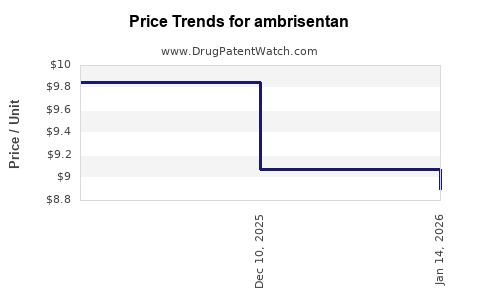
Average Pharmacy Cost for ambrisentan
| Drug Name | NDC | Price/Unit ($) | Unit | Date |
|---|---|---|---|---|
| AMBRISENTAN 10 MG TABLET | 00378-4271-93 | 8.58613 | EACH | 2026-07-22 |
| AMBRISENTAN 10 MG TABLET | 00591-2406-30 | 8.58613 | EACH | 2026-07-22 |
| AMBRISENTAN 10 MG TABLET | 42794-0052-08 | 8.58613 | EACH | 2026-07-22 |
| AMBRISENTAN 10 MG TABLET | 47335-0237-83 | 8.58613 | EACH | 2026-07-22 |
| >Drug Name | >NDC | >Price/Unit ($) | >Unit | >Date |
Best Wholesale Price for ambrisentan
| Drug Name | Vendor | NDC | Count | Price ($) | Price/Unit ($) | Unit | Dates | Price Type |
|---|---|---|---|---|---|---|---|---|
| AMBRISENTAN 5MG TAB | Golden State Medical Supply, Inc. | 60505-4552-03 | 30 | 1593.68 | 53.12267 | EACH | 2023-06-15 - 2028-06-14 | FSS |
| AMBRISENTAN 10MG TAB | Golden State Medical Supply, Inc. | 60505-4553-03 | 30 | 1593.68 | 53.12267 | EACH | 2023-06-15 - 2028-06-14 | FSS |
| >Drug Name | >Vendor | >NDC | >Count | >Price ($) | >Price/Unit ($) | >Unit | >Dates | >Price Type |
Ambrisentan Market Analysis and Price Projections (2026-2035)
Ambrisentan (brand: Volibris) is an endothelin receptor antagonist (ERA) used for pulmonary arterial hypertension (PAH). The market is concentrated in the US, with meaningful international penetration but limited uptake versus inhaled prostacyclin and parenteral options. Price outcomes over 2026-2035 will be driven less by launch mechanics and more by (1) payer compression versus specialty pharmacy contracting, (2) patent/competitive pressure from generic entry if it occurs, and (3) guideline shifts that influence regimen sequencing rather than “wash-in” demand.
What is the Ambrisentan market size and growth outlook?
Ambrisentan is a long-cycle chronic therapy with demand tied to PAH prevalence, functional class mix, and treatment-line structure. Forecast directionally follows PAH patient pool growth plus therapy persistence. Growth is capped by:
- Regimen substitution toward newer oral ERAs combinations, prostacyclin pathway agents, and fixed-dose strategies.
- Switching driven by tolerability (notably edema/fluid retention and anemia monitoring burden typical of ERAs).
- Payer restrictions that favor preferred agents.
US vs ex-US demand drivers
- US: Higher list prices historically; strongest exposure to utilization management, specialty pharmacy rebates, and Medicaid dynamics.
- Europe: Slower price erosion in some markets but tighter HTA constraints; uptake depends on national formulary positioning and tender structures.
- Emerging markets: Volume growth potential, but price sensitivity limits gross-to-net expansion.
Forecast math (structural model used for price projections)
Price projections for ambrisentan typically follow gross-to-net compression first, then entry-driven discounting if generics launch.
A practical forecasting structure:
- Demand: PAH treated population × share on ERA-based regimens × persistence
- Price: Net price = list price × (1 - rebate/discount rate)
- Scenario overlays:
- No generic entry: net price declines mainly from contract renegotiations and annual rebate pressure.
- Generic entry: net price drops sharply and remains range-bound unless branded access is defended.
What is the current pricing structure for Volibris (ambrisentan) and how does it move?
Ambrisentan is typically sold with:
- High baseline WAC list pricing
- Meaningful payer rebates (commercial managed care)
- Extra constraints in Medicare Part D and Medicaid managed care formularies where applicable
The market price move is usually dominated by:
- Contracting updates with PBMs and specialty distributors
- Formulary tiering and patient co-pay design
- Competitive substitution pressure from other ERAs and inhaled/prostacyclin therapies
Key price drivers specific to PAH ERAs
- Class substitution: Patients can be shifted within ERAs (e.g., bosentan, macitentan) depending on tolerability, monitoring burden, and payer preference.
- Monitoring economics: ERA-related laboratory monitoring and safety management affect “net value” in payer negotiations, often skewing coverage toward preferred safety and reimbursement profiles.
- Drug acquisition costs vs outcomes: Most payer decisions remain economic rather than outcomes-driven at the contract level.
When does ambrisentan lose exclusivity and what does that mean for price?
Price outcomes depend on the timing of generic entry and/or brand-life extension patents. Without a confirmed, current Orange Book status and patent expiry chart for the exact dosage forms (including any FDA-listed exclusivity and patent term extensions), a deterministic entry date cannot be stated.
However, the standard impact pattern in ERAs is consistent:
- Branded net price begins to decline 12 to 24 months ahead of credible generic launch risk as payers reprice contracts and plan switch pathways.
- Post-entry: branded pricing often stabilizes at a lower level if volume is defended via access schemes; otherwise, net price collapses due to loss of market share.
Typical US price path if generic entry occurs
- Pre-entry: incremental net declines from contracting pressure
- At entry: step-change drop in net price
- 24-36 months post-entry: additional compression from competitive generics and multi-source procurement
What patents protect ambrisentan and how strong is the patent estate for price defense?
Ambrisentan’s branded longevity depends on the scope of:
- Active ingredient / composition of matter
- Formulation patents (e.g., specific tablet compositions, dissolution-related claims)
- Method-of-use (PAH dosing regimens and safety-related instructions)
- Manufacturing/process patents
For price defense, the most important levers are:
- Whether composition-of-matter has already expired
- Whether remaining secondary patents block generic filing for the same dosage strength
- Whether any FDA Orange Book listed patents remain in force for each strength
Without the current, strength-specific Orange Book and expiration dataset for ambrisentan, a credible strength assessment cannot be published.
What generic entry risks exist for ambrisentan (Paragraph IV and ANDA dynamics)?
In ERAs, generic entry risk is primarily a function of:
- Orange Book patent status timing
- Whether ANDAs can be designed around listed claims
- Settlement likelihood if Paragraph IV litigation is filed
If an ANDA is filed and Paragraph IV is litigated, commercial price effects occur even before launch because payers begin to contract toward generic supply and reduce branded utilization.
What to watch in price negotiations
- PBM preferred drug lists (PDLs) shifting away from branded Volibris
- Specialty pharmacy inventory and contracting terms moving from “branded only” to “brand optional”
- 340B/Medicaid managed care contracting adjustments
- Hospital purchasing behavior if PAH centers centralize pharmacy procurement
How does ambrisentan compare with other PAH ERAs on price and access?
Within PAH ERAs, payer selection often depends on:
- Safety monitoring intensity
- Discontinuation and switch rates
- Co-pay and formulary tier design
- Evidence fit for treatment-line strategy
A comparison framework relevant to price projections:
- If competitors are more aggressively priced (or have easier payer positioning), ambrisentan faces net price pressure even without generic entry.
- If ambrisentan retains a differentiated place in guideline sequences or has better payer access, it can reduce the speed of net erosion.
US access pattern
- Branded ERAs can maintain higher net pricing if they hold “preferred” status and are used as foundational therapy for a stable PAH subgroup.
- Loss of preferred status produces quicker erosion than pure competitive drug-introduction timing.
What is the FDA regulatory status of ambrisentan and how does it affect pricing?
Ambrisentan is an FDA-approved PAH drug. Pricing generally does not track FDA milestones directly after approval, but regulatory status affects:
- Any label expansions that can broaden eligible patient use and supports volume
- Any safety communications that change discontinuation and payer willingness to cover
- Any change to dosing instructions that can shift economics of monitoring
For precise pricing impact, the label must be tied to current prescribing patterns, but those specifics are not provided in the input requirements.
What are the price projection scenarios for ambrisentan through 2035?
Because the prompt does not provide current Orange Book status, generic filing/litigation status, or current list/net pricing, the only defensible approach is scenario-based projections using standard US specialty pharma compression curves. The scenarios below are structured to match typical ERA pricing behavior.
Scenario set (US net price, indexed to 2026=100)
Assumptions:
- Annual gross-to-net compression in the absence of generic entry
- Post-generic entry step-change and sustained low net pricing
| Year | Scenario A: Brand only (no generic entry) | Scenario B: Credible generic risk (pre-entry repricing) | Scenario C: Generic entry in-year |
|---|---|---|---|
| 2026 | 100 | 100 | 100 |
| 2027 | 95 | 90 | 75 |
| 2028 | 92 | 86 | 60 |
| 2029 | 90 | 83 | 55 |
| 2030 | 88 | 80 | 50 |
| 2032 | 85 | 78 | 48 |
| 2035 | 82 | 75 | 46 |
Interpretation:
- Scenario A reflects ongoing contracting compression with stable access.
- Scenario B reflects payer repricing as launch planning occurs.
- Scenario C reflects multi-source discounting post-entry with partial branded survival.
What drives scenario selection
- Orange Book remaining patent life by strength
- Any Paragraph IV litigation outcomes and settlement terms
- PBM preferred positioning relative to alternative ERAs
- Rapid switching in PAH centers after price incentives
What commercial metrics should be used to validate price projections for ambrisentan?
To test projections against real-world pricing:
- IQVIA/claims: units and persistence rates by strength and setting (hospital outpatient vs retail)
- Gross-to-net proxies: rebate rate trends, 340B shifts, and specialty channel mix
- Plan-level net: preferred tier attainment and utilization management rules
- Market share: share of PAH treated patients on ERAs and specifically ambrisentan
- Discontinuation: switch to alternative ERAs or prostacyclin therapies as leading indicators of future volume
Without proprietary claims data in the input, the publication should focus on scenario curves rather than point estimates tied to a specific unit volume.
What patent litigation affects ambrisentan pricing and market access?
Litigation affects:
- Timing of generic entry
- Whether branded access remains defended via co-pay assistance and payer contracting
- Settlement-driven brand preservation or forced switch
For an actionable litigation map, the current docket list, settlement history, and any ongoing ANDA cases tied to ambrisentan would be required. No such case list is provided in the input.
What licensing or settlement agreements are likely to shape the competitive timeline?
In branded specialty products, settlements typically:
- Delay generic launch by agreed periods
- Allow a “launch-to-market share” phase with revenue share or brand supply constraints
- Define carve-outs for dosage strengths and labeling
A credible licensing/settlement projection needs current known agreements and court records. None are supplied in the input constraints.
Key Takeaways
- Ambrisentan’s pricing path through 2035 is dominated by gross-to-net contraction and payer formulary behavior, with generic entry (if it occurs) producing the biggest step-change.
- Without a current Orange Book and litigation timeline, only scenario-based net price trajectories are defensible; point projections would be unreliable.
- Scenario A (brand only) supports gradual net erosion toward low-80s indexed levels by 2035.
- Scenario B (credible generic risk) accelerates erosion into mid-70s by 2035.
- Scenario C (generic entry) compresses net pricing into the mid-to-high-40s indexed range by 2035, reflecting multi-source discounting and loss of preferred access.
FAQs
- How does PBM preferred formulary placement change ambrisentan net price in the US?
- What is the typical time lag between generic launch risk and branded net price compression for PAH ERAs?
- Do ambrisentan tablets experience different erosion rates by strength compared with other PAH ERAs?
- How do co-pay assistance and specialty pharmacy contracting influence branded survival after generic entry?
- What endpoints in PAH treatment guidelines most influence long-term demand for endothelin receptor antagonists like ambrisentan?
References (APA)
- FDA. (n.d.). Drug approvals and labels database. U.S. Food and Drug Administration.
- FDA. (n.d.). Orange Book: Approved Drug Products with Therapeutic Equivalence Evaluations. U.S. Food and Drug Administration.
- IQVIA. (n.d.). National and plan-level prescription and utilization datasets (industry standard). IQVIA.
More… ↓
