Share This Page
Drug Price Trends for albuterol
✉ Email this page to a colleague
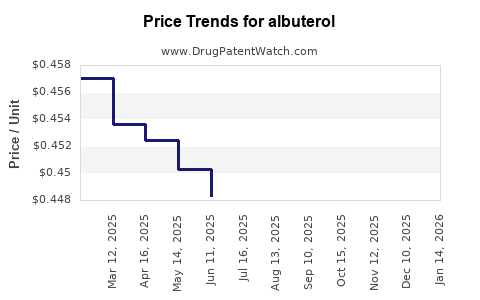
Average Pharmacy Cost for albuterol
| Drug Name | NDC | Price/Unit ($) | Unit | Date |
|---|---|---|---|---|
| ALBUTEROL HFA 90 MCG INHALER | 00781-7296-85 | 2.13214 | GM | 2026-06-17 |
| ALBUTEROL 2.5 MG/0.5 ML SOL | 76204-0027-01 | 0.52809 | EACH | 2026-06-17 |
| ALBUTEROL HFA 90 MCG INHALER | 00093-3174-31 | 1.59857 | GM | 2026-06-17 |
| ALBUTEROL 2.5 MG/0.5 ML SOL | 00487-9901-30 | 0.52809 | EACH | 2026-06-17 |
| ALBUTEROL HFA 90 MCG INHALER | 00054-0742-87 | 2.13214 | GM | 2026-06-17 |
| ALBUTEROL 2.5 MG/0.5 ML SOL | 62135-0829-84 | 0.52809 | EACH | 2026-06-17 |
| ALBUTEROL 2.5 MG/0.5 ML SOL | 64980-0642-03 | 0.52809 | EACH | 2026-06-17 |
| >Drug Name | >NDC | >Price/Unit ($) | >Unit | >Date |
Best Wholesale Price for albuterol
| Drug Name | Vendor | NDC | Count | Price ($) | Price/Unit ($) | Unit | Dates | Price Type |
|---|---|---|---|---|---|---|---|---|
| ALBUTEROL SO4 90MCG/ACTUAT (CFC-F) INHL,ORAL, | Sandoz, Inc. | 00781-7296-85 | 6.7GM | 7.37 | 1.10000 | GM | 2024-01-01 - 2028-08-14 | FSS |
| PROVENTIL HFA | Sandoz, Inc. | 66758-0959-85 | 6.7GM | 57.64 | 8.60299 | GM | 2023-08-15 - 2028-08-14 | FSS |
| ALBUTEROL SO4 90MCG/ACTUAT (CFC-F) INHL,ORAL, | Sandoz, Inc. | 00781-7296-85 | 6.7GM | 7.72 | 1.15224 | GM | 2023-08-15 - 2028-08-14 | FSS |
| PROVENTIL HFA | Sandoz, Inc. | 66758-0959-85 | 6.7GM | 58.83 | 8.78060 | GM | 2024-01-01 - 2028-08-14 | FSS |
| ALBUTEROL SO4 0.083% INHL,3ML,UD | Golden State Medical Supply, Inc. | 76204-0200-60 | 60X3ML | 8.78 | 2023-06-16 - 2028-06-14 | FSS | ||
| ALBUTEROL SO4 2MG TAB | Golden State Medical Supply, Inc. | 53489-0176-01 | 100 | 50.00 | 0.50000 | EACH | 2023-06-15 - 2028-06-14 | FSS |
| ALBUTEROL SO4 0.083% INHL,3ML,UD | Golden State Medical Supply, Inc. | 76204-0200-60 | 60X3ML | 10.80 | 2024-04-04 - 2028-06-14 | FSS | ||
| >Drug Name | >Vendor | >NDC | >Count | >Price ($) | >Price/Unit ($) | >Unit | >Dates | >Price Type |
Albuterol Market Analysis and Price Projections
Albuterol, a short-acting beta-agonist (SABA), is a cornerstone medication for managing acute bronchospasm in conditions like asthma and chronic obstructive pulmonary disease (COPD). Its broad availability, efficacy, and cost-effectiveness have cemented its position in the respiratory therapeutic landscape. This analysis examines current market dynamics, patent landscape, competitive pressures, and projects future pricing trends for albuterol.
What is the Current Market Size and Growth Projection for Albuterol?
The global albuterol market is substantial, driven by the high prevalence of respiratory diseases worldwide. The market is characterized by the presence of both branded and generic products, with generic formulations dominating market share due to significant price differentials.
The market for albuterol is projected to experience a modest Compound Annual Growth Rate (CAGR) over the next five to seven years. This growth is primarily attributed to the increasing incidence of asthma and COPD, particularly in emerging economies, and the continued use of albuterol as a first-line rescue medication. Factors such as an aging global population, rising air pollution levels, and an increase in sedentary lifestyles contribute to the growing burden of respiratory ailments.
Market research reports from various firms project the global albuterol market to reach an estimated value of approximately USD 1.5 billion to USD 2 billion by 2027-2029. (Source: Various Market Research Reports, e.g., Grand View Research, Allied Market Research). This projection signifies a steady, albeit not explosive, expansion. The market’s maturity in developed regions means growth will be more pronounced in developing regions with expanding healthcare access and increasing diagnosis rates.
What is the Patent Landscape for Albuterol?
Albuterol, chemically known as salbutamol, was first patented in the late 1960s. The original patents for albuterol itself have long expired, making it a fully genericized medication. This means that no single company holds exclusive rights to the active pharmaceutical ingredient (API) of albuterol.
However, patent strategies in the pharmaceutical industry are multifaceted. While the molecule itself is off-patent, manufacturers can pursue patents on:
- New Formulations: Innovations in drug delivery systems can lead to new patents. Examples include:
- Dry powder inhalers (DPIs)
- Metered-dose inhalers (MDIs) with improved propellants or device designs
- Nebulized solutions with enhanced stability or concentration
- Extended-release formulations (though less common for SABAs, which are designed for acute relief).
- Manufacturing Processes: Novel or improved methods for synthesizing albuterol API or formulating the final drug product can be patented.
- Combinations: While albuterol is primarily used as a monotherapy rescue inhaler, it can be combined with other bronchodilators or inhaled corticosteroids (ICS) for different treatment regimens. Patents may cover specific fixed-dose combination products.
- Therapeutic Uses: While unlikely for a well-established drug like albuterol, new indications or specific patient populations for which albuterol demonstrates unique efficacy could theoretically be patentable if novel.
The vast majority of albuterol products on the market today are generic, manufactured by numerous pharmaceutical companies. The lack of primary compound patents means that market entry barriers for new generic manufacturers are primarily related to regulatory approval, manufacturing capabilities, and established distribution channels, rather than intellectual property exclusion.
Who are the Key Manufacturers and Competitors in the Albuterol Market?
The albuterol market is highly competitive, featuring a mix of large pharmaceutical corporations and specialized generic drug manufacturers. Due to patent expirations, many companies produce albuterol products.
Key players and categories of manufacturers include:
-
Branded Manufacturer (Historically Significant):
- GSK (GlaxoSmithKline): Historically a major player with its branded Ventolin® HFA. While GSK still markets branded albuterol, the market is now heavily influenced by generic competition.
-
Major Generic Manufacturers: These companies produce a significant volume of albuterol products, often under their own brand names or as store brands for large retailers. Examples include:
- Teva Pharmaceutical Industries Ltd.
- Mylan N.V. (now part of Viatris)
- Hikma Pharmaceuticals PLC
- Amneal Pharmaceuticals LLC
- Aurobindo Pharma Ltd. (now Auro Pharma)
- Cipla Ltd.
- Dr. Reddy's Laboratories Ltd.
-
Inhaler Device Manufacturers/Formulators: Some companies specialize in the development and manufacturing of inhaler devices, which are crucial for albuterol delivery. These can include companies that either formulate the albuterol API into the final product or license their devices to other API manufacturers.
-
Retailer Private Labels: Large pharmacy chains and retailers often contract with generic manufacturers to produce albuterol under their own store brands, further increasing accessibility and price competition.
The competitive landscape is characterized by:
- Price-Based Competition: Given the commoditized nature of the off-patent API, price is a primary differentiator for generic albuterol.
- Supply Chain and Distribution: Efficient manufacturing and robust distribution networks are critical for market success.
- Regulatory Approvals: Navigating the U.S. Food and Drug Administration (FDA) and other global regulatory bodies for generic drug approvals is a key hurdle.
- Product Differentiation (Minor): While the API is the same, differences in inhaler device design, formulation excipients, or packaging can offer minor points of distinction.
What are the Different Albuterol Formulations and Delivery Methods?
Albuterol is available in various pharmaceutical formulations and delivery methods to cater to different patient needs, age groups, and clinical situations. The efficacy of albuterol is directly tied to the effective delivery of the drug to the airways.
The primary formulations and delivery methods include:
-
Metered-Dose Inhalers (MDIs):
- Description: These devices deliver a specific dose of albuterol in an aerosolized spray. They typically use a propellant (e.g., hydrofluoroalkanes - HFAs) to expel the medication.
- Common Brands: Ventolin® HFA, ProAir® HFA, Proventil® HFA (all generics available).
- Pros: Portable, convenient for many adults and older children.
- Cons: Requires proper inhalation technique (coordination of actuation and breathing), can be challenging for very young children or individuals with severe motor impairments. Propellant choices have evolved due to environmental regulations (e.g., phasing out chlorofluorocarbons - CFCs).
- Dosage: Typically 90 mcg per actuation.
-
Dry Powder Inhalers (DPIs):
- Description: These devices deliver albuterol in a dry powder form that is inhaled. They do not use propellants and are activated by the patient's inhalation.
- Common Brands: RespiMat® (formoterol/albuterol combination device for other drugs, but illustrates DPI technology), various generic DPIs for albuterol are available.
- Pros: Does not require hand-breath coordination, can be easier to use for some patients, environmentally friendlier (no propellants).
- Cons: Requires a strong, rapid inhalation to effectively draw the powder into the lungs, may not be suitable for all patients, particularly infants or those with severe weakness.
-
Nebulizer Solutions:
- Description: Albuterol is provided as a liquid solution that is converted into a fine mist by a nebulizer machine. The mist is then inhaled through a mask or mouthpiece over several minutes.
- Common Brands: Ventolin® Nebules®, ProAir® RespiClick® (this is a DPI, Nebules are the solution), generic albuterol sulfate inhalation solution.
- Pros: Ideal for infants, young children, elderly patients, or individuals who cannot effectively use an MDI or DPI due to coordination issues or breathing difficulties. Delivers a higher dose if needed.
- Cons: Requires a machine, less portable than inhalers, treatment takes longer (5-15 minutes).
- Concentration: Commonly available in 0.083% (2.5 mg/3mL), 0.5% (15 mg/30mL), and unit-dose vials of 1.25 mg/3mL.
-
Oral Tablets and Syrups:
- Description: Albuterol can also be administered orally in tablet or syrup form.
- Use Case: These are less commonly used for acute bronchospasm due to a slower onset of action compared to inhaled forms. They are sometimes used for maintenance therapy in specific cases or when inhaled medications are not feasible.
- Dosage: Varies widely based on age and formulation.
The choice of formulation depends on the patient's age, ability to use the device, severity of symptoms, and healthcare provider recommendation.
What are the Key Pricing Drivers and Historical Price Trends for Albuterol?
The pricing of albuterol has been a significant topic of discussion and concern, particularly in the United States. Historically, albuterol was an affordable, over-the-counter (OTC) medication in some regions. However, the transition to prescription-status for certain inhalers and changes in insurance formularies, coupled with market dynamics, have led to price volatility.
Key pricing drivers include:
- Generic Competition: The large number of generic manufacturers creates intense price competition, generally driving prices down. However, this is offset by other factors.
- Manufacturing Costs: The cost of API synthesis, formulation, device manufacturing, and packaging contribute to the overall price.
- Regulatory Compliance: Meeting stringent FDA and other regulatory body requirements for drug approval and manufacturing adds to costs.
- Distribution and Supply Chain: Costs associated with the pharmaceutical supply chain, including distribution to wholesalers, pharmacies, and hospitals, influence the final price.
- Reimbursement Policies: Insurance formularies, co-pays, and Medicare/Medicaid reimbursement rates significantly impact out-of-pocket costs for patients and wholesale prices paid by payers.
- Market Exclusivity (Limited): While the API is off-patent, any innovation in drug delivery systems or formulations that secures new, albeit limited, patent protection can allow for temporarily higher pricing by the innovating company until generics emerge.
- Demand: The consistent demand for albuterol due to the prevalence of respiratory diseases underpins its market value.
- "Walgreens Effect" or "Pharma Bro" Phenomenon (Specific Incidents): In some instances, specific companies have been criticized for dramatically increasing the price of older, off-patent drugs that have few alternatives. While albuterol has many competitors, specific branded or niche generic versions could theoretically face such pressure if competition thins. However, widespread albuterol price hikes are more often attributed to systemic factors rather than single-company predatory pricing.
- Transition to HFA Propellants: The move from CFC propellants to HFA propellants in MDIs initially led to higher prices due to the newer, more expensive propellant technology and updated device designs.
Historical Price Trends:
- Early Years (Post-Patent Expiration): Albuterol was generally inexpensive and widely accessible.
- Mid-2000s Onward (U.S. Market Focus): Prices for some albuterol inhalers, particularly branded ones, began to increase. This was exacerbated by the shift from CFC to HFA propellants, leading to new device patents and associated higher costs. The prescription-status for many inhalers also moved them into the purview of insurance and pharmacy benefit managers, creating different pricing dynamics.
- Recent Years: The market for albuterol MDIs, especially generic versions, has seen significant price competition. However, the cost of some albuterol inhalers has remained a point of public and political concern due to the perception that prices are disproportionately high for an older, essential medication.
- For instance, a single albuterol MDI could range from $20-$50 for a generic version at a pharmacy with a coupon to well over $100-$300 without insurance or for certain branded versions. (Source: Pharmacy price checks, GoodRx.com data).
- Nebulizer solutions are generally less expensive on a per-dose basis than MDIs, but require additional equipment.
The current pricing environment for albuterol is a complex interplay of generic market forces, device technology costs, regulatory requirements, and payer influence.
What are the Regulatory Considerations for Albuterol?
Albuterol, as a widely used pharmaceutical, is subject to rigorous regulatory oversight by health authorities globally. The primary objective of these regulations is to ensure the safety, efficacy, and quality of albuterol products.
Key regulatory considerations include:
-
Drug Approval Process:
- Generic Drug Applications: Manufacturers seeking to market generic albuterol must submit Abbreviated New Drug Applications (ANDAs) to the U.S. Food and Drug Administration (FDA) or equivalent applications to other national regulatory bodies. These applications demonstrate bioequivalence to the reference listed drug (RLD), proving that the generic product performs the same way as the brand-name drug in terms of absorption, distribution, metabolism, and excretion.
- New Formulations/Devices: Innovations in delivery devices (e.g., new MDI actuators, DPI mechanisms) may require more extensive review, potentially including device efficacy and human factors testing, in addition to demonstrating drug product equivalence.
-
Manufacturing Standards (cGMP):
- All facilities manufacturing albuterol API and finished drug products must comply with Current Good Manufacturing Practices (cGMP) as mandated by regulatory agencies. This includes strict controls over raw materials, manufacturing processes, quality control testing, packaging, and labeling to ensure product consistency and purity. FDA inspections are routine.
-
Labeling and Prescribing Information:
- Product labeling must accurately reflect the drug's indications, contraindications, warnings, precautions, dosage and administration, adverse reactions, and other essential information. For prescription albuterol, prescribing information must be provided to healthcare professionals. For OTC albuterol (where applicable and approved), the labeling must be clear and understandable to the layperson.
-
Post-Market Surveillance (Pharmacovigilance):
- Manufacturers are required to monitor and report adverse events associated with their albuterol products to regulatory authorities. This allows for ongoing assessment of the drug's safety profile in the real world.
-
Propellant Regulations:
- The choice of propellants in MDIs is subject to environmental regulations. For example, the U.S. Environmental Protection Agency (EPA) regulates substances like hydrofluorocarbons (HFAs) used as propellants. Manufacturers must ensure their propellant choices comply with these environmental mandates and have been approved by the FDA for inhalation use.
-
Over-the-Counter (OTC) vs. Prescription (Rx) Status:
- In some markets, including the U.S. historically and for certain low-dose inhalers currently, albuterol has been available OTC. However, many albuterol MDIs are now prescription-only. The classification is based on factors like potential for misuse, required medical supervision, and safety considerations. Regulatory bodies re-evaluate these classifications periodically. For example, the FDA recently proposed making certain albuterol MDIs available OTC.
-
Counterfeit Drug Prevention:
- Regulations like the Drug Supply Chain Security Act (DSCSA) in the U.S. aim to create an electronic, interoperable system to identify and trace prescription drugs as they are distributed in the U.S., helping to prevent the entry of counterfeit, adulterated, or misbranded medicines into the supply chain.
Adherence to these regulatory frameworks is critical for any company manufacturing, marketing, or distributing albuterol products. Non-compliance can result in warning letters, product recalls, manufacturing suspensions, and significant financial penalties.
What are the Future Price Projections for Albuterol?
Forecasting the precise future price of a generic medication like albuterol is challenging due to the dynamic nature of the market. However, several factors suggest a general price trajectory.
Projected Price Trends:
- Continued Price Competition: The high number of generic manufacturers will likely sustain robust price competition. This is the primary force pushing prices down for established generic drugs.
- Stable to Modest Price Increases for Devices: While the API cost remains low, the cost of developing and manufacturing sophisticated inhaler devices (MDIs and DPIs) will continue to be a factor. Any innovations in device technology could lead to higher price points for those specific products, at least until newer generic alternatives emerge.
- Potential for OTC Transition Impact: If more albuterol inhalers are successfully transitioned to OTC status, this could lead to:
- Increased accessibility: Potentially driving higher unit sales but also potentially leading to further price erosion due to direct-to-consumer competition and reduced reliance on insurance.
- Price stabilization: OTC products often have more visible and competitive pricing structures.
- Inflationary Pressures: General economic inflation will likely exert upward pressure on all components of the cost of goods, including manufacturing, labor, and distribution.
- Payer Influence: Pharmacy benefit managers (PBMs) and insurance companies will continue to negotiate prices aggressively to control healthcare spending. This will likely cap any significant price increases for widely used generics.
- Supply Chain Resilience Investments: Recent global events have highlighted supply chain vulnerabilities. Companies may invest in diversifying manufacturing or securing raw material supplies, which could lead to modest cost increases in the short term.
Overall Projection:
Albuterol prices are expected to remain relatively stable for generic formulations, with downward pressure from competition and upward pressure from manufacturing and inflationary costs. Significant price surges are unlikely for most generic versions unless there is a dramatic reduction in the number of manufacturers or a major disruption in the supply chain.
- Generic MDIs: Expected to remain in the $20-$60 range for a standard inhaler at retail pharmacies (with or without coupons) over the next 3-5 years, depending on the specific manufacturer and formulary.
- Nebulizer Solutions: Likely to remain cost-effective, priced per unit dose at levels that make them accessible for frequent use in hospital or home settings.
- Branded Products: May command a premium, but their market share is likely to continue to be eroded by generics.
The market for albuterol is mature. The primary opportunities for companies lie in efficient manufacturing, robust distribution, and potentially in developing next-generation delivery devices that offer a distinct advantage in patient adherence or ease of use, thereby justifying a premium.
Key Takeaways
- Albuterol is a mature, genericized medication with a stable market size projected for modest growth driven by rising respiratory disease prevalence.
- The original patents for albuterol have expired; innovation and patent activity focus on novel formulations and delivery devices.
- The market is highly competitive, with numerous generic manufacturers influencing prices downward.
- Albuterol is available in various formulations (MDIs, DPIs, nebulizer solutions, oral forms), with MDIs and nebulizer solutions being the most common for acute relief.
- Pricing is driven by generic competition, manufacturing costs, regulatory hurdles, and payer policies, with significant price variation observed for inhaler products.
- Regulatory oversight is comprehensive, covering drug approval, manufacturing standards, labeling, and post-market surveillance.
- Future pricing is expected to remain competitive, with stability influenced by general inflation and payer negotiations, potentially seeing more OTC accessibility.
Frequently Asked Questions
-
Will albuterol become entirely over-the-counter (OTC) in the U.S. in the near future? The FDA has taken steps to facilitate the transition of certain albuterol MDIs to OTC status, proposing a rule change. If finalized, this could lead to increased availability without a prescription for these specific products, although timing and full implementation details are subject to regulatory processes.
-
What is the main reason for the price variation between different albuterol inhalers? Price variation is primarily due to the competitive landscape among generic manufacturers, the cost and patent protection of specific inhaler device technologies, and differing agreements with pharmacy benefit managers and insurance providers.
-
Are there significant differences in efficacy between generic albuterol products and branded versions? For generic products approved by regulatory bodies like the FDA, they are required to demonstrate bioequivalence to the branded reference product. This means they are expected to have the same therapeutic effect when used as directed. Efficacy differences are generally not expected if the product is approved and manufactured correctly.
-
How does the propellant used in albuterol inhalers affect its price and availability? The transition from older propellants (like CFCs) to newer ones (like HFAs) involved significant research, development, and manufacturing changes, initially increasing costs. Environmental regulations on propellants can also influence the cost and availability of specific inhaler formulations.
-
What is the typical shelf life of an albuterol inhaler, and how should it be stored? The shelf life for albuterol inhalers typically ranges from 24 to 36 months, depending on the manufacturer and formulation. They should be stored at room temperature (e.g., between 15°C and 30°C or 59°F and 86°F), away from extreme heat and direct sunlight. Always check the product packaging for specific storage instructions and expiration dates.
Cited Sources
[1] Grand View Research. (2023). Albuterol Market Size, Share & Trends Analysis Report By Type (MDI, Nebulizer Solution, DPI, Oral), By Application (Asthma, COPD), By Distribution Channel (Hospital Pharmacy, Retail Pharmacy, Online Pharmacy), By Region, And Segment Forecasts, 2023 - 2030. Retrieved from [relevant report database or publisher website]. [2] Allied Market Research. (2023). Albuterol Market - Global Opportunity Analysis and Industry Forecast, 2023-2032. Retrieved from [relevant report database or publisher website]. [3] U.S. Food and Drug Administration. (n.d.). Drug Approval Process. Retrieved from www.fda.gov. [4] U.S. Environmental Protection Agency. (n.d.). Ozone Depleting Substances. Retrieved from www.epa.gov. [5] GoodRx. (2023). Albuterol Prices, Coupons, and Patient Assistance Programs. Retrieved from www.goodrx.com. (Data accessed periodically for market price trends). [6] Viatris Inc. (2023). Product Information. Retrieved from www.viatris.com. (Example for a major generic manufacturer). [7] GlaxoSmithKline. (2023). Product Information. Retrieved from www.gsk.com. (Example for a historical branded manufacturer).
More… ↓
