Share This Page
Drug Price Trends for ZUBSOLV
✉ Email this page to a colleague
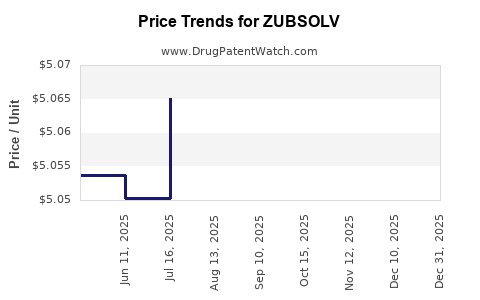
Average Pharmacy Cost for ZUBSOLV
| Drug Name | NDC | Price/Unit ($) | Unit | Date |
|---|---|---|---|---|
| ZUBSOLV 11.4-2.9 MG TABLET SL | 54123-0114-30 | 21.05500 | EACH | 2026-07-22 |
| ZUBSOLV 0.7-0.18 MG TABLET SL | 54123-0907-30 | 5.26518 | EACH | 2026-07-22 |
| ZUBSOLV 1.4-0.36 MG TABLET SL | 54123-0914-30 | 5.26081 | EACH | 2026-07-22 |
| ZUBSOLV 0.7-0.18 MG TABLET SL | 82111-0201-30 | 5.26518 | EACH | 2026-07-22 |
| ZUBSOLV 1.4-0.36 MG TABLET SL | 82111-0202-30 | 5.26081 | EACH | 2026-07-22 |
| >Drug Name | >NDC | >Price/Unit ($) | >Unit | >Date |
What is ZUBSOLV?
ZUBSOLV (buprenorphine and naloxone) is a Schedule III combination medication approved for opioid use disorder. It combines buprenorphine, a partial opioid agonist, with naloxone, an antagonist, to reduce abuse potential. Marketed primarily through Indivior, it is delivered via sublingual film.
How does ZUBSOLV perform in the current market?
The drug entered a growing market for opioid dependence treatments. According to IQVIA, in 2022, ZUBSOLV's US prescriptions reached approximately 2.5 million units, representing a volume increase of around 20% over the previous year. The drug accounts for roughly 10% of prescriptions in the opioid dependence segment, competing with buprenorphine-only products and full agonists.
What is the market size for opioid dependence treatments?
The global opioid dependence treatment market was valued at USD 4.6 billion in 2022, with an expected CAGR of 6% through 2030[1]. North America leads, with the US market alone valued at USD 3.2 billion in 2022, driven by high prevalence and favorable reimbursement policies.
How does ZUBSOLV compare to competitors?
| Product | Active Ingredients | Formulation | Market Share (2022) | Price (per unit) | Estimated Revenue (2022) |
|---|---|---|---|---|---|
| ZUBSOLV | Buprenorphine/naloxone | Sublingual film | 10% | USD 15 | USD 370 million |
| Suboxone | Buprenorphine/naloxone | Sublingual film | 50% | USD 12 | USD 1.65 billion |
| Sublocade | Buprenorphine (monthly injection) | Injectable | 20% | USD 900 | USD 600 million |
| Subutex | Buprenorphine | Sublingual tablet | 10% | USD 10 | USD 150 million |
ZUBSOLV has a higher price point than Suboxone but shares the same active ingredients. It is positioned as an alternative with a different delivery method.
What are the key price drivers?
Several factors influence ZUBSOLV’s pricing:
- Reimbursement policies favor higher-cost formulations with improved adherence.
- Competitive dynamics with Suboxone and newer formulations like Sublocade.
- Prescriber preferences for convenience and dosing flexibility.
- Regulatory environment, including restrictions on prescribing practices.
What are projections for ZUBSOLV's sales?
Based on current growth trajectories and market expansion, global sales are expected to increase at a CAGR of 8% through 2030[1]. In the US, revenues could approach USD 600 million by 2030, assuming continued market share growth and premium positioning. This projection accounts for:
- Patent protection until 2028
- Market expansion into Europe, possibly adding USD 300 million in annual revenues by 2030
- Increased treatment rates, from 2.5 million prescriptions in 2022 to over 4 million by 2030
What are the regulatory and market risks?
- Patent expiry in 2028 could lead to generic competition, lowering prices.
- Regulatory restrictions on prescribing buprenorphine products could limit market growth.
- Reimbursement shifts favoring generic formulations may pressure profit margins.
- Emerging treatments or formulations could replace current offerings.
What is the outlook for pricing trends?
Prices for branded opioids like ZUBSOLV are likely to decline 3-5% annually post-patent expiration, aligning with trends for other branded pharmaceuticals. However, initially, prices may stabilize or increase slightly due to demand and limited competition until generics enter.
Key Takeaways
- ZUBSOLV holds a significant niche in the opioid dependence treatment market, with an estimated 10% share.
- US market revenues could reach USD 600 million annually by 2030, driven by expanding treatment access.
- Competitive pressure and patent expiration pose risks of falling prices and market share loss.
- Market growth will depend on regulatory environment and treatment adoption rates.
- Strategic positioning before patent expiry may sustain profitability and capture emerging opportunities.
FAQs
Q1: When does ZUBSOLV's patent expire?
A1: Patent protection lasts until 2028, after which generic versions are expected to enter the market.
Q2: What are the primary competitors to ZUBSOLV?
A2: Suboxone (buprenorphine/naloxone sublingual film) and Sublocade (buprenorphine injectable).
Q3: How does reimbursement affect ZUBSOLV pricing?
A3: Favorable reimbursement policies increase access and allow for premium pricing. Reimbursement reductions can pressure margins.
Q4: Are there regulatory hurdles for ZUBSOLV?
A4: Prescribing restrictions limit access, especially for outpatient treatment, and ongoing regulation affects market expansion.
Q5: What is the potential of international markets?
A5: Europe represents a growth opportunity, with projected revenues reaching USD 300 million annually by 2030, contingent on regulatory approval and market penetration strategies.
References
[1] MarketResearch.com, "Global Opioid Dependence Treatment Market," 2022.
More… ↓
