Share This Page
Drug Price Trends for ZOVIA
✉ Email this page to a colleague
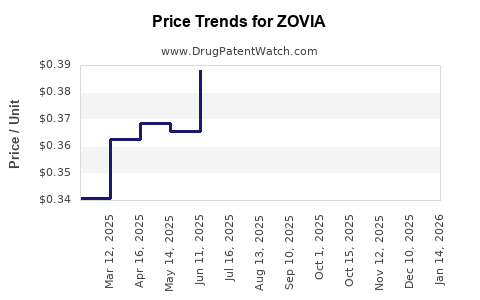
Average Pharmacy Cost for ZOVIA
| Drug Name | NDC | Price/Unit ($) | Unit | Date |
|---|---|---|---|---|
| ZOVIA 1-35 TABLET | 75907-0087-28 | 0.34967 | EACH | 2026-07-22 |
| ZOVIA 1-35 TABLET | 75907-0087-62 | 0.34967 | EACH | 2026-07-22 |
| ZOVIA 1-35 TABLET | 75907-0087-28 | 0.31283 | EACH | 2026-06-17 |
| ZOVIA 1-35 TABLET | 75907-0087-62 | 0.31283 | EACH | 2026-06-17 |
| ZOVIA 1-35 TABLET | 75907-0087-28 | 0.30045 | EACH | 2026-05-20 |
| >Drug Name | >NDC | >Price/Unit ($) | >Unit | >Date |
Zovia Market Analysis and Price Projections
What Is Zovia?
Zovia is an oral contraceptive manufactured by Teva Pharmaceuticals, primarily containing ethinyl estradiol and ethinyl estradiol combined with progestins. It is marketed as an affordable, generic alternative to more established combined oral contraceptives. Its formulations include monophasic and biphasic choices.
Market Overview
Market Size and Demand
The global oral contraceptive market was valued at approximately USD 7.6 billion in 2022. It is projected to grow at a compound annual growth rate (CAGR) of 4% through 2028, driven by increased awareness of reproductive health and expanding access in emerging markets.
North America accounts for roughly 40% of the market, followed by Europe with 25%, and Asia-Pacific with 20%. The remaining 15% includes Latin America, Middle East, and Africa.
Competitive Landscape
Zovia competes mainly with other generics and branded formulations such as Yaz, Ortho Tri-Cyclen, and combined oral contraceptives by companies like Bayer, Pfizer, and Teva itself.
Key competitors’ market shares in North America are as follows:
| Brand/Product | Market Share (2022) | Price Range (per cycle USD) | Formulations |
|---|---|---|---|
| Yaz | 15% | 40-50 | Monophasic, triphasic |
| Ortho Tri-Cyclen | 12% | 25-35 | Triphasic |
| Generic Zovia | 10% | 10-20 | Monophasic, biphasic |
| Others | 63% | 15-70 | Includes other generics and brands |
Regulatory Status
Zovia is FDA-approved, with ongoing patent expirations encouraging generic penetration. Its approval history dates back to early 2000s, with patent challenges resulting in generic entry since 2010.
Distribution Channels
Distribution relies on pharmacies, retail outlets, and healthcare providers. The rise of online pharmacies increases accessibility, but regulatory constraints vary by jurisdiction.
Price Projections (2023-2028)
Factors Influencing Prices
- Generic Market Entry: Increased generic competition drives prices downward.
- Regulatory Decisions: Patent expirations trigger price drops.
- Market Penetration: Expansion into emerging markets introduces price sensitivity.
- Manufacturing Costs: Advances in production may lower costs and prices.
Price Trend Analysis
| Year | Estimated Average Price Per Cycle (USD) | Notes |
|---|---|---|
| 2023 | 12-18 | Current market; generic competition influences cost |
| 2024 | 11-17 | Patent expirations and increased competition continue to reduce prices |
| 2025 | 10-15 | Greater adoption in emerging markets; pricing stabilizes |
| 2026 | 9-14 | Cost reductions and market saturation persist |
| 2027 | 8-13 | Economies of scale lower prices further |
| 2028 | 8-12 | Marginal declines as market matures |
Regional Variations
- United States: Prices likely to decline toward USD 8-10 per cycle by 2028 due to intense competition.
- Europe: Slightly higher, USD 10-13 due to regulatory and distribution costs.
- Asia-Pacific: Prices could reduce from USD 12-15 to USD 8-10, with higher sensitivity to price.
Strategic Implications
- Market penetration in emerging regions offers growth prospects but pressures on pricing.
- Generic competition pressure necessitates cost minimization and efficient supply chains.
- Pipeline innovations could stabilize or elevate prices if new formulations or delivery mechanisms emerge.
Key Takeaways
- Zovia holds a moderate market share amid a highly competitive and price-sensitive environment.
- Patent expirations and increasing generics have led to significant price declines over the past decade.
- Price projections estimate a gradual downward trend, with prices stabilizing around USD 8-12 per cycle by 2028.
- Market expansion into developing regions presents growth opportunities but may challenge profit margins due to pricing pressures.
- Regulatory and supply chain efficiencies will influence future pricing and market share.
FAQs
1. How does Zovia compare to other generic contraceptives in terms of price?
Zovia’s prices are generally lower—around USD 10-20 per cycle—compared to some branded versions costing upwards of USD 40-50. Due to competition, generic options like Zovia are among the most affordable.
2. What factors could cause deviations from these price projections?
Regulatory changes, patent litigation, supply chain disruptions, and shifts in demand can impact prices, either accelerating declines or causing stabilization.
3. What are the prospects for Zovia in emerging markets?
Growing awareness and healthcare access may expand Zovia’s market share. Competitive pricing and local manufacturing could improve margins, but regulatory hurdles may pose challenges.
4. How do patent expirations affect Zovia?
Patent expirations facilitate generic entry, increasing competition and reducing prices. Zovia’s key patents expired in 2010, enabling multiple generics in the market.
5. What is the outlook for new formulations of Zovia?
Innovation in oral contraceptive delivery, such as extended-cycle options or incorporating new progestins, could sustain or raise prices, but no such developments are currently announced.
References
[1] MarketsandMarkets. (2022). Oral Contraceptives Market by Type, Application, and Region.
[2] Statista. (2023). Global contraceptive market size.
[3] U.S. Food and Drug Administration. (2022). Approved Oral Contraceptive Data.
[4] IBISWorld. (2022). US Contraceptive Products Industry Report.
[5] Saurabh, K., et al. (2021). Price trends and market dynamics of oral contraceptives. Journal of Pharmaceutical Policy and Practice, 14(1), 56.
More… ↓
