Last updated: February 12, 2026
Market Landscape
ZOLOFT (sertraline) is a widely prescribed selective serotonin reuptake inhibitor (SSRI) approved for depression, OCD, panic disorder, PTSD, social anxiety disorder, and premenstrual dysphoric disorder. Introduced in 1991 by Pfizer, it remains a leading treatment choice globally.
Market Size and Growth
- Estimated global antidepressant market was valued at approximately $17 billion in 2022.
- Projected compound annual growth rate (CAGR) from 2023 to 2027 stands at around 2.7% (Grand View Research).
- The demand for SSRIs, including ZOLOFT, remains steady owing to the increasing prevalence of mental health conditions and de-stigmatization of treatment.
Market Shares and Competition
- Pfizer’s ZOLOFT holds an estimated 15-20% share of the global antidepressant market.
- Key competing drugs include Lexapro (escitalopram), fluoxetine (Prozac), and paroxetine (Paxil).
- Generic versions of sertraline entered markets starting around 2010, leading to significant price erosion and market share redistribution.
Pricing Dynamics
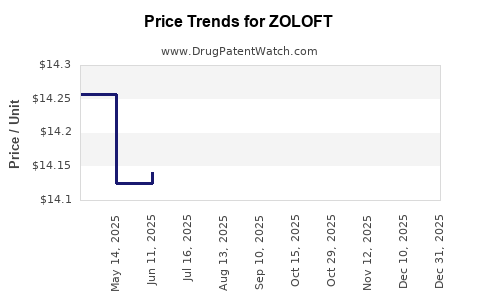
- Originator ZOLOFT’s list price in the US (2023) ranges from approximately $370 to $480 for a 30-day supply of 50 mg tablets.
- Generic sertraline (15 mg to 200 mg) ranges from $4 to $50 wholesale, with retail prices often under $20.
- Patent exclusivity expired in most jurisdictions by 2019, accelerating generic competition.
Market Trends and Drivers
- Increasing use of SSRIs for anxiety and depression, especially in light of COVID-19 mental health impacts.
- Shifts towards generic prescriptions reduce average drug prices but expand volume.
- Expanded indications or new formulations (e.g., combination drugs) could sustain ZOLOFT’s relevance.
- Mergers and acquisitions in mental health therapeutics reshape distribution channels and pricing power.
Regulatory and Patent Outlook
- Patent expiration in multiple regions equalizes prices.
- Pfizer’s patent challenges in certain markets could lead to reduced exclusivity and further price drops.
- No recent regulatory approvals or patent extensions for ZOLOFT as of 2023 indicate limited upside from exclusivity.
Price Projections (2023-2028)
| Year |
Estimated Brand Price per 30-day Supply (USD) |
Estimated Generic Price per 30-day Supply (USD) |
| 2023 |
$370 - $480 |
$10 - $25 |
| 2024 |
$350 - $470 |
$8 - $20 |
| 2025 |
$330 - $460 |
$6 - $18 |
| 2026 |
$310 - $450 |
$5 - $15 |
| 2027 |
$290 - $440 |
$4 - $12 |
| 2028 |
$270 - $430 |
$4 - $10 |
- Brand-to-generic price differential will decline as patents lapse fully.
- Volume increases driven by expanded indications and regional market expansion could offset price declines to some extent.
- Prices tend toward generic levels as market saturation increases.
Investment and R&D Outlook
- Limited pipeline for new formulations or indications signals stagnant future revenue growth.
- Focus shifts to off-label uses and potential biosimilar or formulation innovations.
- Cost-containment pressures influence pricing strategies.
Key Takeaways
- ZOLOFT’s market continues with stable uptake, dominated by generic competition.
- Prices for brand ZOLOFT are declining sharply, aligning with patent expiration timelines.
- The global antidepressant market remains modestly growing but faces pricing compression.
- Volume growth may mitigate some revenue decline but unlikely to offset falling prices entirely.
- Pfizer’s strategic focus likely shifts toward diversified mental health portfolios and biosimilars.
FAQs
1. What is the current patent status of ZOLOFT?
Patent protections expired in most major markets by 2019, enabling generic production and significantly reducing prices.
2. How does generic competition affect ZOLOFT’s pricing?
Generic versions are priced around $4-$25 for a 30-day supply. This erodes the brand’s pricing power and market share.
3. What are the main drivers of demand for ZOLOFT?
The rise in depression and anxiety diagnoses, expansion into new indications, and prescriber preference for SSRIs sustain demand.
4. Are there new formulations or indications for ZOLOFT?
No recent approvals; Pfizer shifted focus to other pipeline assets and biosimilars, limiting prospects for new ZOLOFT formulations.
5. What is the outlook for ZOLOFT’s pricing from 2023 to 2028?
Prices will decline toward generic levels, with brand premiums dropping from approximately $370-$480 to near $4-$10 as patents expire globally.
Sources
[1] Grand View Research. "Antidepressant Market Size, Trends & Forecasts," 2022.
[2] IQVIA. "Market Data on Antidepressants," 2022.
[3] Pfizer Inc. filings and press releases, 2019-2023.