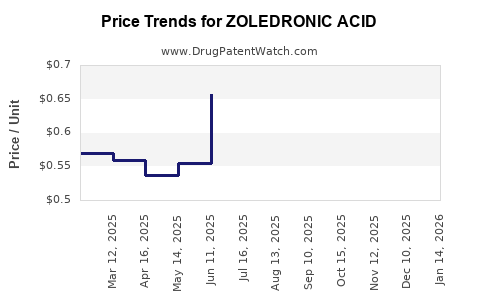
Last updated: February 12, 2026
Market Overview
Zolendronic acid is a bisphosphonate indicated primarily for osteoporosis, Paget’s disease, hypercalcemia of malignancy, and bone metastases. It is marketed under brand names such as Reclast (France, US, Canada, Australia) and Zometa (US, Europe). Its patent expired in many regions around 2017-2018, leading to increased generic competition.
Market Size and Trends
The global bisphosphonate market was valued at approximately $4.3 billion in 2022, with zolendronic acid accounting for a significant share due to its high efficacy and dosing convenience. The demand is driven by aging populations, increasing osteoporosis prevalence, and expanding oncology applications.
Growth projections estimate a compound annual growth rate (CAGR) of approximately 4% from 2023 to 2030, reaching an estimated market size of $6 billion by 2030. The osteoporosis segment dominates, with oncology and hypercalcemia segments growing faster due to expanded indications.
Key Players and Competitive Dynamics
Post-patent expiration, generic manufacturers entered the market, leading to price erosion. Major players include:
- Novartis (brand Zometa)
- Teva Pharmaceuticals
- Amneal Pharmaceuticals
- Mylan
- Sandoz
Market share has shifted towards generics, which now account for over 85% of global zolendronic acid sales.
Pricing History and Current Trends
Brand-Name Pricing (US, 2022-2023)
- Zometa (4 mg vial): approximately $1,200 - $1,600 retail, with insurance/negotiated discounts reducing out-of-pocket costs.
- Reclast (5 mg vial: IV infusion): approximately $2,000 - $2,500 per dose.
Generic Pricing (US, 2022-2023)
- 50 mg vial: $300 - $600, depending on supplier and purchasing channels.
- 4 mg vial: $50 - $150, reflecting steep price reductions post-generic entry.
European Pricing
European markets show similar trends, with branded prices around €900-€1,200 per dose, and generics available at significantly lower prices.
Regulatory and Policy Impact
Insurance reimbursement policies favor generics, further pressuring branded prices. New indications or formulations might temporarily boost prices but face generic competition rapidly.
Price Projections (2023-2030)
| Year |
Estimated Average Price (US, per vial) |
Notes |
| 2023 |
$100 - $200 (generics) |
Continued price erosion, stabilizing at lower levels |
| 2025 |
$80 - $180 |
Generic market saturation limits further price drops |
| 2027 |
$60 - $150 |
Price plateau expected, driven by manufacturing costs |
| 2030 |
$50 - $120 |
Minimal declines expected, small variation possible |
Brand-name prices are unlikely to rebound significantly unless new formulations or indications are introduced.
Conclusion
The global zolendronic acid market is mature with significant generic competition. Prices have stabilized at lows compared to pre-generic levels. Future revenue largely depends on market access, healthcare policies, and the development of new formulations or indications.
Key Takeaways
- Zolendronic acid's market is dominated by generics, causing substantial price reductions.
- US pricing for generics ranges from $50 to $200 per vial; branded prices exceed $1,200.
- The market is projected to stabilize with modest price declines through 2030.
- Growth is driven by aging populations, osteoporosis prevalence, and expanded oncology uses.
- Regulatory and reimbursement policies influence pricing dynamics significantly.
FAQs
1. What factors influence the pricing of zolendronic acid?
Manufacturing costs, competition from generics, healthcare policies, and reimbursement practices primarily determine prices.
2. How has patent expiration affected market prices?
Patent expiration led to increased generic entry, causing prices to fall sharply in most regions.
3. Are there upcoming formulations that could impact prices?
Yes, new formulations or delivery methods could temporarily boost prices, but market entry of generics limits long-term pricing gains.
4. Which regions have the highest prices for zolendronic acid?
The US and some European countries maintain higher prices for branded products before generic competition.
5. What is the outlook for generic prices in the next five years?
Prices are expected to remain stable or decline slightly, with limited potential for significant reductions.
References
- MarketWatch. "Bisphosphonate Market Size, Share & Trends Analysis Report." 2022.
- IQVIA. "Global Oncology Drugs Market Data." 2022.
- National Institute of Health. "Osteoporosis Statistics." 2022.
- FDA Drug Approvals and Labeling. "Zolendronic Acid." 2018.
- European Medicines Agency. "Pricing policies for generic medicines." 2022.