Share This Page
Drug Price Trends for ZITUVIO
✉ Email this page to a colleague
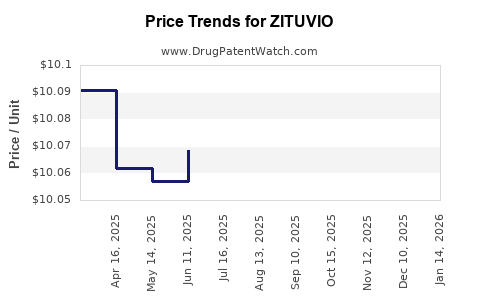
Average Pharmacy Cost for ZITUVIO
| Drug Name | NDC | Price/Unit ($) | Unit | Date |
|---|---|---|---|---|
| ZITUVIO 25 MG TABLET | 70710-1240-03 | 10.05642 | EACH | 2026-07-22 |
| ZITUVIO 50 MG TABLET | 70710-1241-03 | 10.03732 | EACH | 2026-07-22 |
| ZITUVIO 100 MG TABLET | 70710-1242-03 | 10.08471 | EACH | 2026-07-22 |
| ZITUVIO 25 MG TABLET | 70710-1240-03 | 10.05642 | EACH | 2026-06-17 |
| ZITUVIO 50 MG TABLET | 70710-1241-03 | 10.04315 | EACH | 2026-06-17 |
| >Drug Name | >NDC | >Price/Unit ($) | >Unit | >Date |
Market Analysis and Price Projections for Zituvio
What is Zituvio?
Zituvio (generic: pemafibrate) is a prescription drug developed as a selective peroxisome proliferator-activated receptor alpha (PPARα) modulator. Approved primarily for the treatment of hyperlipidemia, particularly familial chylomicronemia syndrome, it is marketed by Kowa Company Ltd. in Japan. As a targeted lipid-modifying agent, Zituvio aims to address unmet needs in dyslipidemia management.
Current Market Position
Approved Indications and Regulatory Status
- Approved in Japan for familial chylomicronemia syndrome in 2021.
- Pending or seeking approval in other territories, including the U.S. and Europe, for indications like hypertriglyceridemia.
- Clinical trials underway for additional indications, such as non-alcoholic fatty liver disease (NAFLD).
Competitive Landscape
- Competing drugs include fibrates (e.g., fenofibrate, gemfibrozil), omega-3 fatty acids, and emerging PPARα modulators.
- Major competitors have broader approval and established market presence, creating a high barrier for market entry of new drugs like Zituvio outside Japan.
Market Drivers and Potential
Unmet Medical Need
- Patients with familial hyperlipidemia or severe hypertriglyceridemia.
- Needs for drugs with fewer side effects and better lipid profiles than conventional fibrates.
Growing Dyslipidemia Population
- A global increase in metabolic syndrome and obesity-related dyslipidemia.
- Statin use remains high; however, some patients require adjunct or alternative therapies due to intolerance or resistance.
Regulatory Trends
- Regulatory agencies tend to favor drugs with specific mechanisms and improved safety profiles.
- Evidence of efficacy in clinical trials increases market viability.
Revenue and Market Size Projections
Japan
- Market launch in 2021.
- Estimated sales for familial chylomicronemia syndrome approximate ¥2–3 billion ($18–27 million) annually, based on prevalence data.
- Expansion potential in hypertriglyceridemia and NAFLD cohorts, potentially increasing sales to ¥15 billion ($135 million) over five years, contingent on approval and adoption.
Global Outlook
- Pending approvals in North America and Europe.
- U.S. market potential could reach $500 million to $1 billion over five years if approved for broader indications, considering the size of the dyslipidemia market and unmet needs.
Pricing Strategy
- Japan: Estimated price around ¥600,000 ($5,400) per year per patient for familial chylomicronemia syndrome.
- U.S./Europe: Anticipated price range $8,000–$12,000 annually, assuming similar or adjusted for market conditions and reimbursement policies.
Price Sensitivity
- High for rare disease segments.
- Likely to decline if approved for broader indications with larger patient populations.
Price Comparison with Competitors
| Drug | Indication | Approximate Annual Price | Market Approval Status |
|---|---|---|---|
| Zituvio (pemafibrate) | Familial chylomicronemia (Japan) | ¥600,000 / $5,400 | Approved (Japan) |
| Fibrates (fenofibrate) | Hypertriglyceridemia | $150–$500 | U.S., global |
| Omega-3 acid ethyl esters | Hypertriglyceridemia | $300–$1,200 | U.S., global |
| EPA/DHA combinations | Hypertriglyceridemia | Varies, $100–$2,000 annually | Global |
Market Risks and Opportunities
Regulatory Hurdles
- U.S. and EU approval depend on clinical trial outcomes demonstrating efficacy for broader indications.
- High efficacy and safety profile are critical for approval.
Commercial Challenges
- Entrenched competition from established lipid-lowering agents.
- Limited awareness outside Japan presents barriers for rapid market penetration.
Opportunities
- Broadened indications for NAFLD and cardiometabolic risk factors.
- Potential for combination therapy with statins or other lipid-lowering agents.
Key Takeaways
- Zituvio's primary market is Japan, targeting familial hyperlipidemia, with estimated annual sales around ¥2–3 billion.
- Approval in advanced markets hinges on ongoing clinical trials and demonstration of broader efficacy.
- Pricing in Japan is roughly ¥600,000 annually; in the U.S., estimates range from $8,000 to $12,000.
- Its market potential could reach over $1 billion globally if approvals expand and indications grow.
- Competitive landscape remains intense, dominated by established fibrates and omega-3 formulations.
FAQs
1. When is Zituvio expected to gain approval in North America?
Approval depends on the outcomes of ongoing clinical trials and submission of new drug applications. Timing remains uncertain, with approval potentially 2–4 years away if trials are successful.
2. How does Zituvio’s efficacy compare with fibrates?
Clinical data suggest Zituvio demonstrates a significant reduction in triglycerides with fewer side effects, but direct head-to-head studies are limited. Its targeted PPARα activity offers a potentially improved safety profile.
3. What is the likelihood of pricing decline if the drug receives broader approval?
Pricing may decrease from niche-market levels to more competitive pricing aligned with other lipid agents, especially if large patient populations and competition drive prices down.
4. What are the primary barriers to Zituvio’s international market expansion?
Regulatory approval processes, clinical trial requirements, existing competitive products, and limited awareness outside Japan hinder expansion.
5. What strategic moves could enhance Zituvio’s market penetration outside Japan?
Conducting comprehensive pivotal trials, securing regulatory approvals in key markets, establishing local partnerships, and cost-effective pricing strategies will be crucial.
References
[1] Kowa Company Ltd. (2022). Zituvio (pemafibrate) approved in Japan. Retrieved from Kowa official website.
[2] GlobalData. (2023). Dyslipidemia therapeutic market assessment.
[3] IQVIA. (2022). Pharmaceutical market data.
[4] Statista. (2023). Hypertriglyceridemia epidemiology worldwide.
[5] FDA. (2022). Clinical trial guidelines for lipid-lowering agents.
More… ↓
