Share This Page
Drug Price Trends for ZINC OXIDE
✉ Email this page to a colleague
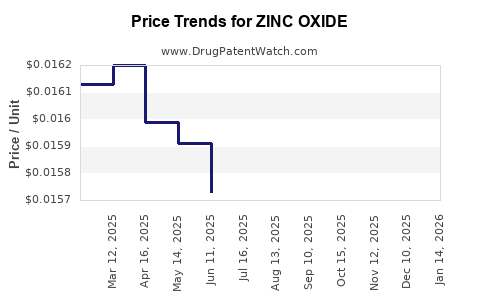
Average Pharmacy Cost for ZINC OXIDE
| Drug Name | NDC | Price/Unit ($) | Unit | Date |
|---|---|---|---|---|
| ZINC OXIDE 20% OINTMENT | 00536-1316-25 | 0.05813 | GM | 2026-07-22 |
| ZINC OXIDE 20% OINTMENT | 00536-1316-28 | 0.07658 | GM | 2026-07-22 |
| ZINC OXIDE 20% OINTMENT | 00536-1316-98 | 0.01570 | GM | 2026-07-22 |
| >Drug Name | >NDC | >Price/Unit ($) | >Unit | >Date |
Market Size and Current Pricing of Zinc Oxide
Zinc oxide (ZnO) is a chemical compound widely used in various industries, including pharmaceuticals, cosmetics, rubber manufacturing, and food products. The global market for zinc oxide was valued at approximately $1.5 billion in 2022. It is projected to grow at a compound annual growth rate (CAGR) of 4.2% between 2023 and 2030, reaching an estimated $2 billion by the end of the decade [1].
Within the pharmaceutical segment, zinc oxide is primarily used as an active ingredient in topical agents, diaper rash creams, sunscreens, and wound dressings. The demand for zinc oxide in these markets influences pricing trends and production capacity planning.
Market Segmentation and Industry Drivers
Industries and Applications
- Pharmaceuticals: Cutaneous drugs, topical ointments, and diaper rash creams constitute about 25% of total zinc oxide consumption.
- Cosmetics: Sunscreens and skincare products account for roughly 40%, with a focus on UV protection.
- Rubber and Plastics: About 20% of zinc oxide is used as a vulcanizing agent.
- Food Additive: Approximately 10%, mainly in fortified foods and supplements.
Industry Drivers
- Rising demand for zinc oxide in sunscreens driven by increased awareness of UV radiation hazards.
- Growing use in baby care and wound management products.
- Increased production of rubber related to automobile manufacturing and infrastructure projects.
- Regulatory standards favoring zinc oxide's safety profile in topical applications.
Current Price Benchmarks
Pricing varies based on purity, particle size, and form (powder or paste). As of Q1 2023, typical prices include:
- Standard pharmaceutical-grade zinc oxide: $3.00–$4.50 per kilogram FOB (Free on Board) Asia.
- Cosmetic-grade products: $4.00–$6.00 per kilogram FOB Asia.
- Specialized high-purity variants: $6.00–$8.00 per kilogram FOB.
These prices are influenced by raw material costs, processing complexity, and regional supply-demand dynamics.
Price Trends and Forecasts
Past Trends
Over the past decade, zinc oxide prices have experienced fluctuations correlated with raw material costs, regulatory changes, and industry demand cycles. Prices peaked around 2010 at approximately $6.50 per kg due to supply constraints and have since stabilized.
Future Projections
With increased regulatory support for safety and expanding applications, prices are expected to trend upward gradually. By 2030, average pharmaceutical-grade zinc oxide could reach $5.00–$6.50 per kilogram, depending on purity level and market conditions.
Factors influencing future pricing include:
- Raw material cost fluctuations, mainly zinc ore prices, which have shown volatility.
- Technological advancements reducing production costs.
- Regulatory changes affecting supply channels and safety standards.
Competitive Landscape and Production Capacity
Major producers include:
- US Zinc: A leading global supplier with a production capacity exceeding 150,000 metric tons per year.
- EverZinc: European-based, producing about 70,000 tons/year.
- Shandong Mingchuan Zinc Industry: Chinese manufacturer with regional dominance, approximately 130,000 tons/year capacity.
- Huzhou Zhenyu Zinc Industry: Japan, with specialized pharmaceutical-grade manufacturing.
Market consolidation and capacity expansion are ongoing, with Chinese producers expanding exports and capacity to meet global demand.
Key Takeaways
- The global zinc oxide market valued at $1.5 billion in 2022 is expected to reach $2 billion by 2030, driven by applications in pharmaceuticals, cosmetics, and rubber.
- Prices for pharmaceutical-grade zinc oxide hover around $3.00–$4.50 per kg in 2023, with forecasts suggesting gradual increases to $5.00–$6.50 per kg by 2030.
- Demand growth in sunscreens, wound dressings, and baby care products sustains upward pricing momentum.
- Raw material costs and regulatory factors drive price fluctuations, with supply chains susceptible to regional and geopolitical influences.
- Major producers are based in China, Europe, and North America, with capacity expansions indicating increasing supply to meet rising demand.
FAQs
1. What factors influence zinc oxide prices in the pharmaceutical industry?
Raw material costs, purity specifications, manufacturing technology, regulatory standards, and regional supply-demand imbalances influence prices.
2. How does the growth of the sunscreen market impact zinc oxide demand?
The increasing popularity of UV protection products drives higher demand for zinc oxide, contributing to price stability and upward pressure.
3. Are there regional differences in zinc oxide pricing?
Yes, prices tend to be lower in Asia due to large-scale manufacturing, while costs are higher in North America and Europe attributable to logistics, regulation, and quality standards.
4. Will new regulatory standards affect zinc oxide supply and pricing?
Potentially. Stricter safety standards could lead to increased production costs or supply chain adjustments, impacting prices.
5. How does zinc ore availability influence zinc oxide market stability?
Zinc ore prices and mining disruptions directly affect input costs; supply constraints can push zinc oxide prices upward.
References
[1] ResearchAndMarkets, "Global Zinc Oxide Market Report," 2023.
More… ↓
