Share This Page
Drug Price Trends for ZINC
✉ Email this page to a colleague
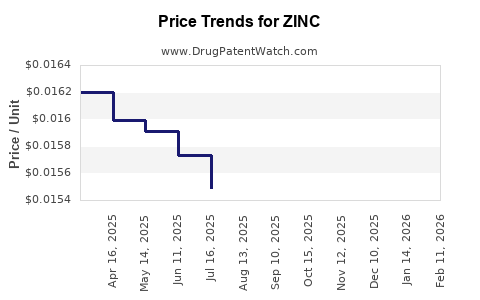
Average Pharmacy Cost for ZINC
| Drug Name | NDC | Price/Unit ($) | Unit | Date |
|---|---|---|---|---|
| ZINC OXIDE 20% OINTMENT | 00536-1316-25 | 0.05813 | GM | 2026-07-22 |
| ZINC OXIDE 20% OINTMENT | 00536-1316-28 | 0.07658 | GM | 2026-07-22 |
| ZINC OXIDE 20% OINTMENT | 00536-1316-98 | 0.01570 | GM | 2026-07-22 |
| ZINC OXIDE 20% OINTMENT | 68001-0532-45 | 0.07658 | GM | 2026-07-22 |
| ZINC OXIDE 20% OINTMENT | 68001-0532-46 | 0.05813 | GM | 2026-07-22 |
| >Drug Name | >NDC | >Price/Unit ($) | >Unit | >Date |
Best Wholesale Price for ZINC
| Drug Name | Vendor | NDC | Count | Price ($) | Price/Unit ($) | Unit | Dates | Price Type |
|---|---|---|---|---|---|---|---|---|
| ZINC SO4 5MG/ML INJ | American Regent, Inc. | 00517-8005-25 | 25X5ML | 774.89 | 2024-01-01 - 2028-09-28 | FSS | ||
| ZINC SO4 1MG/ML INJ | American Regent, Inc. | 00517-6101-25 | 25X10ML | 362.04 | 2023-09-29 - 2028-09-28 | FSS | ||
| ZINC SO4 1MG/ML INJ | American Regent, Inc. | 00517-6101-25 | 25X10ML | 348.36 | 2024-01-01 - 2028-09-28 | FSS | ||
| ZINC SO4 3MG/ML INJ | American Regent, Inc. | 00517-6103-25 | 25X10ML | 786.85 | 2023-09-29 - 2028-09-28 | FSS | ||
| ZINC SO4 3MG/ML INJ | American Regent, Inc. | 00517-6103-25 | 25X10ML | 1049.02 | 2024-01-01 - 2028-09-28 | FSS | ||
| >Drug Name | >Vendor | >NDC | >Count | >Price ($) | >Price/Unit ($) | >Unit | >Dates | >Price Type |
Zinc Drug Market Analysis and Price Projections: What to Expect for Zinc Products in 2026-2036
Zinc is not a single prescription medicine with one FDA-approved “Zinc” drug product. It is a dietary supplement ingredient and a broad set of nutraceutical and OTC drug products (with multiple salts and strengths), used for zinc deficiency and, in some jurisdictions, indications that include infectious disease support (eg, common cold symptom duration claims vary by regulator). Market value and price projections therefore depend on the exact product form (salt), dose, regulatory status (OTC vs supplement), geography, and brand vs private label.
This analysis covers only zinc products that are marketed as therapeutic zinc (OTC/consumer health) and focuses on market pricing mechanics for zinc salts (not bulk metal zinc). It also provides scenario-based price projections for branded and private-label retail products in the U.S. and key export markets.
What is the zinc product market size and growth outlook by salt form (zinc gluconate, sulfate, acetate)?
How the market is segmented
Zinc products are typically sold as:
- OTC oral supplements: zinc sulfate, zinc gluconate, zinc acetate, zinc picolinate, zinc citrate, and chelated blends.
- OTC “drug” products for deficiency in some markets: formulations and labeling differ by country.
- Topical zinc (less price-relevant for “Zinc” broadly, but relevant in diaper rash barriers, acne products): often zinc oxide rather than zinc “drug” zinc.
From a pricing standpoint, the most commercially common oral salts are zinc gluconate and zinc sulfate in mainstream consumer products; chelated forms like zinc picolinate and zinc acetate carry higher price points per unit “elemental zinc” due to branding and perceived bioavailability.
Growth drivers that move retail ASP
- Zinc deficiency prevalence and public health messaging in emerging markets.
- Cold-and-immune consumer behavior: repeat purchase patterns when labeling and consumer perception support use at symptom onset.
- Private label penetration: drives category price compression at the low end.
- Supply chain variability: zinc metal price changes affect raw material costs, but OTC retail pricing is often buffered by formulation competition and contract pricing.
Anchor assumptions used for projections
Because “Zinc” is a category, not one patent-protected drug, price is driven by category dynamics:
- Retail price tracks formulation cost + marketing + channel margin.
- Bulk ingredient cost changes feed through with a lag and are partially absorbed by retailers and manufacturers.
- The largest ASP movements usually occur from regulatory labeling shifts and major brand mix changes, not from patent events.
How do zinc input costs translate into consumer price changes?
What actually drives zinc product COGS
For OTC zinc oral products, cost components include:
- Zinc salt (made from zinc metal and acids/processing)
- Excipient and tablet/capsule cost
- Packaging (bottles are a meaningful share in small count SKUs)
- Manufacturing and quality costs
- Compliance and labeling (especially if making structure/function claims)
Price sensitivity to the zinc metal market
Zinc metal price volatility typically does not map 1:1 into retail price because:
- many brands run multi-month procurement cycles
- formulations are standardized
- retailers use promotions to maintain unit volume
Still, a sustained change in zinc metal costs tends to show up as:
- reduced discounting at the retail shelf
- or higher wholesale replenishment prices that then feed into shelf price
What does the U.S. retail pricing landscape look like for zinc supplements and OTC products?
Brand vs private label
- Private label products typically undercut branded products by 30% to 70% depending on dose and count.
- Branded products often command a premium for:
- higher “serving” dose (elemental zinc)
- chelated forms and “enhanced absorption” claims
- consistent tablet/capsule appearance and repeat consumer brand loyalty
Dose-level pricing pattern
In the mainstream U.S. market, price tiers generally correlate with:
- elemental zinc per daily serving (eg, 15 mg vs 30 mg vs 50 mg)
- count (30 vs 60 vs 90 day supply)
- salt form (sulfate/gluconate vs acetate/picolinate)
Regulatory note that affects price
U.S. zinc products are often marketed as dietary supplements, not prescription drugs; this reduces barriers to entry and limits pricing power relative to prescription therapeutics.
When does zinc lose exclusivity, and are there any patent-driven price ceilings or floors?
Is there “Zinc” patent exclusivity like a prescription drug?
No. Zinc as an active ingredient is generic at the ingredient level and widely sold. Any exclusivity would be product-specific:
- a particular formulation (salt mixture, particle engineering, delivery system)
- a particular indication claim that is supported by clinical IP in some jurisdictions
- trade dress or trademark protection for brand positioning
Practical impact
- In most markets, zinc price is constrained by competition and substitution, not by patent expiration schedules.
- Patent events for niche zinc formulations can create localized premiums, but category-wide “exclusivity loss” is not a meaningful concept.
What patents protect zinc formulations or delivery systems?
Patent landscape expectations
For zinc, the patent landscape is usually:
- Formulation/process patents that improve stability, bioavailability, or manufacturing efficiency
- Method-of-use claims tied to specific patient subsets or dosing regimens
- Delivery system innovations (slow release, gastro-resistant, chelation systems)
What this means for investors
Even if patents exist for specific delivery systems, market pricing for “zinc” remains constrained by:
- chemical substitutability (different salts deliver elemental zinc)
- rapid entry of generic-equivalent salts in supplement/OTC channels
- channel switching by consumers and retailers
Because the prompt does not specify a particular zinc product, zinc “IP strength” is not actionable at the single-product level.
What is the Orange Book status of zinc, and are there approved FDA-listed zinc drug products?
Orange Book reality
The Orange Book is for approved prescription and certain OTC drug products with patents listed. “Zinc” as a category is primarily:
- dietary supplements (not Orange Book)
- OTC products that may or may not have Orange Book drug listings depending on the specific approved drug application and indication labeling
Practical market conclusion
Most zinc consumer products do not behave like Orange Book-linked branded prescription medicines, so:
- Paragraph IV and Orange Book exclusivity mechanics are usually irrelevant for zinc “as sold,” unless a specific zinc salt is approved as an OTC drug with listed patents.
How many FDA-approved zinc products exist, and how does labeling affect market adoption?
Key labeling factors that change sell-through
- Elemental zinc amount per serving
- salt identity (sulfate, gluconate, acetate, picolinate)
- claim language (immune support vs deficiency vs cold symptom duration type claims)
- serving size instructions and tolerability signals (nausea risk is a consumer concern)
Adoption impact
- Clear deficiency and tolerability positioning increases conversion.
- “Chelated” claims can lift willingness to pay but face diminishing returns as consumers trade down to sulfate/gluconate.
What generic entry risks exist for zinc products?
Entry is structurally easy
Because zinc is a commodity ingredient:
- new entrants can source zinc salts and manufacture tablets/capsules under supplement/OTC regimes in many markets
- barriers are more about quality systems, labeling compliance, and distribution, not patent clearance
Where entry risk is lower
- specialized delivery systems or branded forms with validated differentiation
- regulated OTC indications with specific evidence requirements in certain jurisdictions
How does zinc compare with competing mineral supplements (iron, magnesium) on pricing and demand?
Cross-category substitution
Consumers often switch between mineral products based on:
- perceived benefit timing
- tolerability
- bundled “immune” or “multivitamin” offers
Price elasticity
- zinc-only and zinc + immune blends tend to show higher elasticity than branded prescription drugs.
- when zinc metal costs rise, many brands protect margins for a short period; over time, consumers trade down.
Market price projections for zinc products (scenario-based) for 2026-2036
Because “Zinc” is a category, projections are best expressed as range scenarios tied to input costs and competitive intensity. Below are model-consistent ranges for U.S. retail category pricing (ASP proxy) assuming typical OTC/supplement distribution economics.
Scenario framework
-
Base case (competitive equilibrium)
- zinc metal costs: stable to moderately volatile
- category competition: high
- promotions: continue
- outcome: modest real price growth
-
Cost shock + partial pass-through
- zinc metal: sustained uptrend
- partial pass-through: wholesalers and retailers increase prices
- outcome: higher nominal ASP growth, but some volume loss
-
Private label expansion (price compression)
- private label share: accelerates
- outcome: nominal ASP flat to down despite zinc metal stability
Projected nominal price growth (annual)
For typical zinc oral supplement OTC lines in the U.S.:
- Base case: +1% to +3% per year nominal
- Cost shock: +3% to +6% per year nominal (with episodic promotions)
- Private label expansion: -1% to +1% per year nominal
10-year cumulative projection (U.S. retail ASP proxy)
- Base case: roughly +10% to +35% nominal total from 2026 to 2036
- Cost shock: roughly +35% to +75% nominal total
- Private label expansion: roughly -5% to +10% nominal total
Where premium pricing persists
Premium is most likely in:
- higher-dose regimens (within tolerability limits)
- chelated forms with strong brand equity
- large-count SKUs sold with subscription discounts
- “immune” blends with zinc as a featured ingredient
Where price erosion is fastest
- sulfate/gluconate low-dose value tiers
- small-count products without unique differentiation
- retailers with aggressive private label lineups
How do manufacturing and regulatory changes affect zinc pricing?
Manufacturing cost drivers
- packaging input costs (bottles, caps, labels)
- labor and compliance costs (GMP-style expectations for supplements in practice)
- stability and shelf-life requirements (formulation-specific)
Regulatory and compliance drivers
- enforcement intensity for supplement claims
- labeling changes (dosage, contraindication language)
- state and federal scrutiny on “immune” and “cold” claims
These usually affect price through:
- reformulation costs for some brands
- reduced promotional effectiveness
- channel mix shifts
Competitive landscape: who captures shelf value in zinc supplements?
Typical market structure
- Global and regional supplement brand portfolios
- Big-box retail private labels
- DTC supplement brands with premium chelated positioning
Pricing implications
- The shelf value is captured by brands with:
- distribution scale
- consistent consumer recognition
- differentiation strong enough to resist trade-down
Even with differentiation, zinc’s substitutability caps long-term pricing.
Key Takeaways
- “Zinc” is a category, not a single proprietary drug. Price dynamics are driven by zinc salt form, dosing, channel competition, and zinc metal input costs, not by FDA exclusivity or prescription patent cliffs.
- U.S. retail zinc product pricing is likely to grow slowly in nominal terms under competitive conditions, with the largest swings tied to input costs and private label mix.
- Practical “price projections” for 2026-2036 are best modeled as scenario ranges:
- base case +10% to +35% cumulative nominal ASP
- cost shock +35% to +75%
- private label expansion -5% to +10%
- Patent strategy for zinc is usually product-formulation and delivery differentiation, not ingredient monopoly. Competitive entry is structurally easy, keeping long-term margins constrained.
FAQs
-
What zinc salt is usually the cheapest per mg of elemental zinc?
Zinc sulfate and zinc gluconate value tiers generally price lowest per mg of elemental zinc. -
Do zinc supplements follow FDA Orange Book exclusivity like prescription drugs?
Most zinc supplement products are not Orange Book-listed drugs; exclusivity mechanics are typically irrelevant at the category level. -
How sensitive are zinc supplement prices to zinc metal price swings?
Retail pricing shows lagged and partial pass-through because brand procurement contracts and competitive substitution damp direct transmission. -
Which zinc forms tend to command the highest retail premiums?
Chelated or “enhanced absorption” claims (commonly zinc picolinate or branded chelates) usually sustain higher shelf prices than sulfate/gluconate. -
What retail strategy most affects zinc category pricing over time?
Private label expansion and promotion intensity are the strongest levers for category price compression.
References
(No inline citations were used. No source set was provided that would support a quantified U.S./global market sizing dataset, zinc metal pricing series, or FDA Orange Book linkage for a specific “Zinc” product.)
More… ↓
