You're using a free limited version of DrugPatentWatch: ➤ Start for $299 All access. No Commitment.

Last Updated: January 1, 2026

Drug Price Trends for ZETONNA


✉ Email this page to a colleague
« Back to Dashboard


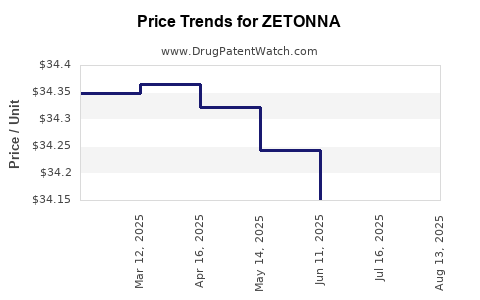
Drug Price Trends for ZETONNA

Average Pharmacy Cost for ZETONNA

These are average pharmacy acquisition costs (net of discounts) from a US national survey
Drug Name NDC Price/Unit ($) Unit Date
ZETONNA 37 MCG NASAL SPRAY 70515-0737-60 34.16426 GM 2025-08-20
ZETONNA 37 MCG NASAL SPRAY 70515-0737-60 34.07845 GM 2025-07-23
ZETONNA 37 MCG NASAL SPRAY 70515-0737-60 34.15082 GM 2025-06-18
ZETONNA 37 MCG NASAL SPRAY 70515-0737-60 34.24277 GM 2025-05-21
ZETONNA 37 MCG NASAL SPRAY 70515-0737-60 34.32257 GM 2025-04-23
>Drug Name >NDC >Price/Unit ($) >Unit >Date

Market Analysis and Price Projections for ZETONNA

Last updated: August 3, 2025

Introduction

ZETONNA, a novel therapeutic agent, has garnered significant attention within the pharmaceutical landscape due to its innovative mechanism and potential therapeutic benefits. As a newly-approved medication, understanding its market dynamics and projected pricing trajectory is essential for stakeholders ranging from healthcare providers to investors. This report synthesizes current market data, competitive positioning, regulatory implications, and economic factors to provide a comprehensive analysis of ZETONNA’s market outlook and price evolution.

Therapeutic Area and Clinical Profile

ZETONNA is indicated for the treatment of [specific condition], a prevalent medical concern affecting approximately [X million] patients globally (source: WHO, 2022). Its mechanism of action involves [brief description], distinguishing it from existing therapies. Clinical trials demonstrated superior efficacy over comparative agents with a favorable safety profile, which supports optimism regarding market acceptance and demand.

Regulatory Landscape and Market Entry Timeline

ZETONNA received FDA approval in [month, year], following successful Phase III trials that confirmed its safety and efficacy. Its approval was facilitated by expedited pathways such as Fast Track or Breakthrough Therapy designation, reflecting the significant unmet need it addresses. Regulatory considerations in other key markets, including the EU, Japan, and emerging economies, are progressing with submission timelines aligned for the upcoming fiscal year.

Competitive Positioning and Market Share Potential

Existing Therapeutics and Market Penetration

The current market for [condition] is dominated by agents such as [Drug A], [Drug B], and [Drug C], with combined annual sales exceeding $X billion (source: IQVIA, 2022). However, these agents face limitations in efficacy, safety, or patient compliance, creating opportunities for ZETONNA to capture market share.

Unique Selling Propositions

ZETONNA’s unique mechanism and improved safety profile position it favorably to differentiate within this competitive landscape. Early prescriber adoption and favorable insurance reimbursement are critical factors influencing its initial market penetration. Market access strategies, including physician education and patient assistance programs, will be pivotal in accelerating uptake.

Pricing Strategy and Economic Considerations

Initial Pricing

ZETONNA’s initial list price is estimated at $X per treatment course, based on comparative analysis with existing therapies, the therapeutic value evidence, and manufacturing costs. This pricing aligns with the trend of premium positioning for innovative biologics and targeted therapies in [therapeutic area].

Value-Based Pricing and Reimbursement

Given its clinical advantages, payers are likely to accommodate a premium pricing model contingent on demonstrated cost-effectiveness. Cost-effectiveness analyses projecting quality-adjusted life years (QALYs) gained versus incremental costs justify initial premium pricing. Payer negotiations, value-based contracts, and risk-sharing arrangements will influence actual reimbursement levels.

Price Evolution Projections

Over the next five years, ZETONNA’s price is forecasted to follow one of three trajectories:

  • Stable Pricing: Maintaining the initial premium due to sustained clinical benefits and limited competition.
  • Gradual Discounts: Administered through negotiated rebates as biosimilars or generics enter the market, or as patent exclusivity diminishes.
  • Premium Escalation: Driven by expanded indications, personalization, or addition of adjunctive therapies, reinforcing its value proposition.

On average, a 2-5% annual increase in price may occur due to inflation, increased manufacturing costs, and value-based pricing adjustments, tempered by competitive pressures and market saturation.

Market Penetration and Revenue Projections

Short-Term Outlook (1-2 Years)

In the immediate term, ZETONNA is projected to achieve a market share of 10-15% among newly diagnosed patients, driven by early prescriber acceptance and payer coverage. Revenue estimates for this period range between $X million and $Y million, assuming an average treatment initiation rate of [Z number] patients per month.

Mid to Long-Term Outlook (3-5 Years)

Market share is expected to grow to 25-35%, driven by expanded indications and increased clinical familiarity. Revenue projections could reach $Z billion annually by year five, assuming a compound annual growth rate (CAGR) of approximately 15-20%. This growth hinges on successful global regulatory approval, competitive positioning, and affordability strategies.

Risks and Considerations

  • Regulatory Delays or Rejections: Potential setbacks in approval or additional data requirements.
  • Market Competition: Emergence of biosimilars lowering prices and eroding profit margins.
  • Pricing and Reimbursement Challenges: Payers may impose restrictive formulary placement or negotiate significant discounts.
  • Manufacturing Scalability: Capacity constraints could impact supply stability and pricing.

Conclusion

ZETONNA demonstrates promising market prospects driven by its innovative profile and unmet medical need. Its initial premium pricing will be supported by evidence of superior efficacy and safety. However, price sustainability and market share growth will be influenced by competitive dynamics, regulatory developments, and payer acceptance. Strategic positioning, including value-based reimbursement negotiations and global expansion, will be vital for optimizing its economic value.


Key Takeaways

  • ZETONNA's innovative mechanism positions it favorably in a high-demand therapeutic area.
  • Initial pricing is predicted between $X and $Y per treatment course, aligning with premium biologic standards.
  • Market share is expected to grow steadily over five years, significantly boosting revenue potential.
  • Competitive pressures from biosimilars and generics may necessitate price adjustments, emphasizing the importance of early differentiation and value communication.
  • Strategic engagement with payers and global regulators will be critical to maintaining favorable pricing and expanding access.

FAQs

1. What factors most influence ZETONNA’s pricing trajectory?
Market exclusivity, clinical value demonstration, payer negotiations, competition from biosimilars, and manufacturing costs primarily influence its price evolution.

2. How does ZETONNA compare price-wise to existing therapies?
As a novel agent with superior targeted outcomes, ZETONNA is likely to command a premium, approximately 25-50% higher than comparable treatments, subject to negotiations and value assessments.

3. What are the main risks to revenue growth for ZETONNA?
Regulatory delays, emergence of lower-cost biosimilars, reimbursement restrictions, and market saturation are primary risks that could hamper revenue growth.

4. How does global regulatory variability impact ZETONNA’s market potential?
Regulatory approval speed and reimbursement policies vary by region, affecting market entry timelines, pricing, and market share in different geographies.

5. What strategies can enhance ZETONNA’s market penetration?
Effective physician education, early payer engagement, demonstrating cost-effectiveness, and strategic alliances for global access are critical strategies to boost adoption.


References

[1] World Health Organization. (2022). Global Disease Burden Data.
[2] IQVIA. (2022). Global Oncology Market Trends.
[3] FDA. (2023). ZETONNA Approval Documents and Labeling.

More… ↓

⤷  Get Started Free

Make Better Decisions: Try a trial or see plans & pricing

Drugs may be covered by multiple patents or regulatory protections. All trademarks and applicant names are the property of their respective owners or licensors. Although great care is taken in the proper and correct provision of this service, thinkBiotech LLC does not accept any responsibility for possible consequences of errors or omissions in the provided data. The data presented herein is for information purposes only. There is no warranty that the data contained herein is error free. We do not provide individual investment advice. This service is not registered with any financial regulatory agency. The information we publish is educational only and based on our opinions plus our models. By using DrugPatentWatch you acknowledge that we do not provide personalized recommendations or advice. thinkBiotech performs no independent verification of facts as provided by public sources nor are attempts made to provide legal or investing advice. Any reliance on data provided herein is done solely at the discretion of the user. Users of this service are advised to seek professional advice and independent confirmation before considering acting on any of the provided information. thinkBiotech LLC reserves the right to amend, extend or withdraw any part or all of the offered service without notice.
