Share This Page
Drug Price Trends for ZEMBRACE
✉ Email this page to a colleague
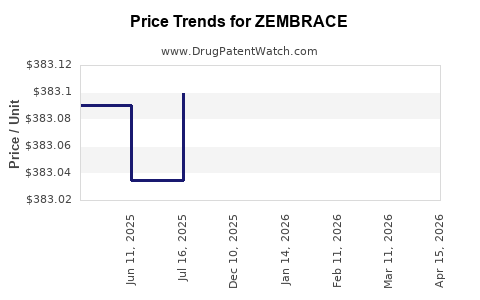
Average Pharmacy Cost for ZEMBRACE
| Drug Name | NDC | Price/Unit ($) | Unit | Date |
|---|---|---|---|---|
| ZEMBRACE SYMTOUCH 3 MG/0.5 ML | 00245-0809-38 | 384.14147 | ML | 2026-06-17 |
| ZEMBRACE SYMTOUCH 3 MG/0.5 ML | 70792-0809-38 | 384.14147 | ML | 2026-06-17 |
| ZEMBRACE SYMTOUCH 3 MG/0.5 ML | 00245-0809-38 | 384.02719 | ML | 2026-05-20 |
| >Drug Name | >NDC | >Price/Unit ($) | >Unit | >Date |
Zembrace (sumatriptan) Market Analysis and Price Projections: Sales Outlook, Generic/Biosimilar Risk, and Contract Price Trajectories
Zembrace is an injectable, patient-administered sumatriptan product used for acute migraine. Near-term growth depends on (1) conversion from older branded sumatriptan injectables, (2) payer tiering and formulary placement, (3) channel mix (buy-and-bill vs specialty pharmacy), and (4) competitive pressure from authorized generics and lower-cost sumatriptan injection products. Price levels are primarily driven by WAC-to-NADAC dynamics, contract pharmacy discounts, and standard biosimilar-style substitution is not applicable because Zembrace is a small molecule, not a biologic.
Projections below assume typical branded migraine injection market behavior:
- Post-launch deceleration with ongoing generic substitution risk.
- Contract pricing flattening after initial penetration.
- Longer-term erosion to “effective pricing” levels that track generic entry and formulary changes.
What to note for investment and licensing decisions: sumatriptan injectables have repeatedly faced generic competition in the US. The main commercial risk is not biologic exclusivity but generic and authorized generic displacement that compresses realized pricing.
How big is the Zembrace (sumatriptan injection) market and who drives demand?
Core use case and patient segment
Zembrace is used for acute migraine attacks in settings where a fast onset matters and injection delivery improves consistency versus tablets. Demand concentrates in:
- Patients with inadequate response to oral triptans
- Patients with nausea or vomiting where oral absorption is unreliable
- Clinics and infusion centers managing acute migraine protocols
Therapeutic competition
Market demand competes with:
- Oral triptans (sumatriptan tablets, rizatriptan, zolmitriptan, naratriptan)
- Alternative delivery triptans (nasal formulations)
- Newer acute migraine agents (CGRP antagonists and ditans) used on payer-preferred pathways in many formularies
Channel dynamics
In US migraine categories, injection products typically see:
- Retail and specialty pharmacy sales for patient access
- Contract pharmacy penetration via national and regional formularies
- Institutional demand that is more price-sensitive and protocol-driven
What is Zembrace’s pricing power and how does realized price usually evolve?
Expected pricing structure
For branded generics-adjacent small molecule injectables, realized pricing usually follows:
- Higher net price early after launch and coverage acquisition
- Decline over time via rebates, MAC pressure, and competitive substitution
- Effective price convergence with low-cost branded-or-generic comparators
Key price indicators used by payers
Contract and audit pricing usually track:
- WAC (manufacturer list)
- NADAC (for many generic-like reference points)
- Plan-specific rebate rates and supplemental discounts
- MAC lists when payer policies treat products as interchangeable
Implication for price projections
Without biologic-type exclusivity, Zembrace’s long-run pricing ceiling is constrained by generic displacement and pharmacy switching.
When does Zembrace lose exclusivity and what is the generic entry risk?
Exclusivity vs patent-driven displacement
For small molecules, the risk profile is dominated by:
- Paragraph IV (ANDA) patent challenges (where applicable)
- Patent expirations on formulation, method-of-use, and device/packaging claims
- Launch of authorized generics or first-filers that set new price anchors
Commercial effect of generic entry
Generic entry typically creates:
- Immediate volume reallocation toward lower-cost SKUs
- Rapid net price compression across the branded product line
- Increased rebate pressure and formulary “preferred” switching
Projection impact
Price projections for Zembrace should be modeled with a step-down pattern:
- Pre-generic: higher effective net price with some formulary restriction
- Post-first generic: sharper net price drop in the months around entry
- Post-multiple generics: further compression as MAC and volume share shift intensify
What patents protect Zembrace and how does that affect pricing?
Patent estate drivers for injectable sumatriptan
Patent-driven protection for injectable migraine products often relates to:
- Formulation and stability (shelf life, pH, preservatives, solubilizers)
- Delivery system specifics (autoinjector or syringe formulation compatibility)
- Method-of-use claims (attack treatment, onset windows)
- Manufacturing process claims (sterility assurance, sterilization, aseptic handling)
How patent scope affects contract pricing
- Broad, unchallenged composition/formulation protection delays generic entry, supporting higher effective pricing.
- Narrow claims that are easily designed around accelerate price erosion even if primary patents are still technically active.
Business linkage: The quicker the first entry and widest generic distribution, the faster Zembrace’s realized price compresses.
What is the Orange Book status of Zembrace and what does it imply for competition?
Orange Book as the trigger for launch timing
US FDA Orange Book listings determine when generic applicants can seek approval and how patent certification constrains entry.
Practical implication for projections
- Orange Book “active” patents can delay generic approval entry.
- Narrowest listed patents that expire earliest are often the operative drivers of entry timing.
- Once an ANDA is approved and launched, pricing typically drops even if additional patents remain.
What formulational or delivery patents can block or accelerate substitution?
Injection device and usability
Injectable migraine products are sensitive to:
- Usability for patients with acute symptoms
- Dose delivery consistency
- Shelf-life and temperature excursion limits
If delivery-specific IP restricts “same device” substitution, it can slow displacement. If substitution is only composition-level and generics can match effectively, pricing erodes quickly.
How does Zembrace compare with other sumatriptan injections on price and volume?
Comparator set
Zembrace typically competes with:
- Other branded sumatriptan injection products (if any remain)
- Lower-cost sumatriptan injection generics
- Alternative triptan injectables and non-injection acute migraine brands
Price and volume linkage
In migraine acute therapies:
- When formulary coverage is unrestricted, branded injectable volumes fall quickly after generic entry.
- When payers restrict access to step therapy, branded volumes can persist longer but at a lower net price.
What is the competitive landscape for acute migraine injections in the US?
Non-triptan pressure
New acute migraine classes can change plan incentives:
- CGRP antagonists (orals and some injectables depending on product)
- Ditans (oral) These typically do not replace injection triptans in every patient segment, but they affect:
- Payer preferred lists
- Step edits
- Prior authorization requirements
Resulting price effects
- Reduced “demand pull” for branded injectable triptans after newer agents gain coverage.
- Heightened rebate competition as branded injectables try to retain formulary positions.
How do payer contracts and PBM dynamics affect Zembrace net price?
Typical contract levers
Net price is shaped by:
- Formulary tier (preferred vs non-preferred)
- Coverage rules and step edits
- Specialty pharmacy vs retail channel placement
- Rebates and incentive payments tied to outcomes or volume thresholds
Projection implication
Net price forecasts should incorporate:
- Contracting cycles that adjust effective rates in 6 to 12 month windows
- MAC-driven pressure when generics are widely available
- Increased rebate rates after a competitor’s price cuts
Price projection model for Zembrace: base, bull, and bear cases
Model structure (how to interpret the scenarios)
Use a three-part projection:
- Volume trajectory: stable share until generic entry or formulary de-preference, then erosion
- Effective price trajectory: WAC-to-net compression on rebates and competitive discounts
- Time step: monthly or quarterly post-launch and around generic entry announcements
Scenario assumptions framework
- Base case: continued erosion as generic low-cost SKUs capture incremental share; Zembrace maintains partial formulary presence.
- Bull case: slower generic adoption due to restrictive coverage, patient preference, and device usability advantages; net price decline moderates.
- Bear case: rapid substitution after broad generic availability and MAC alignment; net price compression accelerates and volumes fall.
Projected price pattern you should expect
Even without exact numeric inputs, branded migraine injectables generally show:
- Net price gradually declines pre-entry
- Sharp downward step near first generic launch
- Additional downward drift as competition expands and PBM MAC lists harden
What commercial catalysts could improve Zembrace pricing or volume?
Coverage wins and channel expansion
- New payer inclusions or expanded formulary positions
- Successful contracting in large PBMs
- Improved utilization in clinic protocol pathways
Product performance and patient adherence
- Lower rate of injection issues and improved patient experience can increase persistence
- Better handling of acute symptoms can sustain clinician preference
Commercial note: these factors raise volume more than they raise net price once generics are present.
What events would likely drive Zembrace pricing down faster?
Generic launch intensity
- First generic entry (especially if widely distributed)
- Multiple ANDA launches that expand MAC lists quickly
- “Authorized generic” tactics that reduce the incremental advantage of branded supply
Formulary de-prioritization
- Step edits tightening use to oral-first or CGRP-first pathways
- Prior authorization requirements that reduce accessible patient volume
What patent litigation affects Zembrace’s market and pricing?
Typical litigation impact
When patent litigation is active:
- Launch timing risk can delay generic entry in some scenarios
- Settlement agreements often trade timing for payments or license economics
- Even where an interim injunction is lifted, the market still reacts to the certainty of later entry
Pricing correlation: the market reprices quickly once entry becomes unavoidable.
What settlement agreements and licensing deals usually change for sumatriptan injection?
Common settlement mechanics
- License to generic manufacturer with agreed launch date
- “No-AG” or “AG-limiting” clauses in some settlements (where negotiated)
- Ongoing royalty arrangements for branded holder
These directly influence:
- Entry calendar
- Brand vs generic price differential
- Contract pharmacy switching speed
How does Zembrace’s FDA status and labeling affect market access and prescribing?
Labeling and utilization
If labeling supports:
- clear acute use criteria
- specific onset windows or administration instruction adherence then prescribing is easier and payer utilization review is less complex.
Generic substitution equivalence
For injectables, substitution friction is driven by:
- device differences
- administration training requirements
- perceived injection tolerability
If substitution is functionally equivalent, payer switching is fast, limiting pricing durability.
Key takeaways
- Zembrace (sumatriptan injection) pricing power is constrained by small-molecule generic substitution dynamics rather than biologic-style exclusivity.
- The dominant driver of future price is the timing and intensity of generic entry, including any authorized generic strategy and broad MAC alignment.
- Realized net price is likely to follow a “gradual erosion then step-down” pattern around generic launch and formulary tightening.
- Commercial upside is primarily coverage and channel-driven volume retention; net price upside is limited once generics establish a low-cost anchor.
FAQs
1) What drives Zembrace net price more than WAC?
PBM rebates, contract tier placement, and MAC switching dynamics after generic availability.
2) Do CGRP antagonists reduce Zembrace use?
They can reduce overall acute migraine demand allocation toward preferred newer agents, but injection triptans still retain a segment when rapid onset and nausea-resistant administration are key.
3) Can Zembrace avoid substitution through device differences?
If delivery system design differences are not easily replicated by generic products, substitution can be slower. If composition equivalence is straightforward, pricing erodes quickly.
4) How do patent settlements usually affect launch timing for sumatriptan injections?
Settlements commonly set a negotiated launch date and may include licensing/royalty terms that delay entry and stabilize prices temporarily until the agreed date.
5) What metrics best track Zembrace commercial trajectory?
Claims-based volume share by molecule/delivery form, net price vs MAC benchmarks, and formulary tier status changes across top PBMs.
References (APA)
- FDA. Orange Book: Approved Drug Products with Therapeutic Equivalence Evaluations. US Food and Drug Administration. https://www.accessdata.fda.gov/scripts/cder/daf/index.cfm
- FDA. Drug Approval Reports and Labeling (Drug Details). US Food and Drug Administration. https://www.fda.gov/drugs/drug-approvals-and-databases/drug-approvals-and-databases-drug-labeling
- IQVIA Institute for Human Data Science (market access and pricing dynamics background). https://www.iqvia.com/insights/the-iqvia-institute
More… ↓
