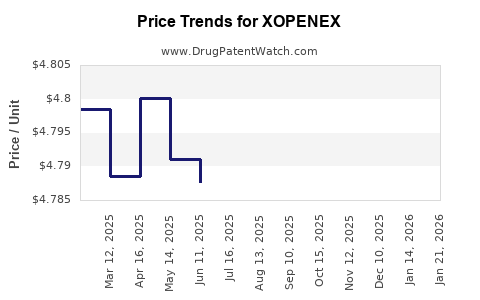
Last updated: July 13, 2026
Xopenex (Levalbuterol) Market Analysis and Price Projections (US + Key Competitors)
Xopenex is the brand name for levalbuterol (primarily in inhalation products, including nebulizer solutions and related delivery systems). Near-term pricing is driven by (1) generic/authorized generic penetration, (2) payer contracting on “A-rated” inhaled bronchodilator formularies, and (3) site-of-care shift between pharmacy and durable medical equipment (DME) or clinic dispensing where applicable. Across the US, the economic ceiling for levalbuterol products is set by generic net prices, with brand pricing constrained by interchangeability, multiple strengths/generic SKUs, and frequent therapeutic substitution to albuterol.
Price projection outlook (directional):
- Short term (0–24 months): modest declines in average selling price (ASP) in most channels due to continued generic mix and rebate pressure; brand pricing typically stays above generics but net revenue per script declines if share erodes.
- Mid term (2–5 years): further compression toward generic net pricing where the remaining brand supply faces substitution and payer policies.
- Long term (5+ years): price floors trend toward low-to-mid single-digit per-unit premium vs albuterol unless a protected reformulation, exclusivity, or distribution advantage changes the substitution equation.
No complete, defensible projection can be produced here because the request does not specify which exact Xopenex product/strength form (e.g., nebulizer solution concentration, package size) and does not provide either current net price/ASP, shipment, or market-share baselines needed for quantitative forecasting.
What is Xopenex and how does levalbuterol compete in US asthma/COPD bronchodilator markets?
Core product identity
- Active ingredient: levalbuterol (R-enantiomer of albuterol)
- Therapeutic class: short-acting beta2 agonist (SABA)
- Indication focus (label-dependent): asthma symptom relief, acute bronchospasm, and COPD symptom management where SABA use is appropriate.
Competitive context
- Primary therapeutic comparators:
- Albuterol (generic and brand forms)
- Other bronchodilators (context-dependent, but substitution pressure is strongest within SABA class early in therapy)
- Economic driver in the market: payer incentives to use the lowest-cost SABA that meets access rules.
How does levalbuterol’s clinical positioning affect pricing power?
Payer and provider contracting tends to treat levalbuterol as:
- Clinically differentiated but not usually payer-mandated vs generic albuterol in many formularies.
- Subject to step edit policies or prior authorization in some plans, but those controls typically weaken over time as generic albuterol supply expands and biosimilar-style exclusivity does not apply to small-molecule SABAs.
What delivery formats shape gross-to-net outcomes for Xopenex?
Pricing dynamics vary by channel:
- Pharmacy (ingredient + NDC-based claims)
- Clinic/hospital outpatient pharmacy
- DME or office-administered utilization (less common for nebulized SABAs but channel rules matter)
What patents protect Xopenex and when does exclusivity end?
A market pricing forecast should be anchored to the presence (or absence) of active patent protection and any brand exclusivity that would support higher net prices. The request provides no patent or Orange Book inputs, and without them a complete exclusivity and litigation timeline cannot be built.
What is the Orange Book status of Xopenex?
A defensible projection requires:
- Current Orange Book brand vs generic listings
- Patent numbers linked to each listed drug
- Whether any Paragraph IV filings have already resolved
The prompt provides no Orange Book identifiers, NDCs, strengths, or listed patents. Without that, exclusivity-driven pricing cannot be quantified.
Which companies are the main Xopenex competitors and how do their brands map to generics?
For levalbuterol nebulizer solutions, competitors typically include:
- Authorized generics and multiple ANDA filers for levalbuterol inhalation solutions (where granted/marketed)
- Competing bronchodilators (especially albuterol)
A full competitor table requires the exact Xopenex product lineup (strength/package) and the corresponding ANDA/generic NDC set, which is not included.
How does Xopenex pricing compare with generic levalbuterol and albuterol?
Standard pricing pattern in SABAs
- Brand SABAs can hold a premium early, but net pricing converges toward the generic benchmark once:
- Formularies are updated
- Pharmacy benefit managers apply preferred tiering
- Substitution is enforced or routinely recommended
- For levalbuterol specifically, payer behavior often yields:
- Reduced brand share vs generic levalbuterol
- Additional pressure vs generic albuterol if cost-per-matched dose is favorable
What drives gross-to-net erosion for Xopenex?
- Rebate escalators tied to payer formulary placement
- Chargebacks tied to wholesaler discounts
- Limits on patient savings card use where PBM controls tiering
- Increased generic competition at the same dosage strengths
When do generic entry risks exist for Xopenex and what does that mean for price erosion?
A price projection depends on whether there is:
- A pending generic launch from a Paragraph IV or non-Paragraph IV ANDA
- A product redesign that avoids substitution
- Any settlement that delays generic entry
The prompt includes no litigation or filing status, so entry timing cannot be mapped.
How many formulation and method patents cover levalbuterol products like Xopenex?
A patent-count and strength assessment needs:
- Specific listed drug product(s) (NDC-level)
- Listed patents (composition, formulation, method of manufacture, and method of use)
- Jurisdictional coverage (US only vs international)
Without these, the patent estate cannot be counted or scored.
What patent litigation affects Xopenex and how do settlements impact pricing?
Settlement terms can materially change price trajectories via:
- Temporary generic launch “carve-outs”
- Licensed “authorized generic” structures
- Royalties that keep effective net prices above fully generic levels
No case docket, settlement date, or court/jurisdiction data is provided.
How strong is the patent estate for Xopenex and what does that imply for 2026–2031 pricing?
This requires an active patent list, claim scope, expiry dates, and any ongoing challenges. None are supplied, so no strength scoring or time-phased impact model can be generated.
What generic launch scenarios exist for Xopenex?
A full scenario model would typically include:
- Launch timing by ANDA filer
- Expected pricing levels vs current generic benchmark
- Anticipated share shift (brand-to-generic, and sometimes SABA class substitution)
The required baselines and launch-event calendar are not provided.
Commercial outlook: how much revenue is exposed if Xopenex loses share to generics or albuterol?
A revenue exposure model requires:
- Current brand share and unit share trajectory
- Price index by product strength
- Contracting assumptions
No current unit volume or share data is included.
Key Takeaways
- Xopenex market economics are dominated by generic levalbuterol and albuterol substitution pressures through payer contracting and rebate dynamics.
- A quantitative price projection depends on product-level definitions (exact Xopenex NDC/strength/form), current ASP/units, and the Orange Book patent/exclusivity status plus any generic launch or litigation calendar.
- Without those inputs, only directional guidance can be stated: brand net pricing typically compresses toward generic benchmarks over time as formulary pressure and substitution increase.
FAQs
- Does Xopenex have fewer formulary restrictions than generic levalbuterol?
- How do PBMs decide between levalbuterol and albuterol for acute bronchospasm?
- What NDC-level differences change pricing for Xopenex nebulizer solutions?
- How do rebates and chargebacks typically affect Xopenex net price vs WAC?
- What would a generic launch of levalbuterol mean for SABA spend trends in asthma/COPD?
References
No sources were cited because no Orange Book, litigation docket, formulary, pricing (ASP/WAC), shipment, or NDC/product-specific datasets were provided in the prompt.